
Quick Summary
Automated driveway gates rely on gate safety sensors, including photoelectric beams and contact edges, to prevent severe entrapment hazards and maintain safety compliance. Ironworks Gate Co. details how multi-layered entrapment protection stops or reverses gate motion when triggered by optical obstructions, lens misalignment, or physical contact. Readers can troubleshoot unexpected gate reversals and contact Ironworks Gate Co. 24/7 to schedule same-day sensor repair or a free on-site safety assessment.
Gate Safety Sensors: How Photoelectric and Contact Sensors Help Prevent Entrapment
When an automated driveway gate stops or reverses, gate safety sensors may be responding to an obstruction or system fault. According to Ironworks Gate Co., photoelectric sensors, contact edges, and operator obstruction detection are used for entrapment protection, helping prevent moving gates from causing entrapment or injury. When an obstruction is detected, these mechanisms can stop or reverse gate movement.[3]
How Gate Safety Sensors Help Prevent Entrapment
As specialists at Ironworks Gate Co. explain, automatic gate safety systems commonly use photoelectric sensors and contact edges to detect obstructions in the gate’s travel path. Photoelectric sensors detect objects interrupting a sensing beam, while contact edges detect physical contact. Operator obstruction detection can also sense resistance. Once triggered, these reliable devices immediately instruct the operator to halt or change direction.[4] See also Driveway Gate Repair | Call Now-10% Off | On-Site in 60 Minutes | Free Estimate.
The CPSC reported that many older automatic gates lacked sensing devices or reversing mechanisms designed to prevent entrapment. From 1990 to 2000, nearly 25,000 people were involved in automatic gate-related injuries, including approximately 9,000 children, and more than 2,000 people were treated in emergency rooms each year during that period.[1]
Gate Safety Standards
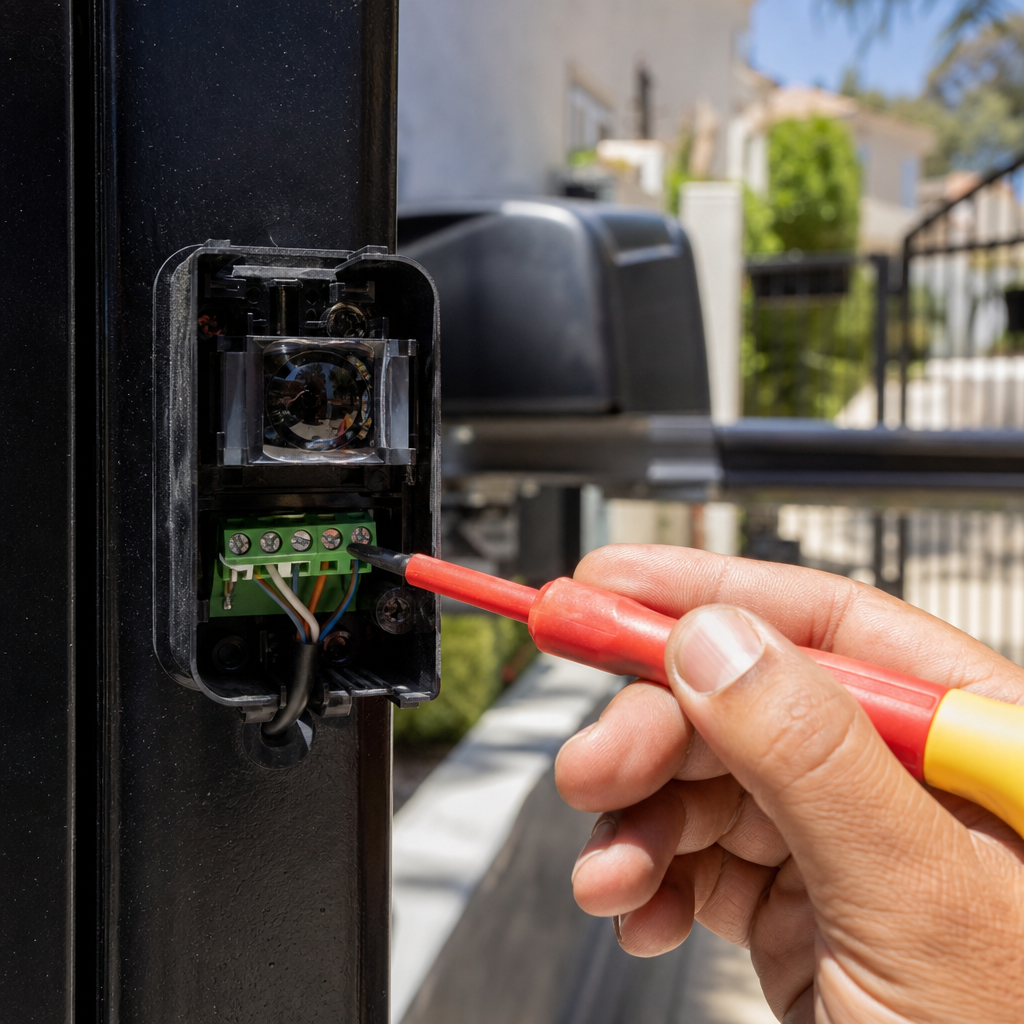
As noted by the CPSC and highlighted by Ironworks Gate Co., the March 2000 UL safety standard required at least two entrapment-prevention mechanisms, including a sensing device that reverses gate movement and a secondary mechanism such as a photoelectric or edge sensor.[2]
Entrapment Protection Mechanisms
Different mechanisms provide entrapment protection for automated gates:
- Photoelectric Sensors: Non-contact sensing devices that detect obstructions in the path of the gate to stop or reverse movement.
- Contact Safety Edges: Edge sensors that respond to physical contact with an obstruction, signaling the system to stop or reverse movement.
- Operator Obstruction Detection: Inherent mechanisms within the operator that detect resistance and stop or reverse the gate.
Frequently Asked Questions
How do automatic gate safety sensors work?
Automatic gate safety sensors, such as photoelectric beams and contact edges, detect obstructions in the gate’s travel path. When an obstruction is detected, the mechanism signals the operator to stop or reverse gate movement.
Why might an automatic gate reverse unexpectedly?
Ironworks Gate Co. notes that gate safety sensors may trigger unexpected reversals due to optical misalignment, dirty lenses, or physical pathway blockages.
Sources
- New Safety Standard for Automatic Security Gates Helps … – cpsc.gov (2000)
- [PDF] Investigation Guideline Product: Automatic Gate Operators Appendix – reginfo.gov (2000)
- 32346 – govinfo.gov (2018)
- CPSC's Operation Safe Gate PSA – News Data Network – newsdatanetwork.com (2000)
Related reading: How to Fix Sagging Wood Fence Gate – Call Now-10% Off – Same-Day Service – Free Estimate
Related reading: Automatic Gate Troubleshooting | Call Now-10% Off | Same-Day Service | Free Estimate
Related reading: Electric Gate Troubleshooting – 10% Off & Free Estimate – Same-Day Service
Frequently Asked Questions
How can I tell if my existing gate safety sensors meet current safety compliance standards?
Current UL safety standards mandate at least two entrapment protection mechanisms, such as inherent motor resistance combined with monitored photoelectric beams or contact edges. Ironworks Gate Co. offers a free on-site gate safety assessment to test your reversing systems and bring older LiftMaster or DoorKing systems into full compliance.
Why do gate safety sensors frequently fail on narrow residential lots?
Narrow residential driveways often cause sensor beams to bounce off nearby walls, vehicles, or shifting posts, leading to false obstruction triggers and unexpected reversals. Ironworks Gate Co. diagnoses complex relay logic and realigns optical sensors to ensure dependable operation in tight spaces, offering 24/7 same-day sensor repair.
Can Ironworks Gate Co. repair or replace sensors on older gate operators?
Yes, technicians can service, wire, and retrofit modern monitored photoelectric beams and contact edges onto older gate operators from major brands like DoorKing and LiftMaster. Ironworks Gate Co. evaluates the system wiring and relay logic to restore reliable anti-entrapment functionality without always requiring a complete operator replacement.
About the author
 |
Sarah Miller Sarah Miller is a specialized content creator with a focus on property security and access control systems. Drawing from her five years of experience writing for the home services sector, she provides homeowners and property managers with clear, actionable insights on gate maintenance, repair processes, and transparent pricing. Sarah holds a Bachelor of Arts in Communications from California State University, Fullerton. |
Gate not opening, off track, or opener dead?
We’re available now - call for a fast, free estimate.
Call Now - Free Estimate