
Quick Summary
This automatic gate troubleshooting guide explains how to identify the root causes of gate operation failures, which often stem from physical drag rather than fried electrical components. As highlighted by Ironworks Gate Co., diagnosing power trips, cleaning misaligned safety sensors, and testing for hinge or track binding can quickly resolve motor shutdown issues. Readers will gain a clear step-by-step process to safely isolate mechanical and electrical faults, knowing when basic maintenance suffices and when to schedule professional diagnostics for complex structural or board-level repairs.
Automatic Gate Troubleshooting: Step-by-Step Fix Guide
When a driveway gate stops working, most homeowners assume the motor burned out or the circuit board fried. As technicians at Ironworks Gate Co. find in the field, the real culprit is often far simpler: mechanical drag masquerading as an electrical failure. On heavy wrought iron gates, an ungreased hinge, a sagging post, or a debris-filled ground track will make the motor pull too many amps, trigger the internal overload protector, and shut down completely.
Replacing a motor without fixing underlying physical resistance only guarantees that the new unit will burn out too. Safety must always guide your diagnosis. According to the U.S. Consumer Product Safety Commission (CPSC), safety standards for automatic security gates were established specifically to help prevent deaths and injuries to children. Emergency room records show head, neck, arm, and hand injuries as frequent hazards, and product safety guidelines highlight that both children and adults risk being crushed or trapped by moving gate mechanisms. This guide walks you through diagnosing your gate safely, starting with the simplest fixes and separating mechanical binding from real electrical faults.[1]
Fast Diagnostics: Separating Electrical Faults from Physical Drag
Before pulling out complex wiring schematics, run through three rapid checks to isolate where the fault actually lives:[4]
- Check line power and status: Look inside the operator enclosure. Are the diagnostic LEDs illuminated? If the unit is completely dark, verify the dedicated breaker and check that the main power switch or disconnect is turned on.
- Inspect the optical photo-eyes: If the gate opens fine but refuses to close, or begins to close and instantly reverses, check the safety sensors. Look for dirt or physical obstructions on the lenses, or misalignment between sender and receiver.
- Disengage the manual release: Pop the clutch or pull the release pin and move the gate by hand. If you have to throw your entire body weight into swinging or sliding the gate, your motor is not dead, it is simply protecting itself from excessive mechanical load.
What You Need Before Starting
Working around high-voltage equipment and heavy iron frames requires basic safety gear and a few standard diagnostic tools:
- Digital multimeter: For testing AC supply voltage and low-voltage accessory terminals.
- Manual release key or hex wrench: To uncouple the drive arm or chain.
- Microfiber cloth and glass cleaner: For clearing optical photo-eye lenses and reflector plates.
- Work gloves and safety glasses: To protect against pinch points, exposed terminals, and metal burrs.
- Lithium or silicone grease: For lubricating hinge grease fittings (zerks) and roller bearings. Avoid heavy petroleum greases that collect road grit.
Step 1: Inspect Power Supplies, Breakers, and Disconnects
Need automatic gate troubleshooting?
We’re available now - call for a fast, free estimate.
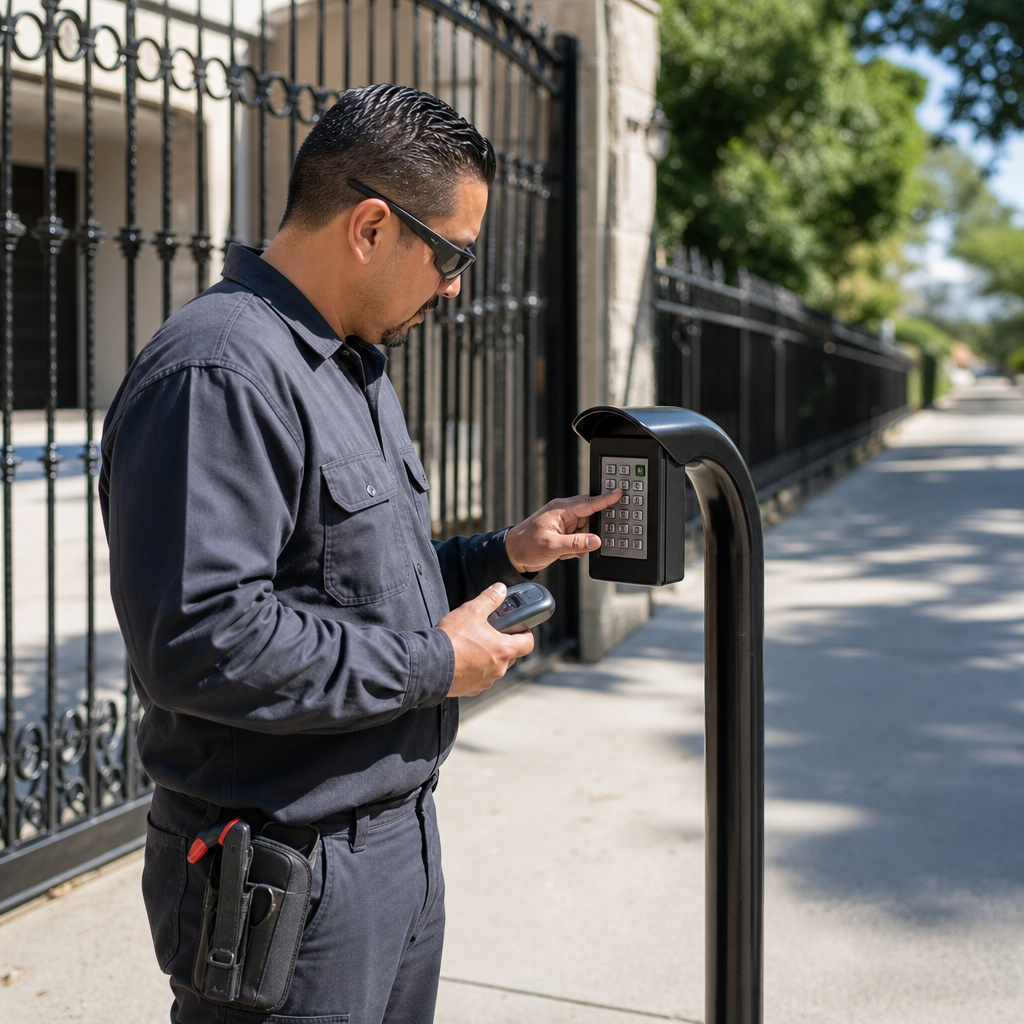
If your operator will not respond to controls or push buttons, start at the electrical supply.
- Test the breaker and disconnect switch: Head to the main electrical subpanel. A power surge or sudden motor stall can trip the dedicated gate breaker. Reset it firmly. Next, check the outdoor disconnect switch near the operator enclosure to confirm it has not been shut off.
- Verify incoming power: Confirm that the power supply to the gate operator is active. If the operator shows no sign of power, ensure all external isolation switches and shutoffs are in the closed/on position before proceeding.
- Inspect terminal connections: Turn off main power before opening the operator box. Check the power input terminals to confirm wiring is firmly seated and free from visible damage or severe corrosion.
Step 2: Clean, Align, and Test Safety Sensors
If your gate opens without issue but stops or reverses when closing, the safety circuit is almost always interrupting the cycle.
- Clean the lenses: Driveway sensors sit close to the dirt. Wipe away mud, dust, cobwebs, and road grime from both the transmitter and receiver lenses.
- Check alignment indicators: Most photo-eyes feature an LED indicator on the receiver housing. A solid light usually indicates clear alignment, while a blinking or unlit LED means the beam is broken, blocked by an obstruction, or off-target. Loosen the mounting bracket and adjust the angle until the light turns solid.
- Inspect sensor wiring and beam path: Ensure the path between sensors is entirely clear of tall grass, overhanging branches, or physical debris. Check visible low-voltage wiring for physical cuts or loose connections at the sensor terminals.
Step 3: Check Hinges, Rollers, and Tracks for Mechanical Drag
As noted by specialists at Ironworks Gate Co., this is where standard troubleshooting guides fail heavy gate owners. Swing gates and sliding security gates exert massive leverage on mounting posts. Over time, ground settling, heavy winds, and worn hardware create intense physical friction.
- Operate the gate manually: Disengage the operator drive arm or chain release. Push the gate through its entire travel path by hand. A properly balanced gate should glide smoothly with the push of a few fingers.
- Diagnose swing gate hinges and sag: If a swing gate drags its bottom edge on the driveway or binds near the fully open position, the post has likely shifted or the internal ball bearings inside the hinges have seized. Lubricate the grease zerks, inspect the hinge welds for damage, and verify the post is plumb with a level.
- Diagnose sliding gate tracks and V-groove wheels: On sliding gates, clear compacted dirt, gravel, and tree leaves out of the ground track. Spin each V-groove wheel by hand to check for flat spots, worn axle bearings, or bent guide rollers along the top support bracket.
Frequently Asked Questions
Why is my automatic gate not opening or closing?
The most common causes are a tripped electrical breaker, a shut-off disconnect switch, an obstructed safety sensor, or heavy mechanical binding. If the operator has power but the gate remains stationary, disengage the manual release to check for physical drag in the hinges or ground track.[2]
How do I reset my automatic driveway gate opener?
Turn off the dedicated circuit breaker or main power switch at the operator enclosure for 60 seconds. While power is disconnected, verify that the path along the gate and safety sensors is clear of obstructions. Restore power to allow the controller to reboot.[3]
Why does my electric gate keep reversing automatically?
A gate automatically reverses when its safety circuit is triggered or when the motor encounters excessive physical resistance. Inspect the infrared photo-eyes for dirt, misalignment, or physical obstructions. Next, check along the physical track and hinges for mechanical binding that triggers the motor’s built-in obstruction sensitivity.
How do I test and fix automatic gate safety sensors?
Look at the diagnostic LED on the sensor receiver. A solid light indicates proper alignment, while a blinking light means the beam is interrupted. Clean the lens surfaces, adjust the bracket until the light stays solid, and wave an object across the beam path to confirm the LED changes state when the beam breaks.
Why is my gate opener making a humming noise but not moving?
A humming or groaning motor indicates that electrical power is reaching the unit, but the mechanical load is too high for the motor to turn. This usually points to seized hinge bearings, a jammed sliding track, physical obstructions, or worn internal reduction gears.
When should I call a professional instead of DIY gate repair?
Call a qualified gate technician if you detect high-voltage electrical faults, burnt control board circuitry, structural frame sagging that requires cutting and welding, or internal gearbox failures. Heavy security gates carry severe crush risks and, as Ironworks Gate Co. recommends, should only be serviced by professionals when structural or high-voltage work is involved.
Need automatic gate troubleshooting?
We’re available now - call for a fast, free estimate.
Sources
- Injury patterns and epidemiology of automatic door-related … – pubmed.ncbi.nlm.nih.gov (2024)
- New Safety Standard for Automatic Security Gates Helps … – cpsc.gov (2001)
- Estimated Injuries Occurring in 2020 and Estimated Deaths – cpsc.gov (2020)
- [PDF] 2017 annual report – Consumer Product Safety Commission – cpsc.gov (2017)
Related reading: Electric Gate Not Opening in Cold Weather – 10% Off & Free Estimate – Same-Day Service
Frequently Asked Questions
How often should I lubricate my automatic gate hinges and tracks to prevent motor overload?
Heavy swing and sliding gates should be lubricated every 3 to 6 months using silicone or white lithium grease on hinge zerks and roller bearings. Routine lubrication prevents amp-draw spikes that trip internal overload protectors and saves your operator from premature burnout. If friction persists after greasing, Ironworks Gate Co. can perform an on-site assessment to check for worn internal bearings or track binding.
Can a sagging gate post be fixed without replacing the entire automatic gate system?
Yes, minor sag can often be corrected by adjusting heavy-duty hinge bolts or adding a support truss to rebalance the frame. Significant structural settling usually requires professional hinge realignment, bracket reinforcement, or resetting the post in concrete. If your gate drags against the driveway, contact Ironworks Gate Co. for professional diagnostics and structural welding repairs.
What should I do if my automatic gate still will not operate after basic troubleshooting?
If breaker resets, sensor realignment, and manual release checks fail, the issue is typically a failed run capacitor, damaged limit switch, or fried control board. Testing high-voltage terminals or logic circuits without proper tools can cause electrical shock and further equipment damage. Call Ironworks Gate Co. for same-day professional diagnostics to safely resolve complex electrical and mechanical faults.
About the author
 |
Sarah Miller Sarah Miller is a specialized content creator with a focus on property security and access control systems. Drawing from her five years of experience writing for the home services sector, she provides homeowners and property managers with clear, actionable insights on gate maintenance, repair processes, and transparent pricing. Sarah holds a Bachelor of Arts in Communications from California State University, Fullerton. |
Gate not opening, off track, or opener dead?
We’re available now - call for a fast, free estimate.
Call Now - Free Estimate