
Quick Summary
Electric gate troubleshooting requires systematically isolating power supplies, access controls, photo-eye safety sensors, and mechanical track resistance to identify why an automated entryway has stopped functioning. While homeowners can safely address minor issues like obstructed optical sensors, tripped breakers, and depleted transmitter batteries, internal control board malfunctions and structural damage require specialized diagnostic tools. Following this step-by-step guide helps you resolve routine operational failures safely and recognize when to contact Ironworks Gate Co. for a free on-site diagnosis and same-day repair.
Electric Gate Troubleshooting: Fast Fixes and Safety Guide
When an automated driveway entrance stops working, effective electric gate troubleshooting comes down to isolating four areas: incoming power, access controls, safety sensors, and mechanical hardware. Working through these checks step by step helps identify simple issues before you schedule a service call. Because automated entryways are powerful machines governed by standards such as UL 325 and ASTM F2200, checking track alignment, disconnect mechanisms, and photo-eyes methodically protects both your equipment and anyone using the driveway.[4]
As noted by Ironworks Gate Co., wiping down dirty sensor lenses or resetting a tripped breaker are manageable DIY tasks. However, diagnosing damaged control boards, high-voltage wiring, or severe structural damage requires specialized tools and experienced technicians.
Diagnostic Checklist: What to Check Before Calling a Technician
Before testing electrical components when your electric gate is not opening, determine whether the problem is mechanical or electrical. On heavy gates, an apparent control failure is often caused by mechanical resistance. As hinges bind or rollers drag on a track, the motor encounters excess resistance, which activates the operator’s built-in safety cutoff and stops the gate in its tracks.[5]
Recommended Tools and Safety Precautions
To safely troubleshoot why your gate remote is not working or why the motor is stalling, have a few basic items on hand:
- Basic hand tools such as screwdrivers
- Silicone spray lubricant (avoid heavy grease on open tracks, which attracts grit)
- A clean cloth for optical sensors
- Fresh transmitter batteries
Always keep hands, clothing, and tools away from drive chains, sprockets, and pinch points while the unit is connected to power. According to the UK Health and Safety Executive (HSE), powered gates are subject to specific maintenance obligations and safety standards to protect users from mechanical crushing and impact hazards.[1]
Fast Diagnostic Checklist
- Check the power source: Confirm the dedicated breaker and outdoor reset switch or outlet have not tripped.
- Inspect the safety eyes: Clean the lenses and verify that the alignment indicator lights show a solid beam connection.
- Test manual movement: Disengage the drive motor using the manual release to see if the gate glides freely or drags on the ground.
Step 1: Verify Main Power and Reset Circuit Breakers
If your electric gate won’t open, verify power supply before assuming the motor or logic board is dead. Power surges, moisture inside outdoor junction boxes, and subpanel trips are common culprits behind sudden power loss.
Checking Power Input and Breakers
- Open your main electrical panel and locate the gate breaker. Turn the breaker firmly to the OFF position, then back to ON to reset a weak trip.
- Test outdoor protective outlets or disconnect switches near the gate. Reset the outlet button if condensation or a surge caused it to trip.
Inspecting Operator Fuses and Power Switches
- Turn off the operator power switch and open the chassis cover.
- Inspect the protective fuses on the control board. If a fuse is blown, replace it with a fuse of the exact same rating.
Standards such as BS EN 12453:2017 (safety requirements and test methods) and BS EN 12604:2017 (mechanical requirements) highlight the need for regular electrical and physical testing. In Ireland, the Health and Safety Authority (HSA) also outlines specific mechanical and operational standards for power-operated doors and gates. If power is reaching the board but the system remains completely unresponsive, an internal component may have failed.[3]
Step 2: Test Access Controls, Keypads, and Remote Transmitters
Need electric gate troubleshooting?
We’re available now - call for a fast, free estimate.
If the operator has power but fails to respond, isolate your radio controls and hardwired triggers. This step determines whether you are dealing with a dead remote transmitter, radio interference, or an unresponsive control board.
Troubleshooting Gate Remote Transmitters
When dealing with an electric gate remote not working, follow these isolation steps:
- Replace the transmitter battery and verify that the remote’s indicator light illuminates when pressed.
- Inspect the external antenna wire on the operator housing to ensure it is undamaged and free of corrosion.
- Test a secondary remote or wireless keypad. If one device works while another fails, the issue is an individual transmitter or lost programming rather than the receiver board.
Testing Hardwired Controls and Keypads
Locate the manual cycle button or cycle terminals on the control board. Activating the cycle input directly bypasses external radio receivers and keypads. If the gate runs normally when triggered at the board, the issue lies in a faulty keypad, damaged wiring, or a triggered safety device.
Guidance from safety organizations such as Gate Safe emphasizes that automated gates must include at least two forms of safety protection, such as photocells, safety edges, or force limitation. If a safety accessory is sending a continuous signal, the operator will ignore open and close commands as a protective measure.[2]
Step 3: Clean, Align, and Test Photo-Eye Safety Sensors
Driveway gate sensor problems are a primary reason an electric gate starts to close and then immediately reverses. Photo-eyes project an infrared beam across the driveway opening. If anything breaks that beam, the control board halts or reverses travel to prevent entrapment.
Diagnosing Misaligned and Blocked Sensors
If your electric gate reverses after moving just a few inches, check the status lights on both photo-eye units:
- Sender and receiver LEDs: Most sensors feature a diagnostic LED. A solid light generally indicates good alignment, while a flashing or dark light means the beam is obstructed, misaligned, or unpowered.
- Environmental obstructions: Debris, spiderwebs, overgrown weeds, and condensation on the optical lenses can break the beam. Wipe both lenses down with a clean, soft cloth.
- Direct sunlight interference: Low-angle sunlight shining directly into the receiving sensor lens can interfere with the infrared beam. Installing small sun hoods or shields over the sensor heads can resolve this issue.
The importance of working safety sensors cannot be overstated. An engineering investigation into a fatal motorized gate collapse at a Hong Kong health centre in 2023 noted that sensor failure was suspected. Keeping safety beams properly aligned, clean, and tested is a fundamental safety responsibility for any property owner.
Step 4: Check Track, Rollers, and Hinges for Mechanical Resistance
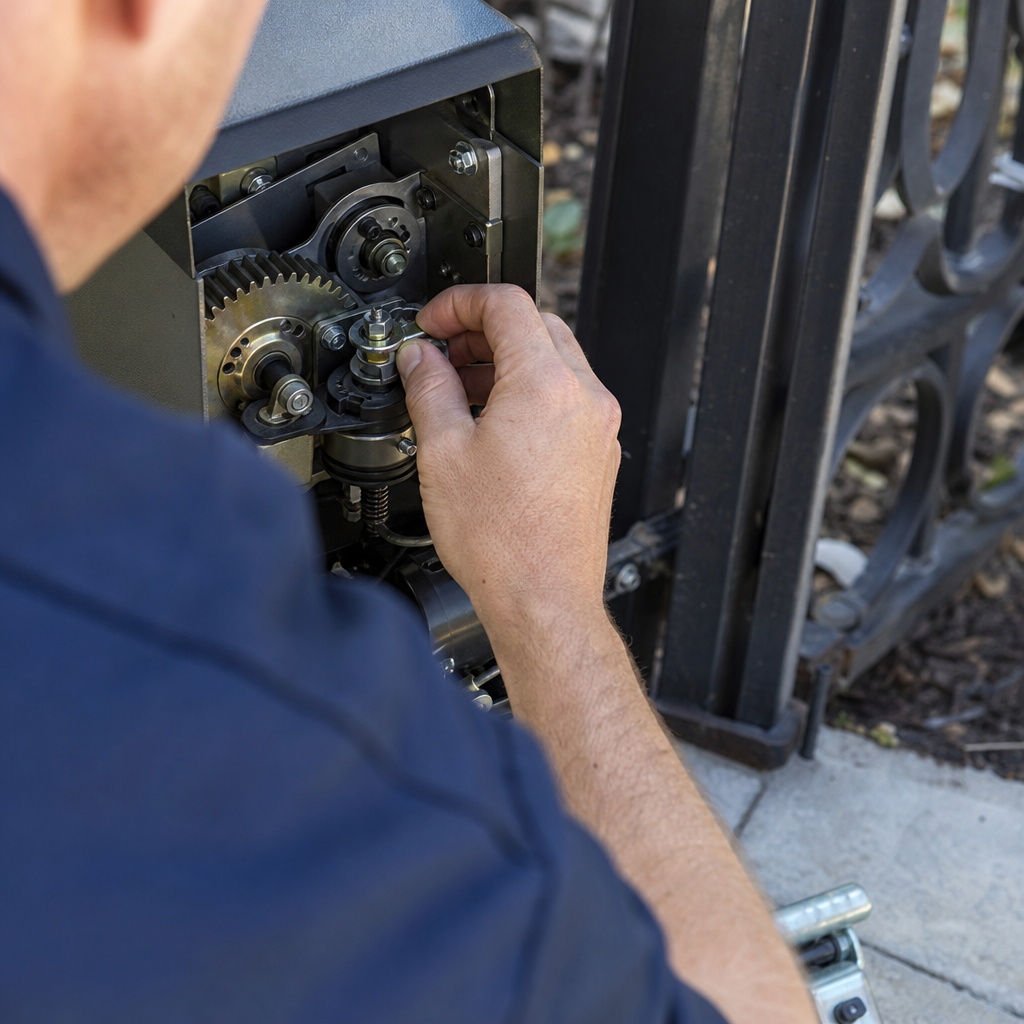
When an electric gate won’t close or stops halfway through its cycle, the root problem is often mechanical resistance rather than an electrical fault.
How Mechanical Drag Trips Electrical Controls
According to specialists at Ironworks Gate Co., modern gate operators monitor physical resistance during travel. When a gate encounters drag, such as a binding hinge or debris on the track, the control board assumes the gate has hit an obstruction and triggers an immediate safety stop or reversal to prevent injury.
Sliding Gate Troubleshooting
- Clear the ground track: Rocks, dirt, and buildup packed inside tracks force sliding gate rollers upward, binding the system. Sweep and clear the full run of track.
- Inspect wheels: Check the lower rollers. If the bearings are seized, worn, or damaged, the gate will drag heavily.
- Check guide rollers: Make sure the top guide rollers spin freely and have not clamped down too tightly on the gate frame.
Swing Gate Troubleshooting
- Check hinge alignment: Heavy swing gates put immense pressure on hinges. Look for damaged welds, rust on hinge pins, or a gate leaf that has dropped out of alignment.
- Wind loads: In regions with strong seasonal winds, solid-panel or tight-mesh swing gates act like sails. High wind force can overload the operator mechanism, triggering the force limiter.
Step 5: Diagnose Limit Switches and Motor Humming
If you activate the gate and hear the electric gate motor humming or clicking without any gate motion, the operator is receiving power but cannot move the mechanical assembly.
Causes of Motor Humming
- Mechanical binding: If the gate or drive linkage is jammed against a physical stop or obstructed by debris, the motor cannot turn.
- Seized gearbox or drive arm: Disengage the manual release. If the motor continues humming without moving the drive assembly, internal mechanical components may be seized.
- Control or component failure: Internal switching components or drive mechanisms may fail over time, preventing full operational power from driving the motor.
Adjusting Limit Switches
To verify the open and close limit switches:
- Locate the limit switches or position sensors inside the operator housing.
- If vibration has loosened a limit switch, the operator may register that the gate is already fully open or closed, refusing to travel further in that direction.
- Adjust the limits so that the gate stops smoothly at the fully open and fully closed positions without striking physical stops excessively or stopping short.
Step 6: How to Open an Electric Gate Without Power
Need electric gate troubleshooting?
We’re available now - call for a fast, free estimate.
Knowing how to open an electric gate without power is essential during outages, emergencies, or equipment failures. Every certified gate operator must include an emergency release mechanism.
Your maintenance company should demonstrate how to operate the emergency release mechanism upon handover and during regular servicing. The manual release must be easy and quick to use in an emergency.
Operating the Manual Release
- Access the manual release mechanism using the supplied key or release handle.
- Disengage the drive mechanism following the procedure demonstrated by your installer or maintenance provider (such as unlocking a release lever or detaching the drive connection).
- Push the gate open by hand. The gate should move smoothly and easily. If excessive force is required, stop and contact a qualified technician to inspect the mechanical hardware.
Diagnostic Control Boards and Status Indicators
Modern operators feature onboard diagnostic lights or status indicators that provide insight into system operation:
- Safety indicator LEDs: Illuminate to show that external photo-eyes, edges, and safety inputs are clear and operational.
- Diagnostic fault LEDs: Signal an active issue, such as an obstruction sensor trigger, battery fault, or safety lockout.
- Backup battery status: If line power is disconnected, low backup batteries may prompt a warning signal or cause the operator to safe-park the gate according to its configuration.
When to Call a Professional for Automatic Driveway Gate Repair
While clearing track debris and cleaning safety eyes are straightforward tasks, technicians at Ironworks Gate Co. emphasize that certain repairs require professional expertise and specialized safety equipment:
- High-voltage electrical supply wiring and power connections
- Structural welding for damaged hinges, mounting posts, or operator brackets
- Internal gearbox servicing and hydraulic component repair
- Safety loop detector installation and wiring
- Upgrading non-monitored systems to modern safety standards such as UL 325 and ASTM F2200
Frequently Asked Questions
Why is my electric gate not responding to the remote or keypad?
First, verify that the operator has power by checking the circuit breaker, reset switches, and fuses. If power is present, replace the remote transmitter battery and inspect the receiver antenna. If keypads and remotes both fail, an active safety sensor signal or motor lockout is often preventing operation.
How do I manually open an electric gate during a power outage?
Use the emergency release mechanism on your operator. Your maintenance company should demonstrate how to use this mechanism, which must be easy and quick to operate. Once the drive is disengaged with the supplied release tool or key, push the gate open manually.
Why does my electric gate start to close and then immediately reverse?
This is almost always caused by an interrupted safety photo-eye beam or excessive mechanical resistance. Clean the sensor lenses and check their alignment lights. If the sensors are clear, check the gate track or hinges for binding; when the motor encounters excess friction, its built-in force limiter detects an obstruction and reverses travel.
What causes an electric gate motor to hum or click without moving?
A humming motor indicates that electrical power is reaching the unit, but the mechanism cannot rotate. Common causes include mechanical binding, a seized drive assembly, or an internal component failure.
How do I clean and align electric gate safety sensors?
Wipe the sender and receiver lenses using a soft, clean cloth to clear away dirt, spiderwebs, and moisture. To align them, adjust the mounting bracket until the diagnostic indicator confirms an uninterrupted beam connection, then secure the bracket firmly.
When is it safe to DIY repair an electric gate versus calling a technician?
Property owners can safely handle simple maintenance like lubricating hinges, clearing debris from ground tracks, replacing remote batteries, and cleaning sensors. Call a qualified technician for electrical supply work, structural welding, control board replacements, or diagnosing internal mechanical failures.
Need electric gate troubleshooting?
We’re available now - call for a fast, free estimate.
Sources
- Ensuring powered doors and gates are safe – HSE – hse.gov.uk (2008)
- The basics – hse.gov.uk (2008)
- INFORMATION NOTE ON AUTOMATIC GATES – psa-gov.ie (2016)
- Revision of Standards for Powered Doors, Gates and Barriers – HSE – hse.gov.uk (2017)
- AUTOMATIC GATES – gate-safe.org
Related reading: Automatic Gate Troubleshooting | Call Now-10% Off | Same-Day Service | Free Estimate
Related reading: Electric Gate Not Opening in Cold Weather – 10% Off & Free Estimate – Same-Day Service
Frequently Asked Questions
How can I tell if my electric gate control board is burnt out rather than just locked out?
A system in safety lockout usually shows active diagnostic LEDs and responds to reset commands, whereas a burnt control board displays no status lights, emits an electrical odor, or repeatedly blows replacement fuses. If incoming voltage is confirmed but the logic board remains completely unresponsive, contact Ironworks Gate Co. for an expert on-site diagnosis and same-day control board repair.
What should I do if the manual emergency release key is stuck or won't disengage?
Never force a stuck release lever or turn a jammed key with pliers, as this can snap the release mechanism or damage internal gearbox linkages. Apply a light spray of silicone lubricant into the key cylinder to free binding pins; if it remains jammed under mechanical tension, an experienced technician should safely disengage the drive arm.
Can legacy or obsolete electric gate openers be repaired to meet modern safety standards?
Many legacy gate systems can be retrofitted with modern monitored photo-eyes, safety edges, and updated logic cards without replacing the entire gate structure. As a 42-year local authority, Ironworks Gate Co. specializes in diagnosing older automated systems and adding modern UL 325 compliant entrapment protection to ensure reliable, safe operation.
About the author
 |
Sarah Miller Sarah Miller is a specialized content creator with a focus on property security and access control systems. Drawing from her five years of experience writing for the home services sector, she provides homeowners and property managers with clear, actionable insights on gate maintenance, repair processes, and transparent pricing. Sarah holds a Bachelor of Arts in Communications from California State University, Fullerton. |
Gate not opening, off track, or opener dead?
We’re available now - call for a fast, free estimate.
Call Now - Free Estimate