
Last updated August 25, 2026
Free on-site gate assessment - hinges, posts, and your LiftMaster or Nice gate operator checked before anything is quoted
The assessment is free and the quote is the invoice.
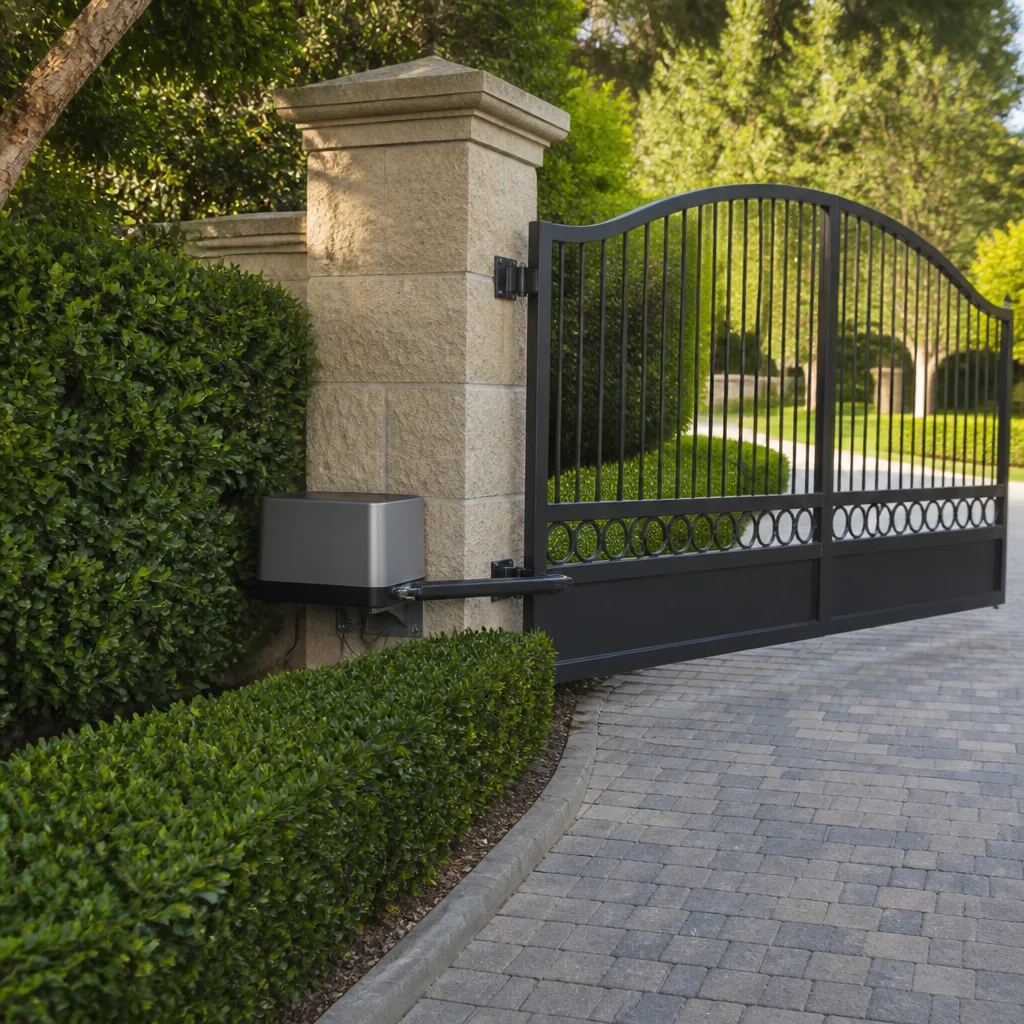
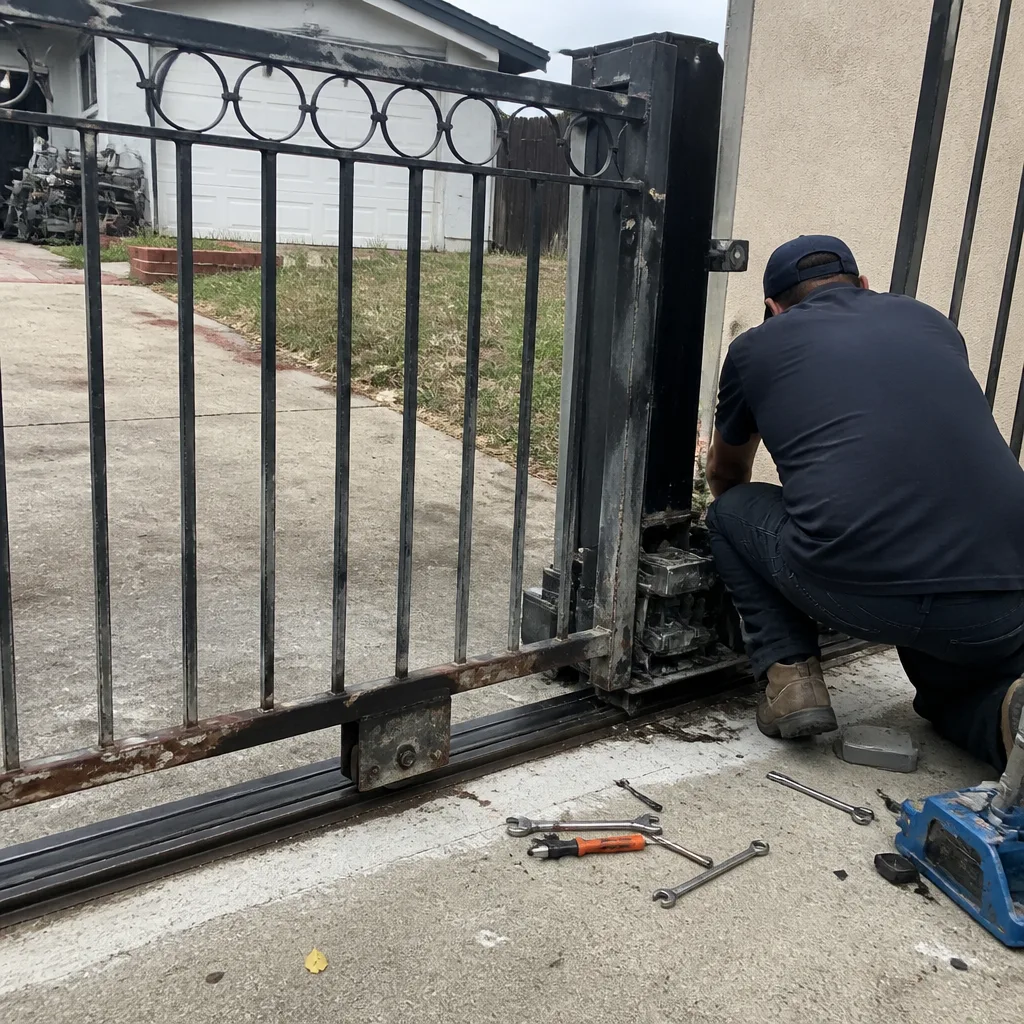 Before
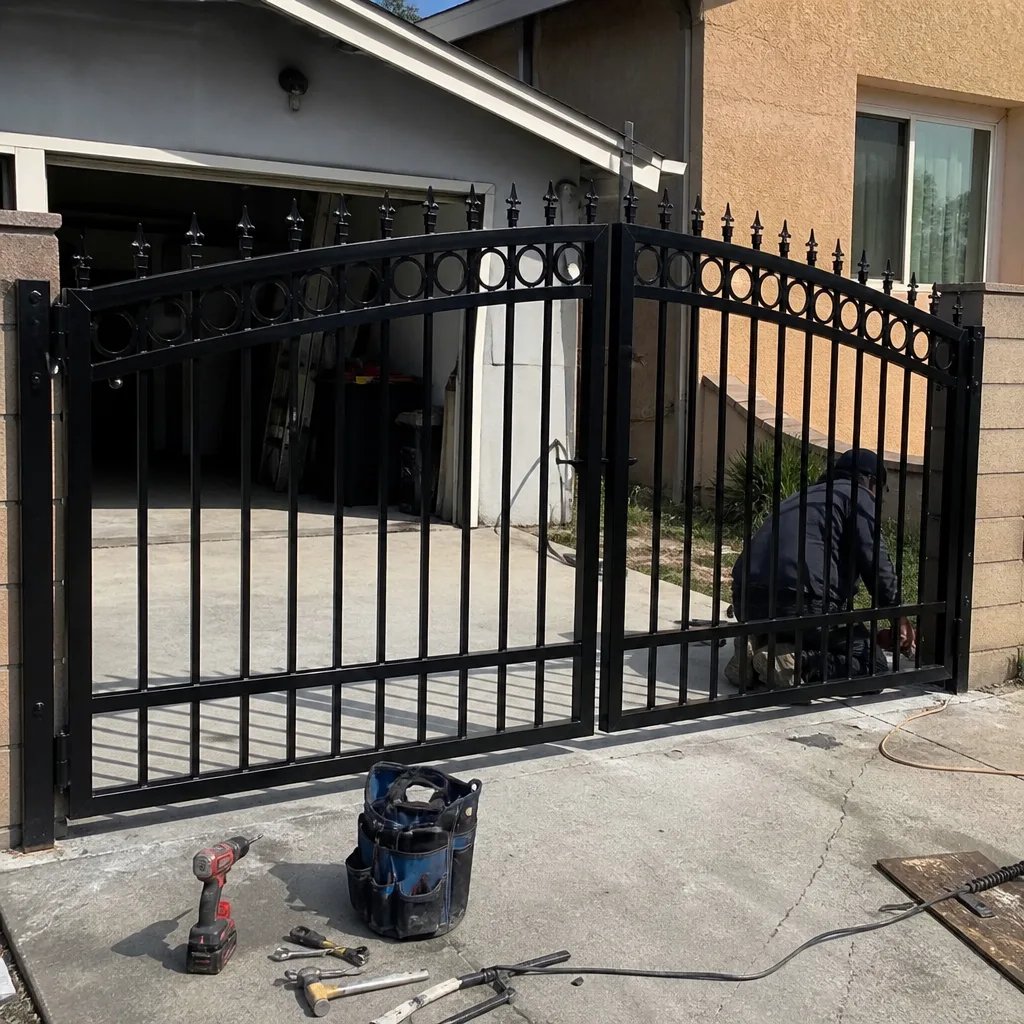 After
After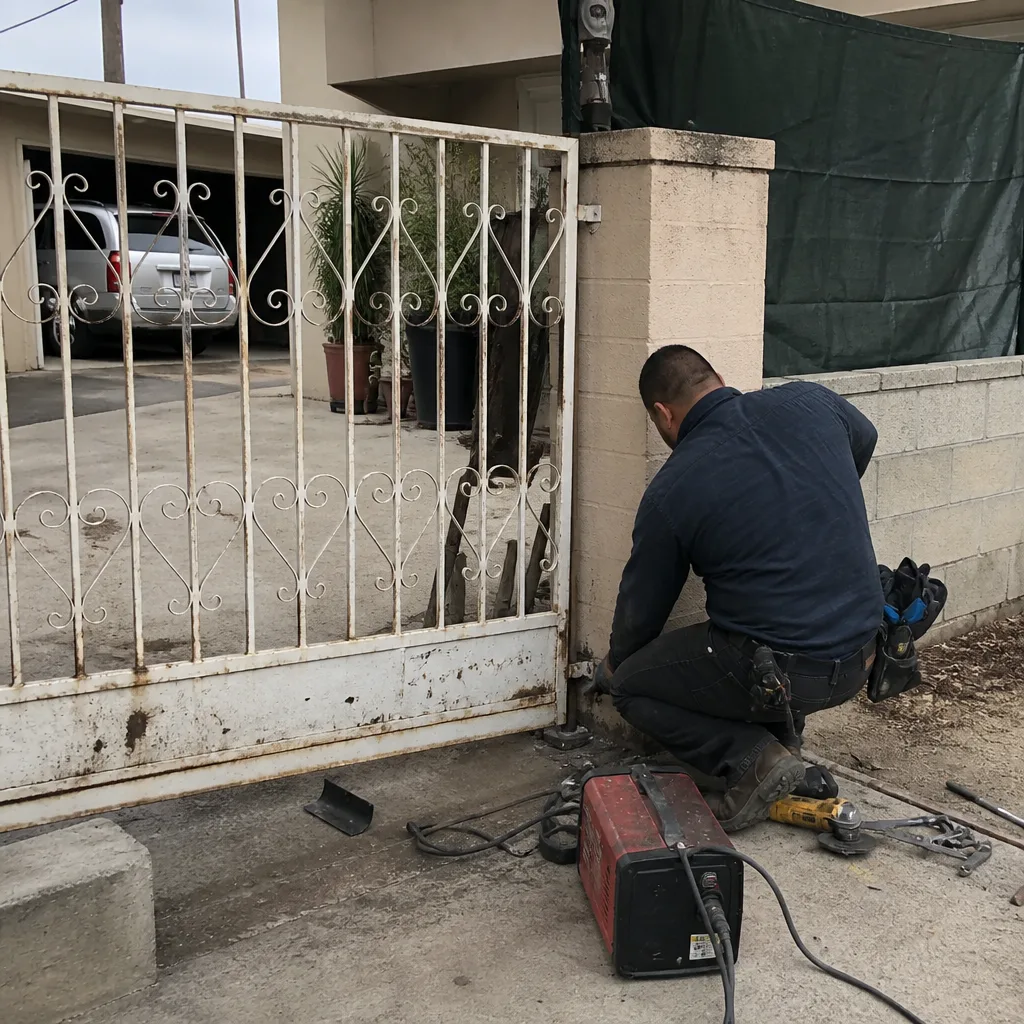 Before
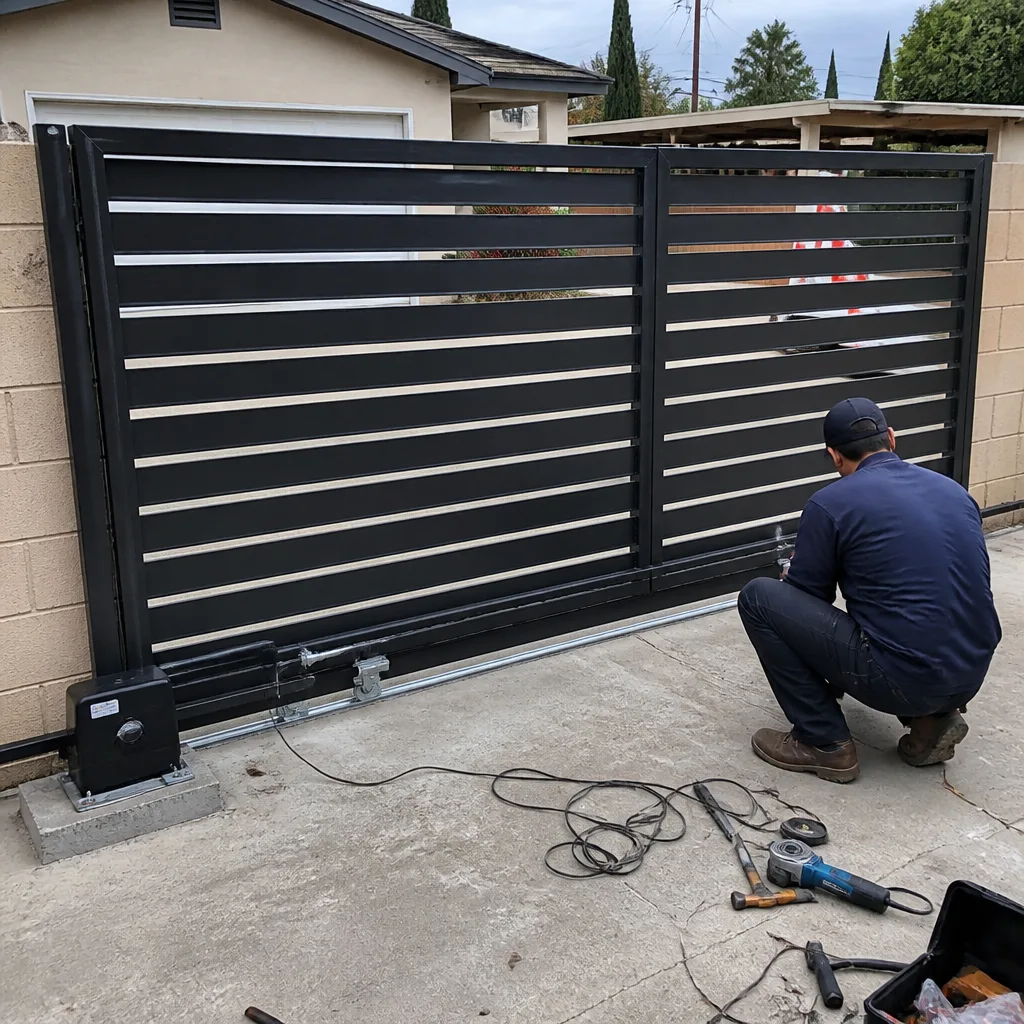 After
After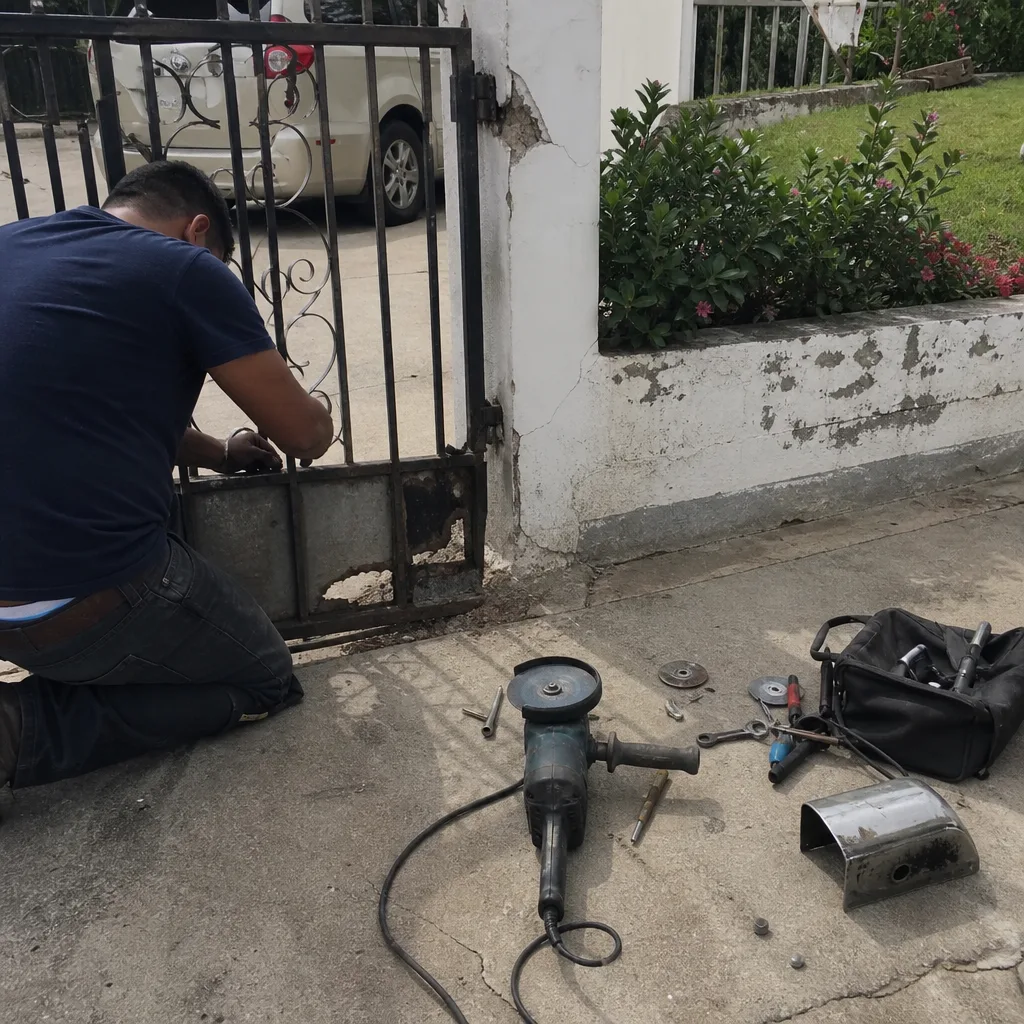 Before
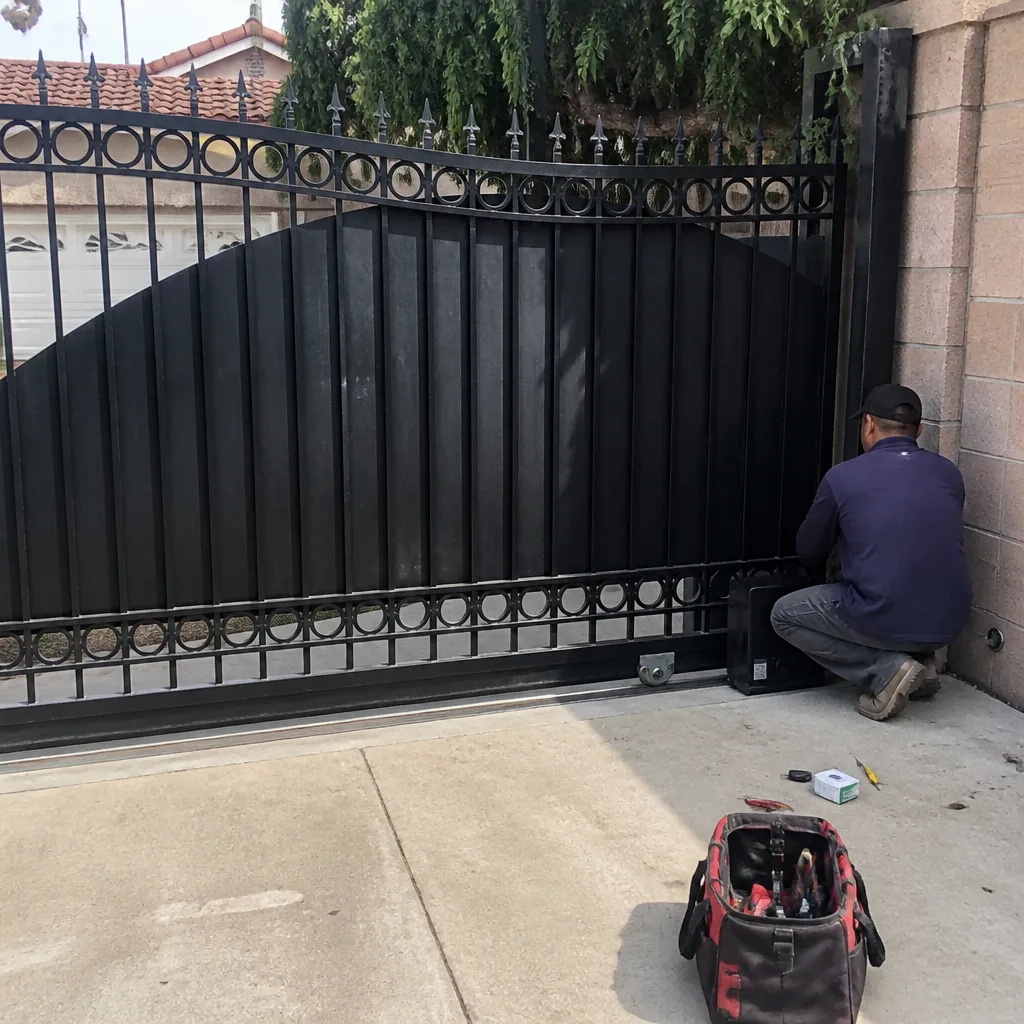 After
AfterGate Repair Maintenance Checklist for Bell Gardens Homeowners
Most gate failures in Bell Gardens don’t start with a dramatic snap or a burned-out motor. They start quietly: a hinge that has been carrying too much weight for six months, a track filling with the fine grit that blows down from the 710 corridor, a battery that has been dying a little more each week since the last heat wave. By the time the gate refuses to open on a Monday morning, the real damage was done weeks earlier. This guide walks you through the checks that catch those quiet failures early. You’ll learn what to inspect monthly, what needs professional attention, and what a Bell Gardens gate actually costs to keep running. It is written for homeowners who would rather spend fifteen minutes a month on prevention than fifteen hundred dollars on a surprise repair.
Quick Answer
A proper gate maintenance routine for Bell Gardens homeowners comes down to four monthly checks: hinges and welds for rust or sag, track and wheels for grit buildup, opener force and battery health, and safety sensors for alignment. Most homeowners can handle the visual inspection and basic cleaning themselves. Anything involving spring tension, motor internals, or welded joints should go to a licensed gate technician. For a written seasonal tune-up that covers all of it, call Ironworks Gate Co. at (213) 497-0081.
Table of Contents
- The Monthly Visual Inspection: What to Look For
- Track and Wheel Maintenance in Bell Gardens’ Climate
- Hinge and Weld Integrity: The Foundation of Every Gate
- Opener and Motor Health: Extending the Life of Your Automation
- Safety Systems: Photo Eyes, Edges, and Auto-Reverse
- Seasonal Maintenance: A Bell Gardens Year-Round Schedule
- The Cost of Neglect: What Small Problems Become
- Common Mistakes to Avoid
- When to Call a Professional
- Frequently Asked Questions
The Monthly Visual Inspection: What to Look For
Once a month, walk your gate through a full open and close cycle while you watch and listen. This takes about five minutes and catches most problems before they become repairs. In Bell Gardens, where many homes sit on compact lots with gates that open directly onto sidewalks or alleys, a gate that fails can block the only point of vehicle access on the property. That makes the monthly check more than a nicety. It’s how you avoid being late to work with a car trapped in the driveway.
Here is the sequence we recommend, in order:
- Open the gate fully and watch the wheel movement. The wheels should roll, not scrape. Any wobble, flat spot, or visible drag against the track means the wheels need attention before the track gets grooved.
- Listen for changes in sound. A gate that has started grinding, squealing, or making a rhythmic thump is telling you something specific. Grinding usually means metal-on-metal contact at the wheels or hinges. A thump on each revolution means a flat spot on a wheel or a bent section of track.
- Check all visible bolts and fasteners. Put a wrench on the bolted connections at the hinge plates, the wheel brackets, and the opener arm. Vibration loosens bolts over months of daily cycles. A loose hinge bolt is the number one cause of gate sag we see on older homes in Bell Gardens.
- Look at the gate’s resting position. When closed, the gate should sit level and true, with an even gap at the top and bottom. If one end hangs lower than the other, you have sag that will accelerate quickly.
- Inspect the track for debris. Leaves, gravel, plastic bags, and the grit that accumulates near busy streets like Eastern Avenue or Florence Avenue end up in gate tracks. Clear it by hand or with a stiff brush, then check for any bent or dented sections while you’re down there.
Track and Wheel Maintenance in Bell Gardens’ Climate
Bell Gardens sits in a semi-arid basin where the air is dry most of the year, but winter brings occasional heavy rain and the morning marine layer leaves a film of moisture on metal surfaces. That combination means gate tracks and wheels face two distinct enemies: abrasive dust and periodic corrosion. The dust that drifts through from the Los Angeles River channel works its way into wheel bearings and track grooves, acting like fine sandpaper every time the gate cycles. The moisture, especially in the cooler months, begins rust where the zinc coating has worn thin.
Track maintenance is straightforward and takes most homeowners under ten minutes:
- Sweep the track clear with a stiff brush or broom head, working from the gate’s closed position toward the open position.
- Wipe the inner rail surfaces with a dry cloth to remove dust film. Do not use grease here. Grease traps dirt and turns into lapping compound.
- Check for flat spots on wheels by running your hand over the rolling surface while the gate is stationary (power disconnected). Any significant flat needs replacement.
- Lubricate wheel bearings only if they are serviceable. Use a light machine oil, never WD-40, which is a solvent that strips away the existing lubricant.
- Test the gate’s travel after cleaning. It should move smoothly without binding, and the opener should not sound like it is straining.
For gates on sloping driveways, which are common in the residential pockets around Suva Elementary and Bell Gardens Intermediate, track wear happens faster because gravity is always pulling the gate’s weight against one side of the track. These gates need the wheel check monthly, not seasonally. If you notice the gate leaning toward the downhill side, that’s an early warning that the wheels or the track brackets are wearing unevenly.
Hinge and Weld Integrity: The Foundation of Every Gate
Every gate problem eventually traces back to the hinges. A gate is a long lever, and the hinges are the fulcrum carrying all of that weight every second of every day. When hinges wear, the gate sags. When the gate sags, it drags on the track or the latch post. When it drags, the opener motor works harder. When the opener works harder, it burns out. The hinge is where that chain begins, and catching hinge wear early is the single most cost-effective thing any homeowner can do.
In our experience working on gates across Bell Gardens, we see two predominant hinge failure patterns. On older ornamental steel gates, the failure is usually rust at the weld points where the hinge barrel meets the gate frame. This is common on gates installed in the 1980s and 1990s that have gone through thirty or more winters of morning moisture. On newer aluminum gates, the failure is more often fastener loosening at the post connection, because aluminum expands and contracts with temperature swings more aggressively than steel post anchors.
Here is the monthly hinge check:
- Visual rust check: Look for orange staining at every weld and bolt head. Surface rust is cosmetic. Flaking or pitted rust is structural.
- Lift test: With the gate closed, grasp the latch end and lift up and down. Total movement at the free end should be less than a quarter inch. More than that means hinge play that needs correction.
- Weld inspection: On steel gates, look at every weld joint for hairline cracks. These often begin at the top hinge where stress concentrates. A cracked weld will fail, not gradually but suddenly.
- Grease check: Hinge pins should have a light film of grease. Dry hinges squeak, and a squeak is metal wearing against metal.
If you find significant sag, cracked welds, or hinge bolts that will not stay tight, that is not a homeowner repair. A gate that sags needs to be jacked, realigned, and have the hinge rebuild done properly. Done right, a rebuilt hinge set on a 1990s steel gate is a permanent fix that outlasts the next two openers.
Opener and Motor Health: Extending the Life of Your Automation
The automated opener is the component homeowners think about most and understand least. Modern gate openers, including units from Ghost Controls, DoorKing, Elite, and Mighty Mule that are common in Bell Gardens driveways, are reliable machines when they are set up correctly and given basic care. Most premature opener deaths come from three causes: the gate binding and forcing the motor to work against resistance on every cycle, the force settings misadjusted and slamming the gate against its stops, and the backup battery being allowed to sit dead for years until it damages the control board.
- Check the backup battery annually. Most gate openers have a 12-volt backup battery that runs the gate during power outages. In Bell Gardens, where summer heat waves stress the grid and outages are not rare, that battery matters. A dead battery also leaks and corrodes the control board. Replace the battery every two to three years or when it no longer holds a charge.
- Test the manual release. Every opener has a manual release mechanism, typically a keyed cylinder or a pull handle. Disconnect the opener and confirm you can move the gate by hand. If you cannot find or operate the release, fix that before you need it. During a power outage, it is the only way to get the gate open.
- Watch and listen during operation. The opener should move the gate smoothly with no surging, grinding, or noticeable change in motor pitch. A motor that sounds like it is working harder than it used to is almost always fighting a mechanical problem elsewhere: a stiff hinge, a dirty track, a misaligned chain.
- Check force settings every six months. The force setting controls how hard the opener pushes before reversing. It should be set just high enough to move the gate reliably, never maximum. A gate set to maximum force will not stop if your grandchild or a pet gets caught between the gate and the post.
One thing we tell every homeowner: if the opener is more than ten years old and needs a major component replaced, weigh the repair against replacement. Opener technology has improved measurably in the last decade in terms of energy draw, noise, and safety features. A new unit on an old gate is often a better investment than repairing a tired motor that will fail again next year.
Safety Systems: Photo Eyes, Edges, and Auto-Reverse
The safety systems on an automated gate are not optional accessories. They are the difference between a gate and an injury. California law and the UL 325 standard for gate operators require functioning safety devices on every automated gate, and for good reason. An automated gate that does not reverse when it encounters an obstruction is a serious hazard, especially on properties where children play in driveways that face busy streets like Garfield Avenue or Bandera Street.
Here is what to check and how often:
- Photo eyes (monthly): These are the small paired sensors near the base of the gate opening on both sides. Wipe the lenses clean with a dry cloth. Then test: with the gate open, block the beam with your hand and press the close button. The gate should not close, or if closing, should immediately reverse. If it does not, stop using the automation and call for service.
- Contact edges (monthly): Many gates have rubber sensing edges on the leading edge of the gate and on the closing post. Test them the same way: apply light pressure to the edge while the gate is closing. It should reverse immediately. A cracked or damaged edge needs replacement, not tape.
- Auto-reverse function (monthly): Even without photo eyes or edges, every opener should have a force-based auto-reverse that kicks in when the gate meets resistance. Test it by placing a rolled-up towel or a cardboard box in the gate’s path and closing the gate on it. The gate should stop and reverse before crushing the object. If it crushes the towel, the force setting is too high.
- Warning signage (annually): Automatic gates require visible warning signs per California code. If your warning sign has faded, cracked, or fallen off, replace it. This is a code compliance issue and a real safety issue.
If any safety device fails its test, do not use the automated function until it is repaired or replaced. Keep the gate in manual mode. A gate that opens is an inconvenience. A gate that closes on a person is a tragedy. We have repaired enough damaged gates in Bell Gardens to know the difference, and the unsafe ones are always the same story: a failed sensor that was ignored until the day it mattered.
Seasonal Maintenance: A Bell Gardens Year-Round Schedule
Bell Gardens weather is mild by national standards, but it has its patterns. Summer brings weeks of 90-degree heat that bakes electronics and strains batteries. Late winter brings rain that tests every seal and encourages rust. Early fall brings Santa Ana winds that drive dry leaves and debris into every track and crevice. A seasonal maintenance rhythm keyed to those patterns keeps the gate running without surprises.
Spring (March - May): Post-Rain Inspection
After the rainy season, do a full rust and water-ingress check. Look for new rust on hinges, welds, and bolted connections. Check the opener housing for signs of water entry: condensation inside the control box, corrosion on terminals, or a musty smell. Check that track drainage is clear so the next rain does not leave standing water in the track channel. Standing water in a steel track is how you get rust-through.
Summer (June - August): Heat and Battery Stress
Heat kills batteries faster than cold. Test the backup battery in June and again in August. Listen for slower gate movement during peak afternoon heat; some older openers struggle when the motor and gearbox are heat-soaked. Check that the opener cover is intact and not warped by sun exposure. Direct afternoon sun on a black control box can push internal temperatures past operating limits.
Fall (September - November): Wind and Debris
Santa Ana winds fill tracks with leaves, plastic, and grit. Sweep tracks weekly during windy periods. Check for loose bolts after windstorms have shaken the gate. If the gate has decorative elements like iron scrolls or pickets, walk the full length and check for any that have come loose from wind vibration. A loose picket is a stabbing hazard and a common injury point.
Winter (December - February): Rain Preparedness
Before the first heavy rain, verify that all electrical connections are covered and the control box seal is intact. Check that the gate does not sit in puddles when closed. Check the manual release and practice using it. The worst time to learn how to manually open your gate is during a power outage in the middle of a winter storm. Most importantly, check the gate’s drainage: if water pools at the base of the posts, it will find its way into the post and begin rusting from the inside.
The Cost of Neglect: What Small Problems Become
Nothing wastes more money in gate ownership than deferring small repairs. We have rebuilt gates in Bell Gardens that started as a simple hinge squeak. Here is what the neglect chain actually costs, based on typical Southern California gate repair and replacement pricing:
| The Small Problem | Cost to Fix Early | What It Becomes | Cost After Neglect |
|---|---|---|---|
| Squeaky hinge (needs grease) | $0 - $15 (household grease) | Worn hinge barrel, gate sag, track damage | $450 - $1,200 |
| Loose hinge bolt | $0 (tighten with wrench) | Elongated hole, weld cracking, hinge replacement | $350 - $900 |
| Debris in track | $0 (sweep it out) | Track groove from wheel drag, wheel bearing failure | $300 - $800 |
| Dead backup battery | $60 - $150 (replace battery) | Corroded control board, gate inoperable during outage | $400 - $900 |
| Misaligned photo eye | $0 - $100 (adjustment) | Gate won’t close without holding override, safety hazard | $150 - $500 plus safety risk |
| Gate dragging on latch post | $200 - $400 (realign and adjust) | Opener motor burned out from constant overload | $900 - $2,500 for new opener plus gate work |
These are honest ranges for the Bell Gardens market. Every gate is different, and the exact cost depends on gate size, material, opener type, and access. What is consistent is the ratio: the early fix costs a fraction of the deferred fix, and the deferred fix always involves replacing components that would have lasted decades with proper care.
Our $89 Seasonal Tune-Up covers the full inspection and adjustment list in this guide, including safety system testing, hinge and track service, and a written condition report. For most Bell Gardens homeowners, one tune-up a year plus the monthly visual check is the entire maintenance program.
Common Mistakes to Avoid
- Lubricating the track with grease or WD-40. Grease in a track trap grit, and WD-40 strips existing protection. The track should be dry and clean. Lubricant goes on hinge pins and wheel bearings, not on the rolling surface.
- Cranking up the force setting when the gate binds. The binding is the problem, not the opener. Increasing force fixes the symptom and creates a safety hazard. A gate that needs maximum force to close is a gate that needs a hinge, track, or wheel repair.
- Ignoring a change in sound. Gates make noise when they are healthy. A new grinding, squealing, or rhythmic thump is diagnostic information. Ignoring it for six months is how a $150 repair becomes a $1,500 replacement.
- Testing safety sensors by kicking the edge or throwing things through the beam. Test them properly with controlled pressure and a stationary test block. Crude testing damages the very sensors you’re checking.
- Painting over rust without addressing the cause. A coat of paint seals rust in and hides it while it continues to eat the steel. Surface preparation and proper primer are the difference between a paint job that lasts five years and one that flakes in six months.
- Replacing the opener without fixing the gate. If the old opener burned out because the gate was binding, a new opener on the same binding gate will burn out too, just on a different clock. Fix the mechanical problem first.
- Skipping maintenance because the gate “still works.” By the time it stops working, the accumulated damage is already done. The maintenance described in this guide is not about making a working gate work better. It is about keeping a working gate working for another twenty years.
When to Call a Professional
Some gate work is homeowner work, and some is not. Hinge rebuilds, weld repairs, opener replacement, spring tension, and any electrical work beyond changing a battery all belong in the hands of someone who does this every day. The test is simple: if the repair involves lifting the gate’s weight, managing stored spring energy, or touching line voltage, call a professional. A gate is a piece of industrial equipment doing industrial work in a residential setting. It deserves the same respect.
Specific scenarios that warrant a call: visible weld cracks, a gate that has sagged enough to drag, an opener that trips its breaker repeatedly, any safety sensor that fails its test, or a gate that has come off its track. Ironworks Gate Co. offers free estimates in Bell Gardens. Call (213) 497-0081 and a live person answers, whatever the hour.
Frequently Asked Questions
Once a year is right for most residential gates, paired with the monthly homeowner checks described in this guide. Homes with high daily cycle counts, steep driveways, or gates facing heavy street dust may benefit from twice-yearly service. Our $89 Seasonal Tune-Up covers the full annual inspection and adjustment, including safety system testing and a written condition report. Call (213) 497-0081 to schedule.
Most residential gate repairs in Bell Gardens run between $200 and $1,200 depending on the component and the gate’s condition. Hinge service and track realignment are on the lower end. Complete opener replacement on a heavy ornamental gate is higher. Ironworks Gate Co. quotes every repair upfront before any work starts, and we offer $50 off any repair over $250. Call (213) 497-0081 for an exact quote, and the estimate is free.
A gate that has slowed down is usually fighting increased mechanical resistance: stiff hinges, dirty track, low wheel bearing grease, or a weakening battery. Occasionally it is the opener motor itself wearing out. The monthly checks in this guide will identify which one it is. If you cannot find the cause, a service call will. Call (213) 497-0081 and we will diagnose it on the first visit.
Yes. Ironworks Gate Co. replaces openers on existing gates of all types and is trained and equipped on nine major brands, including DoorKing, Elite, Ghost Controls, and Mighty Mule. During a replacement, we also inspect the gate itself for the mechanical problems that caused the old opener to fail. The goal is an opener that lasts, not one that repeats the same failure. Call (213) 497-0081 for a free measure and written price.
Every automated gate has a manual release mechanism, typically a keyed cylinder or pull handle, that disconnects the opener so the gate can be moved by hand. Locate yours before you need it and practice using it. If the battery backup has been maintained, the gate will continue operating on battery power for a limited number of cycles. If neither is working, call (213) 497-0081. A live person answers 24 hours a day.
Ironworks Gate Co. services nine major gate automation brands: LiftMaster, FAAC, BFT, Linear, Viking, Ghost Controls, DoorKing, Elite, and Mighty Mule. If your opener is not in that list, we can still diagnose the mechanical side of the gate and advise you on automation options. Most jobs are completed in a single visit, with the price agreed before any work begins. Call (213) 497-0081 and tell us what you have; a live person will answer.
The Bottom Line
A gate in Bell Gardens is a machine doing real work every day, and like any machine, it runs longest when it gets regular attention. Fifteen minutes a month on the checks in this guide catches the small problems before they compound. An annual professional tune-up handles the adjustments and safety testing that keep the gate running safely and reliably. The alternative is the predictable repair cycle: neglect, failure, expensive replacement, repeated neglect. Since 1984, Ironworks Gate Co. has built its reputation on the other approach: fix it right, maintain it simply, and stand behind the work in writing. Call (213) 497-0081 for a free estimate, a second opinion on any written quote, or to schedule the $89 Seasonal Tune-Up. A live person answers, 24 hours a day, 7 days a week.
Written by Victor Salinas, Owner at Ironworks Gate Co., serving Bell Gardens since 2013.