
Quick Summary
Sagging wooden gate repair requires isolating whether ground dragging stems from stripped hinge fasteners, a racked frame, or moisture-induced post decay. Drawing on decades of structural experience, Ironworks Gate Co. provides clear mechanical solutions, from re-securing hardware and squaring frames to installing compression bracing or adjustable tension kits. Homeowners will gain the step-by-step knowledge to fix alignment issues themselves or recognize when severe post rot and automated systems require scheduling a professional on-site assessment.
Sagging Wooden Gate Repair: Fix Dragging Fast
Gate dragging may result from loose hinges or fasteners, frame movement, a leaning post, or wood deterioration across concrete, turf, or dirt. When a gate drops, the latch can bind, the frame can twist, and opening scrapes wood against the ground. While quick adjustments might offer temporary relief, effective repair requires identifying why the structure dropped in the first place.[2]
Gate sag often stems from issues such as hinge fastener pullout, frame racking (loss of squareness), or post deflection caused by soil movement and moisture-driven wood decay. According to the USDA Forest Service Forest Products Laboratory, moisture exposure and ground contact significantly contribute to wood decay, particularly at cut end grain and near post bases. As specialists at Ironworks Gate Co. point out, understanding these factors helps in selecting the appropriate mechanical repair.[3] See also Driveway Gate Repair | Call Now-10% Off | On-Site in 60 Minutes | Free Estimate.
Diagnosing Why Your Wooden Gate Is Dragging
Before purchasing hardware or removing the gate, take time to isolate where the movement is occurring.
- Check the hinge screws: Look closely at the top hinge while gently lifting the latch side of the gate. If the hinge leaf pulls away from the wooden post, the fasteners may have stripped out of the wood fibers. The top hinge carries substantial outward tension, making it a primary point of fastener failure.
- Check the post for plumb and decay: Place a level on the face and side of the hinge post. If the post leans toward the opening, the gate will drop at the latch end. Ground moisture and decay can soften wood over time, allowing gate weight to pull the post off-plumb. Untreated posts generally have shorter service lives than properly treated ground-contact posts, though post material alone does not prove the specific cause of a gate’s failure.
- Check frame squareness: Measure diagonally from the top hinge corner to the bottom latch corner, and from the top latch corner to the bottom hinge corner. If these measurements differ, the rectangular frame has racked out of square. Because wood absorbs moisture readily through end grain, joints can soften and fasteners may loosen under load.
Tools and Materials for Wooden Gate Sag Repair
Having suitable mechanical support makes realigning a wooden gate simpler and safer.
Recommended Tools
- Cordless impact driver with exterior-rated driver bits
- Spirit level
- Tape measure
- Clamps or a ratchet strap
- Wooden shims or flat pry bar
- Socket set and open-end wrenches (for lag screws or through-bolts)
Hardware and Replacement Parts
- Heavy-duty exterior structural wood screws or galvanized through-bolts
- Anti-sag cable-and-turnbuckle kit, steel corner brackets, or an anti-sag frame kit
- Lumber for compression bracing (such as exterior-rated 2x4s)
- Water-repellent wood preservative or exterior finish for exposed wood
Step 1: Relieve Gate Weight and Re-Secure Hinges
Need sagging wooden gate repair?
We’re available now - call for a fast, free estimate.
Avoid adjusting hinges while the full weight of the gate is hanging unsupported, as this can strain wood fibers and hardware.[4]
- Slide wooden wedges, blocks, or a flat pry bar beneath the bottom latch corner of the gate. Support the gate until it aligns properly with the fence line.
- Inspect and remove short or failing screws from the top post hinge.
- Drive heavy-gauge exterior structural screws through the post hinge leaf into sound timber.
- If the screw holes are stripped or degraded, boring through the post to install galvanized carriage bolts with washers provides a secure mechanical anchor.
Step 2: Square the Gate Leaf and True the Frame
Once the hinges are securely anchored, bring the gate frame back into alignment.
- Keep the bottom latch corner supported on shims or blocks.
- Attach a ratchet strap diagonally from the top hinge corner down to the bottom latch corner.
- Tighten the strap gradually, drawing the dropped corner upward until the gate is aligned and clearances are even.
- Measure corner-to-corner diagonally to verify that the frame is square.
Step 3: Install Diagonal Bracing or Frame Reinforcement
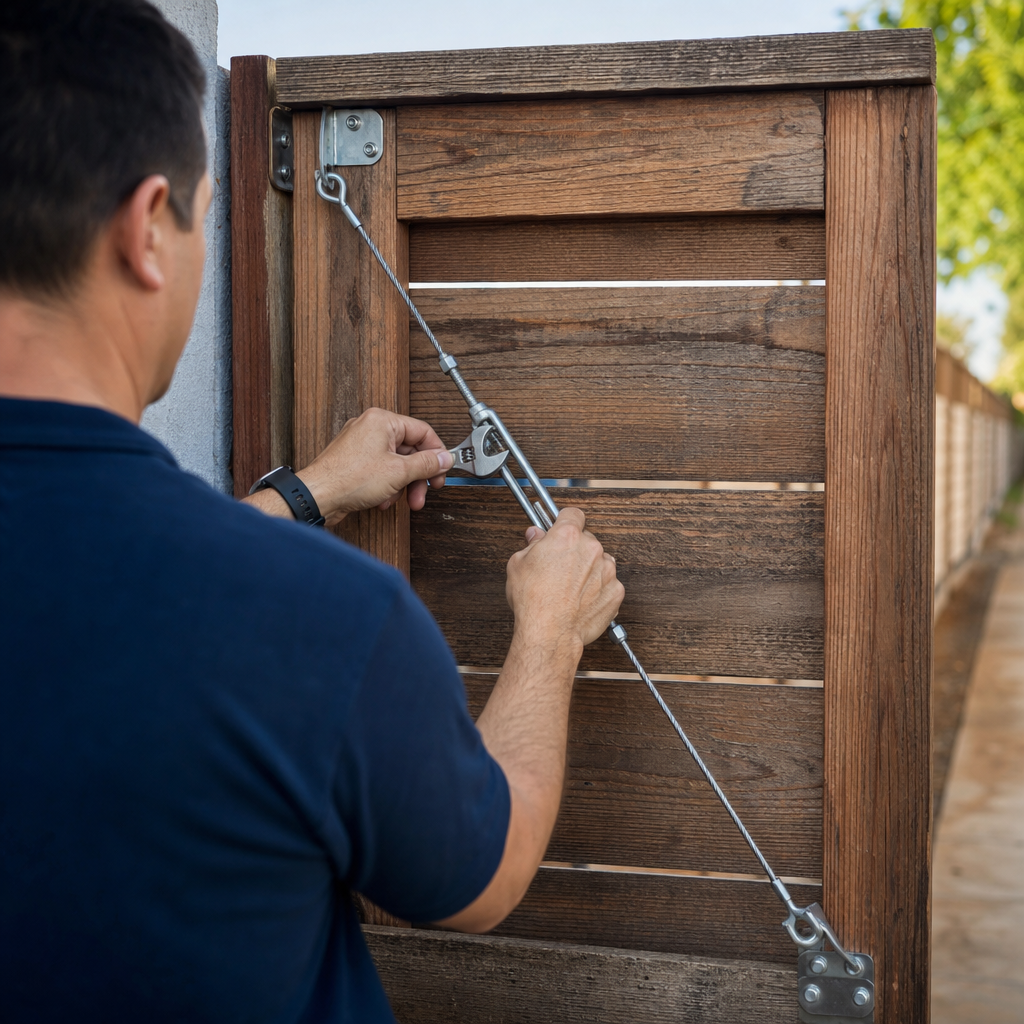
Both diagonal bracing and mechanical kits are supported approaches for stabilizing a sagging gate frame.
Compression Bracing (Wood)
If installing a wooden diagonal brace, configure it to work in compression. Run a solid brace diagonally from the bottom hinge corner upward to the top latch corner. This transfers downward gravitational load from the latch side toward the lower hinge and post. Miter the ends so the brace sits flush against the frame corners.[5]
Tension Bracing (Cable and Turnbuckle Kits)
Cable-and-turnbuckle anti-sag kits provide an adjustable tension option, especially useful for heavy gates where periodic re-tensioning may be needed. When installing a cable or rod in tension, run it from the top hinge corner downward to the bottom latch corner to pull the dropped corner upward toward the upper hinge post.
Corner Brackets and Steel Frames
According to hardware guidelines from Ironworks Gate Co., rigid steel corner brackets or full steel subframes can also be installed to reinforce corner joints and resist frame racking on larger or heavier wood gates.
Step 4: Reinforce or Reset a Leaning Gate Post
If the gate frame is square and hinges are secure, but the gate still drags, the post itself may have shifted or deteriorated.
- Check for rot at ground level: Inspect the post base near the soil or concrete collar. As documented by the USDA Forest Products Laboratory, ground contact creates significant decay risk. If structural wood decay has compromised the post core, replacement is necessary. Periodic finishes or water-repellent preservatives can slow weathering and decay on exposed fencing.
- Temporary support: For a structurally sound post that has shifted in loose or wet soil, a temporary diagonal brace anchored to a ground stake can help hold the post plumb while repairs are made.
- Post replacement: When replacing a post, follow local building requirements and manufacturer or professional guidance regarding post sizing, embedment depth, footing specifications, and drainage to protect the post base.
Step 5: Considerations for Automated and Swing Gate Operators
Need sagging wooden gate repair?
We’re available now - call for a fast, free estimate.
Avoid using an automatic gate operator to force a sagging or binding wooden gate. Automated operators are intended for balanced, free-swinging gates; forcing an operator against resistance can cause excessive wear or damage to mechanical and electrical components.
Complete structural realignment, verify smooth manual movement throughout the swing path, and confirm proper latch clearance before connecting an automated operator.
Estimated Gate Sag Repair Costs (Unverified Estimates)
Note: The following ranges are unverified estimates and depend on local labor rates, materials, and specific site conditions. Obtain current local quotes for exact pricing.
- DIY Hardware and Bracing: Basic hardware (screws, brackets, or cable kits) typically involves modest retail material costs.
- Professional Hinge and Frame Realignment: Hiring a professional contractor to realign the frame and install replacement hardware varies by regional labor rates and gate size.
- Full Post Reset or Replacement: If the post requires excavation, concrete footing work, and structural reset, costs increase based on site accessibility, soil conditions, and chosen post materials.
When to Call a Professional vs. DIY
As noted by Ironworks Gate Co., basic hinge tightening, structural screw replacement, and simple brace additions can often be completed with standard tools. However, a professional assessment may be required if:
- The gate is integrated with an automated electronic access system or mechanical operator.
- The hinge post has severe structural decay below grade requiring excavation or footing replacement.
- The gate leaf is unusually heavy, large, or structurally complex.
- The post or frame shows severe twisting or instability that standard bracing cannot resolve.
Frequently Asked Questions About Sagging Wooden Gate Repair
Why is my wooden gate sagging?
Dragging may result from loose hinges or fasteners, frame movement, a leaning post, or wood deterioration. Exposure to moisture and ground contact accelerates joint softening and decay over time.[1]
How do you fix a sagging wood gate without replacing it?
Support the latch side, replace worn hinge fasteners with structural screws or through-bolts, align the frame using diagonal strapping, and install either a diagonal compression brace (bottom hinge to top latch), a cable-and-turnbuckle tension kit (top hinge to bottom latch), or corner reinforcement brackets.
What is an effective anti-sag kit for a heavy wooden fence gate?
Cable-and-turnbuckle kits offer an adjustable tension option for heavy gates, allowing adjustments over time. Rigid steel corner brackets and metal subframes offer alternative non-adjustable reinforcement to keep frame corners rigid.
How do I brace a wooden gate to stop dragging?
To use wood compression bracing, run a diagonal brace from the bottom hinge corner up to the top latch corner. If using a steel cable or rod in tension, install it from the top hinge corner down to the bottom latch corner.
How long does a wooden gate repair last?
Durability depends on post condition, moisture exposure, materials, workmanship, and maintenance. Applying periodic finishes or water-repellent preservatives can slow weathering and decay on exposed timber.
Need sagging wooden gate repair?
We’re available now - call for a fast, free estimate.
Sources
- NDE SYSTEM FOR DETERMINING WOOD – rosap.ntl.bts.gov (2000)
- [PDF] Long-Term Durability of Pressure-Treated Wood in a Severe Test Site – research.fs.usda.gov (2013)
- PROTECTING WOOD FENCES FOR YARD AND GARDEN – research.fs.usda.gov
- A COMPARISON OF PRESSURE TREATED WOOD AND CEDAR … – oregon.gov
- SERVICE RECORDS ON TREATED AND UNTREATED FENCE POSTS – govinfo.gov
Related reading: Fix Sagging Wooden Gate | Call Now-10% Off | Same-Day Service | Free Estimate
Related reading: Automatic Gate Troubleshooting | Call Now-10% Off | Same-Day Service | Free Estimate
Related reading: Electric Gate Troubleshooting – 10% Off & Free Estimate – Same-Day Service
Frequently Asked Questions
Can adding a caster wheel permanently fix a dragging wooden gate?
A caster wheel provides temporary rolling relief over smooth pavement, but it fails to address structural frame racking, loose hinges, or post decay. Over time, uneven terrain can push upward on the gate leaf, causing additional joint separation. Ironworks Gate Co. recommends correcting the underlying geometry with diagonal compression bracing or resetting the post for a durable fix.
How do I determine if a leaning gate post requires full replacement?
Probe the post with a screwdriver at and just below the soil or concrete collar to test for soft, decayed wood fibers. If structural rot has penetrated the post core or the footing has shifted in the soil, surface bracing will not hold. In these situations, scheduling an on-site assessment with Ironworks Gate Co. to excavate and set a properly treated post is the best path forward.
Why is it risky to run an automatic gate opener on a sagging wooden gate?
Automatic gate operators are engineered to move balanced, free-swinging leaves and lack the torque tolerance to overcome continuous ground drag. Forcing an operator against ground friction or a binding latch risks stripping internal drive gears and burning out the motor. Completing a structural sagging wooden gate repair ensures smooth manual operation before re-engaging automated systems.
About the author
 |
Sarah Miller Sarah Miller is a specialized content creator with a focus on property security and access control systems. Drawing from her five years of experience writing for the home services sector, she provides homeowners and property managers with clear, actionable insights on gate maintenance, repair processes, and transparent pricing. Sarah holds a Bachelor of Arts in Communications from California State University, Fullerton. |
Gate not opening, off track, or opener dead?
We’re available now - call for a fast, free estimate.
Call Now - Free Estimate