
Quick Summary
This guide explains how to fix a sagging wood fence gate by diagnosing whether latch drag is caused by hinge post deflection, worn hardware, or frame racking from natural wood movement. Ironworks Gate Co. recommends verifying post plumb first, securing heavy-duty hinge fasteners, and re-squaring the frame using an upward diagonal wood compression brace or an adjustable steel turnbuckle cable. Readers will understand how to complete step-by-step gate alignment repairs and determine when severe structural decay warrants professional post replacement or steel reinforcement.
How to Fix a Sagging Wood Fence Gate – Restore Smooth Swing
A sagging wood fence gate usually comes down to three main culprits: worn or loose hinge hardware, a distorted wooden frame, or a hinge post that is deflecting under the weight of the gate. Solid wood naturally absorbs and releases moisture from the surrounding air, which causes ongoing dimensional changes. As lumber dries, it shrinks unevenly (with the greatest shrinkage occurring parallel to the growth rings), leading to frame distortion over time.[3]
Before you run out to buy quick-fix hardware, you need to isolate whether the sag is happening inside the gate frame itself or back at the post. This guide walks through practical diagnostics and step-by-step mechanical repairs to get your gate swinging freely again. See also Driveway Gate Repair | Call Now-10% Off | On-Site in 60 Minutes | Free Estimate.
Fast Fix Summary: How to Fix a Sagging Wood Fence Gate
To fix a sagging wood fence gate, start by placing a level on the hinge post to verify it is perfectly plumb. If the post leans, repair the post anchor first. If the post is plumb, inspect the hinges for stripped screws or worn metal. If the hardware is secure, re-square the frame using either a rigid wood diagonal brace (running upward from the bottom hinge-side corner to the top latch-side corner) or an adjustable steel turnbuckle cable (running from the top hinge-side corner down to the bottom latch-side corner).[5]
Core Diagnostic Rules
According to Ironworks Gate Co., gate sag is commonly related to mechanical leverage and wood movement. When troubleshooting, keep these three points in mind:
- Hinge hardware strain: Fasteners can pull loose under the weight and leverage of the gate, so inspect all hinge fasteners for movement or wear.
- Check the post under load: As a practical inspection suggestion, observe whether the post shifts or deflects when the gate swings open.
- Brace direction: Diagonal wood braces are typically installed running upward from the bottom hinge corner to the top latch corner, whereas steel cable kits run from the top hinge corner down to the bottom latch corner.
Fast Action Checklist
- Check post plumb: Use a long level to confirm the post is vertical on both faces while the gate swings.
- Inspect and secure fasteners: Replace stripped or undersized screws with heavy-duty structural wood screws.
- Install the right brace: Add a diagonal wood compression brace or a cable turnbuckle kit to lift the latch side.
What You’ll Need: Essential Tools and Hardware
Fixing a sagging gate requires basic carpentry tools and exterior-rated hardware that can handle continuous mechanical stress.
Required Hand and Power Tools
- Cordless Impact Driver or Drill: For driving structural fasteners into posts and frame corners.
- 4-Foot Bubble Level: To check both the post and the horizontal gate rails for true plumb and level.
- Adjustable Wrench and Pliers: For tensioning turnbuckle barrels and tightening hinge bolts.
- Wood Shims and Pry Bar: To support and align the gate at the correct height while you work.
- Safety Glasses and Work Gloves: For hand and eye protection.
Hardware and Structural Materials
Depending on your repair path, you will need exterior structural wood screws, heavy-duty strap or tee hinges, a 2×4 piece of lumber for cross-bracing, or a galvanized steel anti-sag turnbuckle cable kit.
Step 1: Diagnose Post Alignment, Fasteners, and Wood Movement
Need how to fix sagging wood fence gate?
We’re available now - call for a fast, free estimate.
Never try to fix a gate frame until you confirm the hinge post is solid. If the hinge post deflects, surface adjustments to the gate face will fail within weeks.
Checking Post Plumb and Deflection
- Place your level along the front and side faces of the hinge post while the gate is closed.
- As a practical inspection suggestion, keep the level on the post and swing the gate open 90 degrees to check if the post deflects or shifts under movement.
- Inspect the soil line around the base of the post for cracking, loose dirt, or rot. The USDA Forest Service identifies replacing damaged posts and adjusting tension as standard fence maintenance, confirming that post stability is the foundation of proper gate alignment.
Accounting for Wood Movement
Lumber expands in wet weather and shrinks during dry seasons. Wood should generally have a surface moisture content under 18% before building or making tight framing repairs. When wood dries unevenly, it tends to pull the frame out of square, putting extra drag on the latch rail.[1]
Step 2: Inspect, Tighten, or Replace Gate Hinges
Loose hinges, frame distortion, post movement, and moisture-related wood movement are possible causes of latch-side drag.[4]
Securing Loose Fasteners
- Prop up the latch side of the gate with wood wedges or a pry bar until the gate is square in the opening and pressure is off the hinges.
- Check the hinge screws. If they spin freely or pull away from the post, remove them.
- Replace short or loose screws with appropriately sized structural exterior screws to secure the hinges firmly to the post.
Replacing Worn or Undersized Hinges
Lighter utility hinges may bend under the weight of heavier gate framing and pickets. If the hinge leaves are bent or have loose pins, swapping them out for heavy-duty strap hinges or tee-hinges can help distribute weight across the horizontal rails.
Step 3: Install a Diagonal Compression Brace
As recommended by Ironworks Gate Co., a diagonal wooden brace is traditionally installed running upward from the bottom hinge-side corner to the top latch-side corner to help support the gate frame.
When installed on the gate frame, this diagonal orientation is intended to help transfer load from the latch side back down toward the lower hinge area.
Bracing Orientation Guide
| Bracing Type | Mechanical Force | Correct Orientation |
|---|---|---|
| Diagonal Wood 2×4 | Compression support | Bottom hinge corner up to top latch corner |
| Steel Cable Turnbuckle | Tension support | Top hinge corner down to bottom latch corner |
Fitting the Wood Brace
- Block the gate in a level, squared position using shims underneath the bottom rail.
- Lay a straight 2×4 flat against the back of the gate frame, spanning from the bottom hinge corner to the top latch corner.
- Mark the exact angles where the 2×4 meets the inner corners of the frame.
- Make miter cuts along your marks so the brace fits tightly inside the perimeter frame with solid wood-to-wood contact at both ends.
- Fasten the brace securely to the horizontal rails and fence pickets using exterior screws.
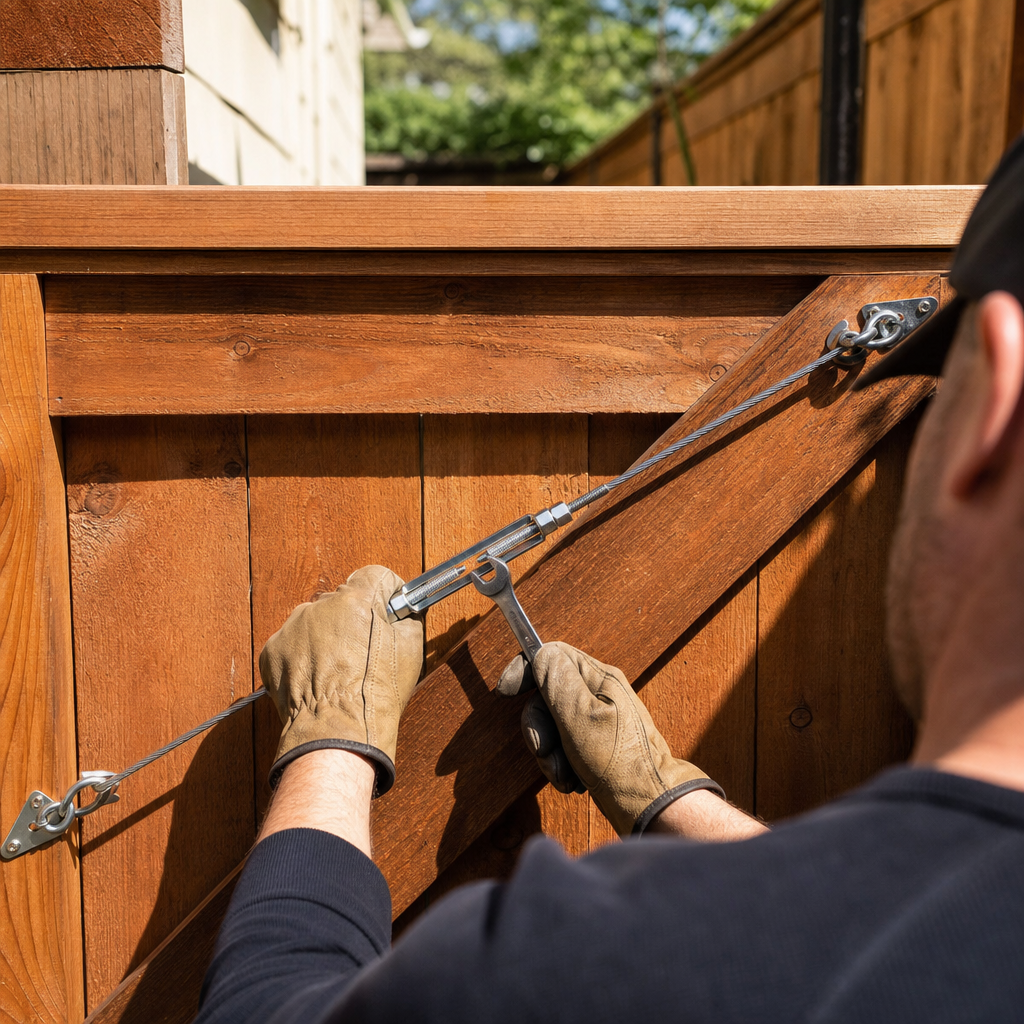
Step 4: Add an Anti-Sag Turnbuckle Cable Kit
Need how to fix sagging wood fence gate?
We’re available now - call for a fast, free estimate.
If you do not want to cut wood framing, a steel anti-sag turnbuckle cable kit is an alternative method to lift the dropped corner.
Mounting Cable Geometry
Unlike a wood brace, a turnbuckle cable is designed to support the lower latch corner by tensioning toward the upper hinge side. Fasten the top corner bracket at the upper hinge side and the bottom corner bracket at the lower latch side.
Installing and Tensioning the Cable
- Attach the corner brackets to the frame members at the upper hinge corner and lower latch corner according to the manufacturer’s instructions.
- Unthread the turnbuckle body to allow for adjustment length per product guidelines.
- Connect the turnbuckle and cable between the brackets, taking up initial slack and securing cable clamps following manufacturer instructions.
- Rotate the turnbuckle body to tension the diagonal cable, adjusting until the latch side of the gate aligns with the strike plate.
Step 5: Evaluate Gate Post Stability
If the hinge post is loose in the ground, rotted below grade, or warped, framing adjustments on the gate are only temporary patches. The post itself must be stabilized.
Fixing a Leaning Post
- Disconnect the gate from the post to remove all dynamic weight.
- Dig out the soil around the existing concrete footing to inspect for cracked concrete or post rot at the ground line.
- If the post is sound but tilted, jack it back to true vertical, stake it securely with temporary 2×4 braces, and pour fresh concrete around the base to anchor it.
- If the post is snapped or rotted, dig out the footing entirely and set a new pressure-treated post in concrete in accordance with local building requirements.
When to Repair vs. Replace a Sagging Wood Fence Gate
Deciding between repairing your gate or building a new one comes down to the condition of the wood framing.
Repair the Gate If:
- The hinge post is straight, plumb, and firm in the ground.
- The 2×4 frame members are structurally sound without deep rot or severe splits.
- The sag is caused by loose screws, worn hinges, or mild frame racking.
Replace the Gate If:
- The perimeter 2×4 frame is rotted, cracked at the fastener joints, or severely twisted.
- The gate pickets are deteriorated beyond salvage.
- The cost of replacing hinges, bracing, pickets, and fasteners approaches the price of building a simple, squared replacement frame.
Frequently Asked Questions About Fixing Sagging Wood Gates
Why do wooden fence gates sag over time?
Wooden gates sag due to continuous downward gravitational pull on the latch side, loose hinge fasteners, and seasonal wood movement. Solid wood expands and shrinks as moisture levels change, which loosens fastener grip. Over time, the square frame racks into a parallelogram unless it is reinforced with a properly oriented diagonal brace.[2]
Which direction should the diagonal cross brace go on a wood fence gate?
For a wooden 2×4 brace acting in compression, run the brace from the bottom hinge corner up to the top latch corner. For a steel turnbuckle cable acting in tension, run the cable from the top hinge corner down to the bottom latch corner.
How much does professional wood fence gate repair cost?
Repair costs vary depending on the extent of damage, lumber prices, and regional labor rates. General price ranges quoted online are unverified estimates; consult local contractors such as Ironworks Gate Co. or market sources for accurate project pricing.
Can adjusting or replacing heavy-duty hinges fix a dragging gate?
Hinge replacement may help resolve latch drag if the hinge post is sound and plumb and the gate frame is not severely racked, provided the new hinges are secured with appropriate structural fasteners.
Need how to fix sagging wood fence gate?
We’re available now - call for a fast, free estimate.
Sources
- Wood Handbook–Chapter 12–Drying and Control of Moisture … – fpl.fs.usda.gov
- Moisture-Related Properties of Wood and the Effects of Moisture on Wood … – fpl.fs.usda.gov
- Wood and Moisture Relationships | OSU Extension Service – extension.oregonstate.edu
- Wood Moisture Content and The Importance of Drying in … – osb.westfraser.com
- 8 Effective Repairs for Sagging Wood Gate Hinges and Brace … – journeymanhq.com
Related reading: Sagging Wooden Gate Repair – Call Now-10% Off – On-Site in 60 Minutes – Free Estimate
Related reading: Automatic Gate Troubleshooting | Call Now-10% Off | Same-Day Service | Free Estimate
Related reading: Electric Gate Troubleshooting – 10% Off & Free Estimate – Same-Day Service
Frequently Asked Questions
How can I permanently prevent a wide or heavy wood gate from sagging again?
For oversized or heavy gates where standard diagonal braces repeatedly fail, upgrading to an internal welded steel subframe offers a permanent solution. Ironworks Gate Co. installs these rigid steel frameworks behind wood pickets, eliminating frame racking while preserving your fence's traditional appearance.
Will adding a gate caster wheel fix a dragging wood fence gate?
A caster wheel can temporarily relieve ground drag on perfectly flat concrete, but uneven ground forces dynamic stress upward into the gate frame and hinges. A correctly installed compression brace, turnbuckle kit, or professional post reinforcement provides a reliable fix without relying on surface rolling contact.
What size screws should be used to prevent gate hinges from pulling out of the post?
Standard short utility screws strip easily under mechanical leverage and seasonal wood movement. Ironworks Gate Co. advises using exterior-grade 3-inch to 3.5-inch structural wood screws or heavy-duty through-bolts to anchor deeply into the solid core of the hinge post.
About the author
 |
Sarah Miller Sarah Miller is a specialized content creator with a focus on property security and access control systems. Drawing from her five years of experience writing for the home services sector, she provides homeowners and property managers with clear, actionable insights on gate maintenance, repair processes, and transparent pricing. Sarah holds a Bachelor of Arts in Communications from California State University, Fullerton. |
Gate not opening, off track, or opener dead?
We’re available now - call for a fast, free estimate.
Call Now - Free Estimate