
Quick Summary
Learning how to fix a sagging gate requires identifying whether alignment failure stems from worn hinge hardware, shifting support posts, or a racked frame that causes ground dragging and operator strain. Drawing on over 40 years of metal fabrication and hinge realignment experience, Ironworks Gate Co. demonstrates how to adjust hardware safely while highlighting when heavy gates demand structural re-welding and post reinforcement. Readers will understand how to systematically diagnose gate mechanics and can contact Ironworks Gate Co. for a free on-site gate assessment and same-day repair quote when professional intervention is required.
How to Fix a Sagging Gate – Fast Repairs That Last
A sagging gate is more than an eyesore. When a gate drops out of square, it scuffs driveways, wears down latching hardware, and puts heavy strain on hinges and support posts. On automated systems, improperly maintained or misaligned gates can move unexpectedly or create hazards.[3]
Learning how to fix a sagging gate starts with a systematic diagnostic sequence. Alignment issues typically involve hinge attachment points, posts shifting out of plumb, or frame distortion. Available research does not validate specific percentages for causes or the success rate of particular sagging-gate repair methods. See also Driveway Gate Repair | Call Now-10% Off | On-Site in 60 Minutes | Free Estimate.
Safety Warning: Sliding gates can fall from tracks and unsecured swinging gates can move unexpectedly. Professional service is strongly recommended for heavy, automated, unstable, or structurally damaged gates. Always brace the leaf securely with wood blocking before loosening hardware. If your gate runs on an automated operator, disconnect power and unpin the drive arm before starting work to avoid sudden mechanical movement or electrical shorting.[1]
What You Need Before Starting Repairs
Before working on the gate, gather tools that can handle both the weight of the leaf and the torque needed to adjust weathered hardware.
Recommended Tools and Materials
- 4-Foot Carpenter’s Level: Essential for checking post plumb and frame square across the full opening.
- Automotive Floor Jack and Wood Blocks: Used to safely take the load off the hinges while making adjustments.
- Deep Socket Set and Adjustable Wrenches: For tightening through-bolts, lag screws, or adjustable J-bolt hinge nuts.
- Heavy-Duty Metal or Wood Shims: Useful for packing out hinge plates to correct minor frame tilts.
- Tape Measure: For measuring diagonal frame dimensions to check for squareness.
The Pitfall of “Quick Fix” Wheels and Turnbuckles on Heavy Gates
Before buying hardware, be cautious with generic DIY anti-sag solutions. Hardware stores often sell spring-loaded gate caster wheels and light-duty turnbuckle cable kits as universal fixes. While an anti-sag gate kit with a turnbuckle may work for a light wooden fence gate, technicians at Ironworks Gate Co. note that it rarely holds up on heavy wrought iron or tubular steel security gates.[4]
Installing a helper wheel on an automated swing gate is especially problematic. Driveways are rarely perfectly flat. When an automated gate is forced up and down by uneven ground, improperly maintained or misaligned gates can move unexpectedly or create hazards. Frame support should come from properly aligned posts and solid frame geometry rather than an unguided wheel on the ground.[2]
Step 1: Diagnose the Root Cause (Diagnostic Sequence)
Need how to fix a sagging gate?
We’re available now - call for a fast, free estimate.
Follow a structured diagnostic sequence before adjusting or loosening components:
1. Inspect the Hinges and Attachment Points
Examine the hinge barrels, pins, and mounting plates while gently lifting the latch side of the gate. Check for stripped screws, wallowed hinge pin holes, bent hinge leaves, loose adjustment nuts, or cracked welds.
2. Check Whether Posts Are Plumb
Place your 4-foot level against the inside face and the side face of the hinge post. Check whether the post remains plumb on both faces or if the post has pulled out of alignment.
3. Tighten or Replace Loose or Damaged Fasteners
Check all structural fasteners holding the hinges to the post and the gate frame. Any loose, corroded, or undersized fasteners must be tightened or replaced with appropriate heavy-duty hardware.
4. Measure the Frame for Squareness
Measure diagonally from the top hinge corner to the bottom latch corner, then from the bottom hinge corner to the top latch corner. If those two measurements are not identical, the frame has racked out of square.
Step 2: Relieve Gate Weight and Disconnect Automation
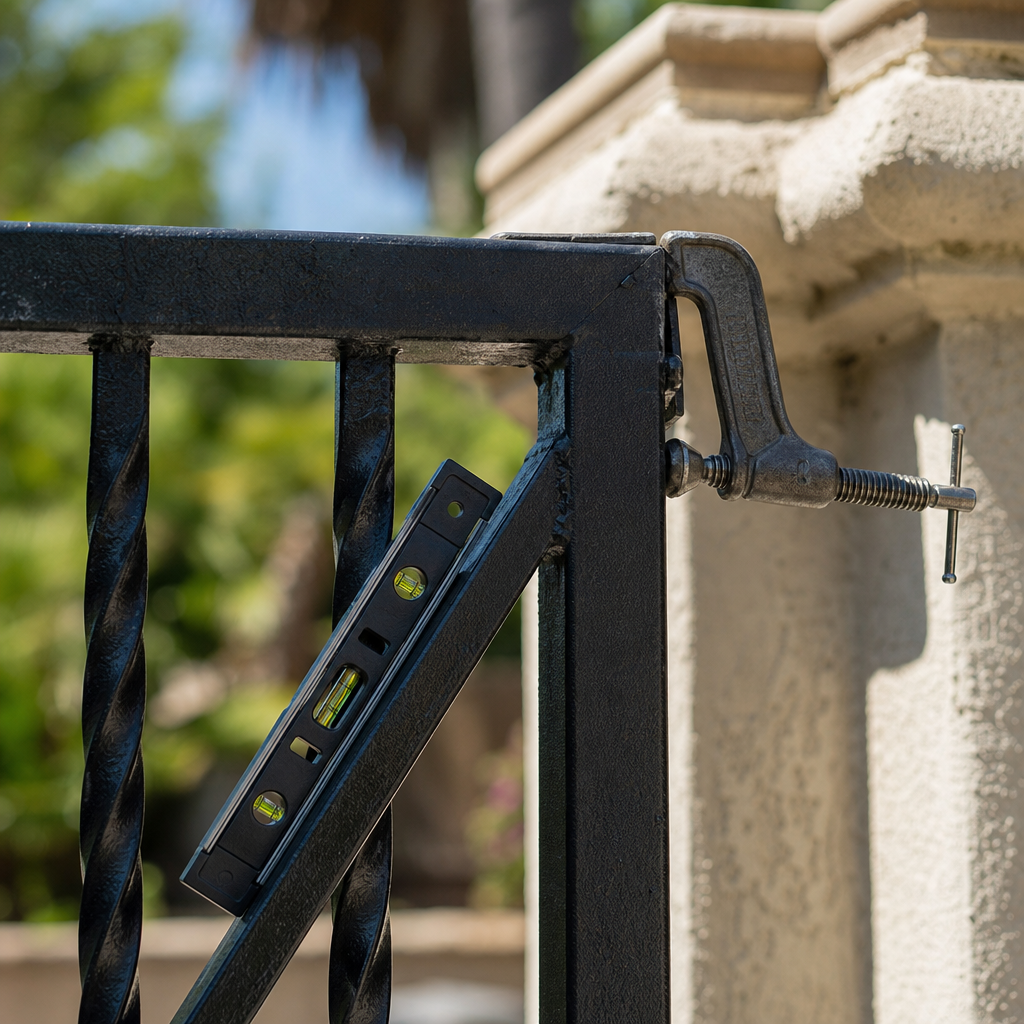
Never adjust hinge bolts or frame braces while the full weight of the gate hangs unsupported. Doing so risks hardware damage and personal injury.
- Disconnect automated arms: If you are working on an electric gate, switch off the main breaker or power disconnect. Pull the quick-release pin connecting the operator arm to the gate bracket so the gate moves freely by hand.
- Jack the latch corner: Place a piece of 2×4 scrap wood under the bottom latch corner of the gate. Position a hydraulic floor jack beneath the wood and raise the jack just enough to take tension off the top hinge.
Step 3: Adjust, Shim, or Replace Gate Hinges
Hinge adjustments and hardware replacement are possible approaches to address sag when posts are plumb, subject to manufacturer guidance and hardware specifications.
Adjustable J-Bolt Hinges
For metal gates equipped with threaded J-bolt hinges, adjustment requires appropriate hardware and manufacturer guidance:
- Loosen the locking nut on the inside of the post on the top hinge, and tighten the outside nut to draw the top of the gate closer to the post.
- If additional adjustment is needed, loosen the outside nut on the bottom hinge and tighten the inside nut to push the bottom of the gate away from the post.
- Tighten jam nuts securely against the post walls once the gate is properly aligned.
Fixed Strap or Butt Hinges
- Replace failing fasteners: Back out loose screws one by one and replace them with structural fasteners designed for the post material.
- Hinge shimming: Placing a thin metal or dense plastic shim behind the bottom hinge plate on the post side is a possible approach to tilt the gate leaf back upward. Ensure hardware remains securely seated.
Step 4: True the Frame with Bracing or Structural Reinforcement
Need how to fix a sagging gate?
We’re available now - call for a fast, free estimate.
If the hinges and post are solid but the frame has racked, structural bracing methods may be considered based on gate design and material.
Wooden Gates
Possible corrective approaches for racked wood frames include:
- Wood compression cross-brace: Installing a rigid timber brace running diagonally from the bottom hinge corner up to the top latch corner to act as a compression strut.
- Anti-sag turnbuckle cable: Installing an adjustable cable assembly running from the top hinge corner down to the bottom latch corner and tensioning the turnbuckle to lift the latch side.
Metal Gates
According to fabricators at Ironworks Gate Co., fixing a sagging metal gate requires proper structural evaluation. Clamping the frame square, structural re-welding, and gusset installation are possible approaches that require appropriate welding equipment, proper hardware, and professional assessment to ensure structural integrity.
Step 5: Reconnect Operators and Realign Latches
Once adjustments are complete, verify that the gate clears the ground and closes without binding:
- Test manual swing: Swing the gate through its full arc by hand. Confirm it clears the ground cleanly and moves without binding or scraping.
- Realign the latch: Loosen and reposition the latch hardware on the post so the gate latches smoothly without requiring manual lifting.
- Reconnect swing gate operator: Reattach the operator arm and restore power. Verify that improperly maintained or misaligned gates can move unexpectedly or create hazards, and ensure limit stops halt the gate safely.
Frequently Asked Questions
Why is my gate sagging and dragging on the ground?
Gates drag on the ground when hinges wear or loosen, support posts shift out of plumb, or the frame distorts out of square. Note that available research does not validate specific percentages for these causes.
Can you fix a sagging gate without replacing the post?
If the post remains sound and plumb, adjustments to J-bolt hinges, shimming, or diagonal bracing are possible approaches to correct gate sag. However, if the post itself is rotted, broken, or significantly out of plumb, post resetting or replacement may be required, and professional assessment is recommended.
How do you address an electric gate that fails to close properly due to sagging?
Disconnect the operator arm and follow the diagnostic sequence to realign the physical gate first. When an automated gate is misaligned or drags, it creates hazards and can move unexpectedly. Once the gate is realigned so it clears the ground and swings freely by hand, reconnect the operator arm and verify safe operation according to manufacturer instructions.
When is a sagging gate a DIY fix versus needing professional repair?
According to specialists at Ironworks Gate Co., basic DIY maintenance is generally limited to tightening loose fasteners, installing basic wooden cross-braces, or minor hinge adjustments on lightweight gates. Professional service is strongly recommended for heavy, automated, unstable, or structurally damaged gates, as well as repairs involving structural welding or resetting concrete-anchored posts.[5]
Need how to fix a sagging gate?
We’re available now - call for a fast, free estimate.
Sources
- [PDF] 2024-11-20-COPF-CODD-Hummingbird-Alliance-Meeting-Log.pdf – cpsc.gov (2024)
- [PDF] Proposed Rule: Safety Standard for Gates and Enclosures – cpsc.gov (2018)
- 32346 – govinfo.gov (2018)
- Gates and Enclosures Business Guidance – cpsc.gov (2021)
- How To Repair a Fence Gate – This Old House – thisoldhouse.com
Related reading: Automatic Gate Troubleshooting | Call Now-10% Off | Same-Day Service | Free Estimate
Related reading: Electric Gate Troubleshooting – 10% Off & Free Estimate – Same-Day Service
Related reading: Electric Gate Not Opening in Cold Weather – 10% Off & Free Estimate – Same-Day Service
Frequently Asked Questions
Why shouldn't you install an anti-sag caster wheel on a heavy automated gate?
Caster wheels follow the uneven contours of driveways, forcing vertical shock loads back into the gate hinges and automated operator arm. Ironworks Gate Co. advises that heavy metal gates require internal frame gussets, welded bracing, or hinge adjustments rather than unguided wheels that cause mechanical binding.
How do you fix a sagging gate if the support post is leaning in concrete?
A leaning post anchored in concrete indicates footing failure or shifting soil, which cannot be permanently resolved through hinge adjustments alone. Restoring proper alignment requires bracing the gate, excavating the compromised footing, and resetting the post in reinforced concrete – a structural repair best evaluated during an on-site assessment with Ironworks Gate Co.
Can a sagging gate cause permanent damage to an electric gate opener?
Yes, ground dragging and misaligned latches force the electric motor to push against severe mechanical resistance. Over time, this extra load strips internal drive gears, shears mounting brackets, and can burn out the operator motor prematurely.
About the author
 |
Sarah Miller Sarah Miller is a specialized content creator with a focus on property security and access control systems. Drawing from her five years of experience writing for the home services sector, she provides homeowners and property managers with clear, actionable insights on gate maintenance, repair processes, and transparent pricing. Sarah holds a Bachelor of Arts in Communications from California State University, Fullerton. |
Gate not opening, off track, or opener dead?
We’re available now - call for a fast, free estimate.
Call Now - Free Estimate