
Quick Summary
Successfully learning how to fix a sagging wooden gate requires identifying underlying structural failures such as post deflection, frame racking, or worn hardware rather than applying temporary screw adjustments. The specialists at Ironworks Gate Co. highlight proven corrective solutions, including correctly oriented compression cross-bracing, upgraded hinge fasteners, and heavy-duty internal steel sub-frame retrofits. Property owners can use these diagnostic insights to evaluate repair scopes and schedule a free on-site assessment or call for same-day professional gate reinforcement.
Fixing a Sagging Wooden Gate: Practical Structural Repair Guide
When a wooden gate begins to drag on the pavement or scrape against its latch post, tightening a few screws rarely solves the underlying problem. While gate sag can stem from multiple factors, common contributors include loose or worn hinges, movement or decay in the hinge post, and frame distortion.[4]
Wood is a living material that reacts constantly to its environment. Exterior wood commonly cycles around 12 percent moisture content in most U.S. areas and about 9 percent in the Southwest, while moisture-related swelling, shrinking, weathering, and decay can contribute to loosened or misaligned components. As specialists at Ironworks Gate Co. point out, restoring smooth, reliable swing requires diagnosing where the movement started and reinforcing the frame correctly. See also Driveway Gate Repair | Call Now-10% Off | On-Site in 60 Minutes | Free Estimate.
Diagnostic Overview: Why Wooden Gates Sag and How to Repair Them
Before buying hardware or taking the gate off its hinges, pinpoint where structural issues or movement have occurred.
Common Causes of Gate Sag and Ground Drag
Common contributors to gate sag include:
- Hinge post deflection: The hinge post bears the rotational load of the gate. If the post foundation shifts or if moisture leads to decay near the soil line, the post may tilt inward toward the opening.
- Frame racking (loss of square): Standard wood gate frames can shift under load. As gravity pulls on the unsupported latch side, rectangular frames can distort out of square.
- Hinge and fastener looseness: Screws can loosen or pull out of timber over time, allowing hinges to pull away from the post or frame.
- Ground contact decay: Wood absorbs moisture through the end grain far faster than through face grain. If the bottom corner of a gate has been dragging in dirt or wet turf, fungal decay can weaken the wood structure. Wood-decay fungi generally require moisture content of approximately 20 percent or more, and moisture above 25 percent is associated with fungal attack or decay in the supplied research.
Diagnostic Checklist
Perform these general checks to identify the source of the sag:
- Hinge looseness: Inspect hinges and fasteners for play, wear, or separation between the hinge post and gate frame.
- Post movement: Check whether the hinge post is plumb and firmly anchored or if it has tilted or moved in the ground.
- Frame squareness: Check the frame diagonals to evaluate whether the gate frame has racked out of square.
- Ground clearance: Inspect the bottom edge of the gate to ensure proper clearance above soil, pavement, or vegetation.
Diagonal Bracing and Structural Framing Methods
Need fix sagging wooden gate?
We’re available now - call for a fast, free estimate.
Adding a diagonal brace is a common method to stiffen a wood gate frame.
Correct Diagonal Cross-Brace Direction
The direction of your diagonal brace depends on whether the brace works in compression or tension:
- Wood Cross-Brace (Compression): A solid wood 2×4 brace typically runs diagonally upward from the bottom hinge corner to the top latch corner. In this position, the weight of the latch side pushes down through the wood brace toward the bottom hinge.
- Cable and Turnbuckle Kit (Tension): A steel cable turnbuckle operates in tension. It typically runs from the top hinge corner down to the bottom latch corner, lifting the bottom latch corner as tension is applied.
Turnbuckle Maintenance
Turnbuckles may require adjustment as wood moves and cycles through seasonal moisture changes.
Optional Approach: Retrofitting an Internal Steel Sub-Frame
For large or heavy wooden gates, retrofitting an internal steel sub-frame behind the wood cladding is an optional approach recommended by Ironworks Gate Co. The wooden pickets attach to the metal framework, helping maintain alignment while preserving a natural wood appearance on the exterior.
| Framing Method | Operating Load | Adjustment Considerations | Application |
|---|---|---|---|
| Wood Compression Brace (2×4) | Compression (Bottom hinge to top latch) | Fixed joint | Standard timber frames |
| Cable Turnbuckle Kit | Tension (Top hinge to bottom latch) | May require adjustment as wood moves | Adjustable tension support |
| Steel Sub-Frame | Full perimeter rigid frame | Minimal adjustment needed | Optional approach for heavy gates |
Inspecting Gate Hardware: Hinges and Posts
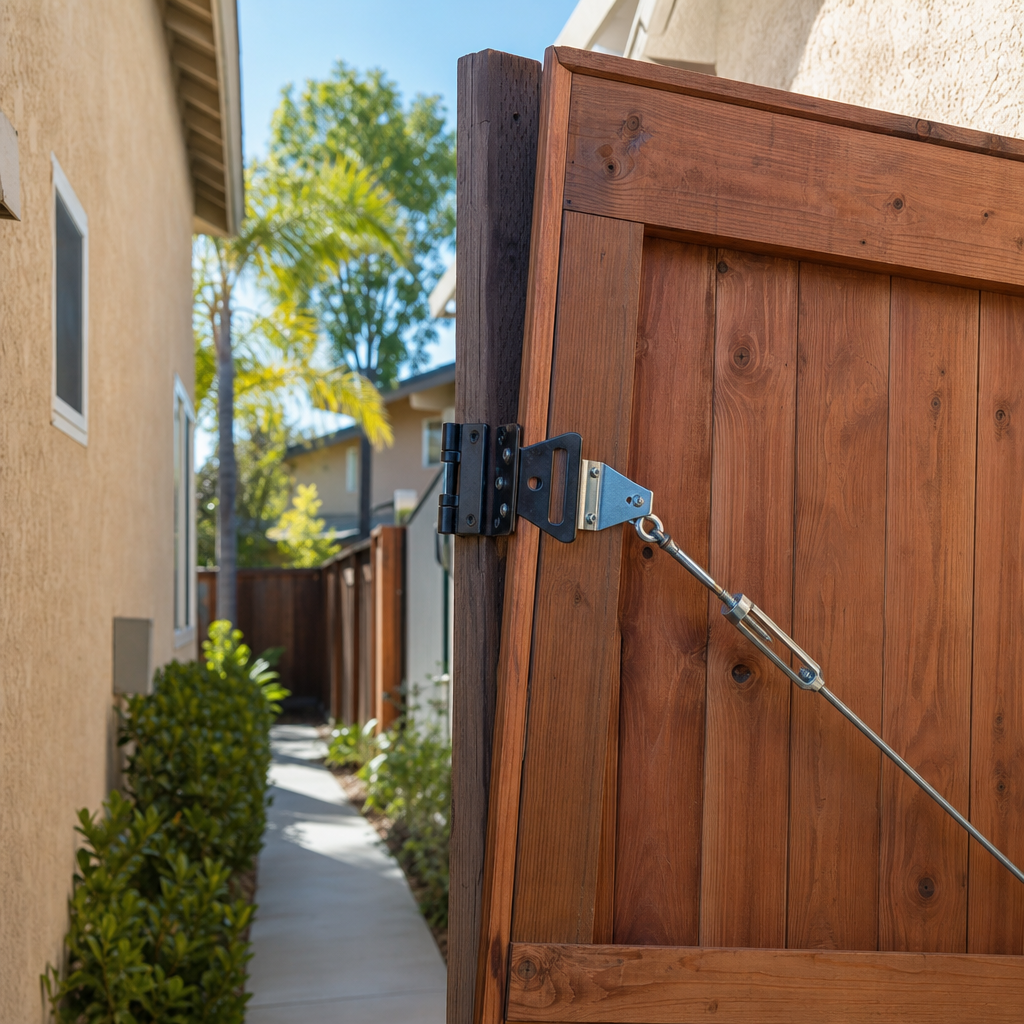
Hardware condition directly impacts gate alignment and longevity.
Hinge and Fastener Options
Selecting appropriate hinges and fasteners depends on site-specific factors such as gate weight and post type. Practical options to consider based on site judgment include:
- Using heavy-duty lag bolts or through-bolts with backer washers where greater holding power is needed.
- Ensuring fasteners penetrate deep into solid structural wood rather than exterior trim boards alone.
- Selecting heavy-duty strap hinges or adjustable barrel hinges that allow fine-tuning of gate alignment.
Leaning Posts and Ground Decay
Post lifespan varies significantly by wood species, treatment, and regional climate. Untreated pine posts are reported at about 3 years in the South, 3 to 6 years in the Midwest and Northeast, and 6 to 12 years in dry western regions. For naturally decay-resistant species, untreated California redwood is reported at about 4 to 20 years, western redcedar at 8 to 24 years, and northern white cedar at 13 to 27 years. Pressure-treated pine posts rated for ground contact are reported at approximately 30 to 40 years.[1]
If a post is leaning or showing signs of decay near the ground line, replacement may be necessary. Setting posts in concrete footings below the local frost depth and incorporating gravel drainage at the base are practical options that require site-specific judgment based on local soil and climate conditions.[3]
Evaluating Gate Repair Options and Costs
Need fix sagging wooden gate?
We’re available now - call for a fast, free estimate.
Deciding between a repair and a full rebuild depends on the condition of your timber framing and foundation posts.[5]
| Repair Scope | Estimated Cost Range (Requires Local Verification) | Work Involved |
|---|---|---|
| Hinge Re-anchoring and Tuning | $150 – $250 (Estimate requiring local verification) | Replacing stripped fasteners with lag bolts, realigning hinge leaves, and resetting latch clearances. |
| Diagonal Bracing / Turnbuckle Setup | $175 – $325 (Estimate requiring local verification) | Installing structural wood compression bracing or an adjustable tension cable system. |
| Post Replacement and Footing Reset | $400 – $800 (Estimate requiring local verification) | Excavating rotted post, pouring new concrete footing, and rehanging existing gate leaf. |
| Internal Steel Sub-Frame Retrofit | $450 – $900 (Estimate requiring local verification) | Fabricating a steel frame backing to support wood pickets. |
| Hardware Realignment and Service | $250 – $600 (Estimate requiring local verification) | Realigning mounting hardware, recalibrating clearances, and balancing gate travel after structural repair. |
Repair vs. Full Replacement
If your gate frame is cracked, waterlogged, or heavily decayed around joint connections, simple re-securing may not hold. However, if the pickets and exterior wood are in solid condition, reinforcing the internal support structure with bracing or an optional sub-frame, as suggested by Ironworks Gate Co., can be a practical alternative to replacing the entire gate.
Frequently Asked Questions About Wooden Gate Repair
Why is my wooden gate sagging or dragging on the ground?
Gate sag can be caused by multiple factors; common contributors include loose or worn hinges, movement or decay in the hinge post, and frame distortion.
Which direction should the diagonal cross brace go on a wood gate?
If using a solid wood 2×4 brace, it typically runs upward from the bottom hinge corner to the top latch corner to work in compression. If using an adjustable steel cable turnbuckle, it runs from the top hinge corner down to the bottom latch corner to work in tension.
Can adjusting or replacing worn hinges fix a sagging fence gate?
Yes, if the sag is caused primarily by loose fasteners or worn hinge hardware. Upgrading fasteners or installing adjustable hinges can help restore alignment, provided the hinge post is stable and the frame remains square.
Can I fix a sagging wooden gate without taking it down?
Minor adjustments like tightening hinge fasteners or installing a cable turnbuckle can often be completed with the gate hanging. However, replacing posts, resetting footings, or installing a sub-frame typically requires removing the gate leaf.
What type of wood should be used for replacement posts?
Practical options include pressure-treated pine posts rated for ground contact (reported at approximately 30 to 40 years of service life) or naturally decay-resistant species such as western redcedar, northern white cedar, or California redwood. Site-specific footing depth and gravel drainage choices should be evaluated based on local conditions.[2]
Need fix sagging wooden gate?
We’re available now - call for a fast, free estimate.
Sources
- [PDF] Long-Term Durability of Pressure-Treated Wood in a Severe Test Site – research.fs.usda.gov (2013)
- PROTECTING WOOD FENCES FOR YARD AND GARDEN – research.fs.usda.gov
- [PDF] Protecting Wood Fences for Yard and Garden – fpl.fs.usda.gov
- [PDF] Chronicle of 65 Years of Wood Finishing Research at the Forest … – fpl.fs.usda.gov
- SD – ir.library.oregonstate.edu
Related reading: How to Fix a Sagging Gate | Call Now-10% Off | Same-Day Service | Free Estimate
Related reading: Automatic Gate Troubleshooting | Call Now-10% Off | Same-Day Service | Free Estimate
Related reading: Electric Gate Troubleshooting – 10% Off & Free Estimate – Same-Day Service
Frequently Asked Questions
How can I tell if gate sag is caused by post movement rather than a racked frame?
Use a level to check if the hinge post has tilted inward toward the opening, and inspect the base of the post for soil shifting or rot near the ground line. If the post is plumb and solid but the gate diagonals are uneven and the latch side is drooping, the frame itself has racked out of square.
When should I upgrade to an internal steel sub-frame instead of standard diagonal bracing?
A steel sub-frame retrofit is recommended for heavy, wide, or automated wooden gates that continuously sag due to weather cycles and structural weight. Specialists like Ironworks Gate Co. install rigid steel backings to permanently prevent frame deflection while preserving the exterior natural wood appearance.
What fasteners offer the strongest hold when re-anchoring heavy gate hinges?
Through-bolts paired with backer washers provide maximum holding power because they clamp entirely through the structural post rather than relying only on thread grip. If through-bolting is not an option, heavy-gauge structural lag screws driven deep into solid timber offer far greater shear resistance than standard exterior wood screws.
About the author
 |
Sarah Miller Sarah Miller is a specialized content creator with a focus on property security and access control systems. Drawing from her five years of experience writing for the home services sector, she provides homeowners and property managers with clear, actionable insights on gate maintenance, repair processes, and transparent pricing. Sarah holds a Bachelor of Arts in Communications from California State University, Fullerton. |
Gate not opening, off track, or opener dead?
We’re available now - call for a fast, free estimate.
Call Now - Free Estimate