
Quick Summary
Driveway gate failures compromise property security and safety, often resulting from underlying electrical issues, sensor faults, or structural damage like sagging hinges and misaligned tracks. Drawing on over 40 years of specialized welding and operator diagnostic experience, Ironworks Gate Co. provides fast, same-day driveway gate repair with transparent pricing across all major equipment brands. Readers will learn how to troubleshoot common gate operator malfunctions and can contact live dispatchers 24/7 to schedule a free on-site driveway gate assessment.
Driveway Gate Repair – Service and Overview
When an automated entry fails, getting prompt driveway gate repair restores your property’s security and keeps your daily schedule on track. A gate that drags along its track, stops halfway, or groans under load is more than an inconvenience; it poses real safety and security concerns. Heavy gate panels exert significant force, meaning mechanical or electrical failures require prompt attention from trained technicians who understand both motor electronics and structural metalwork.
Driveway Gate Repair: What to Expect
Driveway Gate Repair in brief: Professional repair restores manual release capability, alignment, motor drive function, and perimeter security. Technicians, such as those at Ironworks Gate Co., first test line voltage, relay logic, and mechanical balance before performing structural welding, hinge rebuilds, roller replacements, or circuit board repairs.
When an automatic gate refuses to close or stalls during travel, property owners often assume the motor has burned out. In practice, motor strain can be a symptom of structural movement. Ground movement or settlement can shift support posts out of plumb over time. This introduces physical drag that overloads drive gears and triggers internal safety stops, mimicking an electrical fault.[4]
Initial Diagnosis and Safety Evaluation
A comprehensive service process typically begins with a mechanical and electrical inspection. Technicians check line voltage, test primary and secondary entrapment sensors, examine track levelness, and inspect hinges. By determining whether the root issue is an electronic failure or structural binding, repairs can address the underlying cause rather than just treating a symptom.[2]
Safety Standards and Entrapment Protection
Automated gates are heavy machinery operating under automated control. According to historical Consumer Product Safety Commission (CPSC) data, CPSC estimated that nearly 25,000 people, including approximately 9,000 children under age 15, were involved in automatic gate-related injuries from 1990 through 2000. During the period covered by its review, more than 2,000 people, including approximately 800 children, were treated in hospital emergency rooms each year. In addition, CPSC identified 32 deaths related to automatic gates since 1985, including 20 child deaths. CPSC-referenced safety requirements include two entrapment-prevention mechanisms, such as a sensing device and a secondary electric-eye or edge sensor.[1]
Safety inspections also identify hazardous structural conditions: exposed rollers, pinch points, structural gaps wider than 2.25 inches, and push-button controls mounted within reach of moving pickets. CPSC also warns that sliding gates can fall from their tracks and unsecured swing gates can swing unpredictably when improperly installed or maintained.[3]
Automatic Gate Repair: Restoring Automation and Access Controls
Automatic gate repair involves synchronizing physical gate balance with sensitive control logic. When safety loops, optical sensors, or limit switches fail, the operator stops the gate to protect vehicles and pedestrians.
Common Causes of Automation Failures
Modern operators use internal current sensors to detect obstructions. When hinge bearings seize, tracks settle, or strong winds push against heavy panels, the operator interprets the increased physical resistance as an obstruction and reverses or halts. Addressing the physical friction directly prevents recurring motor overloads and damaged control boards.
Restoring Entrapment Protection and Auto-Reverse Logic
During automated swing and slide gate repairs, technicians test optical photo-eyes, magnetic ground loops, and reversing edge sensors. If direct sunlight, vibration, or pest intrusion misaligns an optical beam, the system defaults to a safe state, preventing the gate from completing its cycle. Re-aligning optical heads, cleaning reflector lenses, and protecting junction boxes restores dependable automated cycling.
Gate Opener Repair: Motors, Gearboxes, and Control Boards
According to specialists at Ironworks Gate Co., gate opener repair targets component-level failures in the drive unit, including drive gears, starting capacitors, limit switches, and relay boards. Identifying specific component failures allows for targeted repairs without requiring a full operator replacement when the primary chassis remains sound.
Symptoms of Opener Failure
If an opener hums or clicks without moving the gate, the issue may involve a starting capacitor, reduction gear, or limit switch circuit. If the motor runs but the gate slips, drive chain tension or internal clutch components may require adjustment. Technicians isolate the motor from the gate panel using the manual release to verify whether the drive mechanism moves freely under its own power.
Component-Level Repair vs. Full Unit Replacement
Choosing between component repair and complete unit replacement depends on the age of the operator, parts availability, and the condition of the motor windings. The BLS Consumer Expenditure Survey classifies repairs to outdoor patios, walks, fences, driveways, and permanent swimming pools as a consumer-expenditure category, but the cited materials do not provide driveway-gate-repair-specific spending data.
| Approach | Typical Application | Key Considerations |
|---|---|---|
| Component-Level Repair | Replacing capacitors, limit switches, relay boards, radio receivers, or drive chains | Best when the motor windings, main gearbox housing, and safety architecture remain sound. |
| Full Unit Replacement | Installing a modern operator and updated safety sensors | Recommended when internal gearboxes crack, motor windings burn out, legacy parts are obsolete, or repair costs approach replacement value. |
Electric Gate Repair: Power Feeds, Wiring, and Sensor Circuits
Need driveway gate repair?
We’re available now - call for a fast, free estimate.
Electric gate repair addresses issues across the power delivery network, including direct-burial wiring faults, low-voltage transformer drops, and damaged control wiring.
Breakers, Transformer Voltage Drops, and Underground Wiring
Gate operators installed along perimeter fences often rely on underground electrical runs. Over time, ground moisture, rodent activity, or landscape work can damage low-voltage lines, resulting in intermittent operation or trips at the breaker. Technicians test incoming line voltage under motor load to detect voltage drops that starve the operator of starting amperage.
How to Open an Electric Gate Without Power
During power outages or electrical faults, property owners need safe manual access. Many automated gate systems provide a manufacturer-installed manual release, but the release procedure varies by model:
- Locate the manual release panel, key lock, or release lever on the motor housing.
- Insert the manufacturer key or turn the release lever to disengage the internal drive mechanism or release the arm pin.
- On slide operators, follow manufacturer directions to disengage the drive chain or clutch.
- Carefully move the gate panel open. Secure the panel in place to prevent sudden movement from wind gusts.
Gate Installation and Replacement: Upgrading Aging Systems
When an existing gate suffers from structural fatigue, severe corrosion, or bent frames that resist realignment, replacement provides a dependable solution.
Heavy-Gauge Steel and Iron Fabrications
Fabricated wrought iron and tubular steel gates provide structural rigidity across driveways. Built with sturdy tubing and reinforced corners, gate panels resist sagging under wind load and routine duty cycles, protecting the automated operator from mechanical strain.
Reinforced Concrete Footings and Steel Posts
Setting heavy steel posts into concrete footings helps keep the system plumb despite regional soil movement. A stable structural base protects hinges and keeps moving panels aligned with catches and tracks.
Structural Repairs: Metalwork, Sagging Hinges, and Bent Tracks
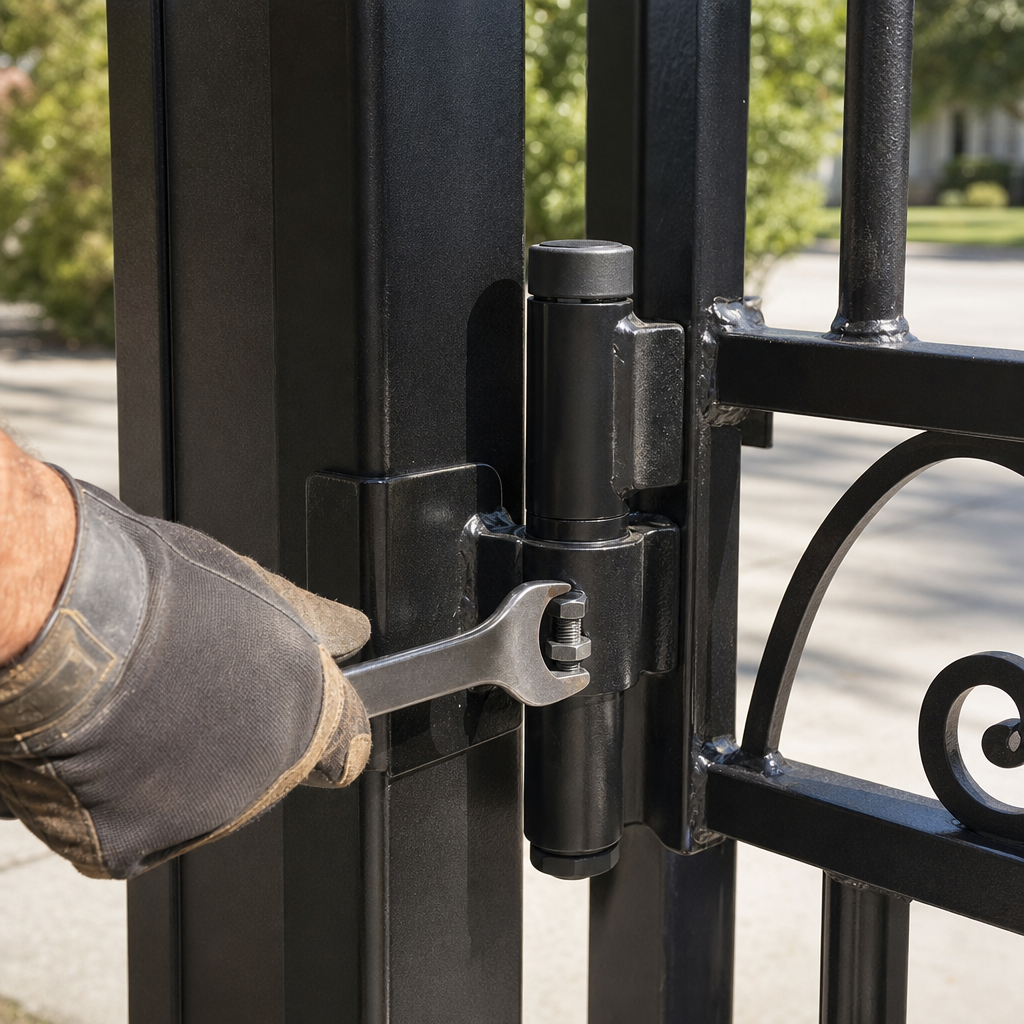
Driveway gate repair frequently requires metal fabrication and welding. When structural components shift, physical resistance builds quickly, stressing operators and safety hardware.
Structural Welding for Damaged Welds and Sagging Frames
Heavy gates place continuous leverage on their pivot points. Operating cycles, combined with environmental factors or contact, can crack mounting welds or bend hinge tabs. Mobile technicians from providers like Ironworks Gate Co. use on-site welding equipment to reinforce fatigued frame corners, repair pickets, and replace failed hinge plates with heavy-duty bearing assemblies.
Leveling Ground Tracks and Replacing V-Groove Rollers
Sliding gates depend on a level, stable track. Repeated traffic can bend track profiles or damage the mounting surface beneath them, causing the gate to derail or bind. Technicians repair or replace damaged track sections and install heavy-duty rollers to ensure smooth travel.
Material and Mechanism Solutions: Iron, Sliding, Swing, and Wood Gates
Different gate styles present distinct mechanical challenges that require tailored repair methods.
Wrought Iron and Steel Gates
Wrought iron and steel provide security and durability but add substantial weight. Maintenance centers on lubricating roller bearings, addressing surface oxidation, and ensuring mounting posts remain vertical.
Sliding vs. Swing Gate Repair Patterns
Sliding gates are sensitive to track debris, roller bearing wear, and guide roller alignment. If a guide roller binds, it scores the frame and introduces friction. Swing gates experience torsional stress at the hinge barrels and drive-arm brackets. Swing gates with solid privacy infill may also experience increased wind resistance, requiring appropriately rated operators to avoid premature mechanical failure.
Parts and Components Repaired and Replaced
Need driveway gate repair?
We’re available now - call for a fast, free estimate.
Common replacement parts used to resolve gate failures across major operational assemblies include:
- Drive Assemblies: Drive chains, master links, sprockets, drive belts, and reduction gears.
- Structural Hardware: Bearing hinges, barrel hinges, cantilever roller sets, guide rollers, and ground track.
- Electrical and Control Parts: Control circuit boards, radio receivers, loop detectors, limit switches, solar charge controllers, and backup batteries.
- Access Controls: Keypads, wireless remotes, telephone entry systems, cellular intercoms, and magnetic locks.
Gate Operator Brands and Systems Serviced
Technicians service a wide variety of residential and commercial gate operator brands and systems.
LiftMaster and Elite Operators
As observed by Ironworks Gate Co., repairs on modern and legacy LiftMaster and Elite units commonly include replacing logic boards, resetting limit switches, and troubleshooting access networks.
DoorKing (DKS) Systems
DoorKing slide and swing operators are common across residential and commercial properties. Typical repairs include motor brush maintenance, clutch adjustments, and relay board diagnostics.
Viking Access, Nice Apollo, Eagle, and BFT Operators
Technicians work across DC, solar, mechanical, and hydraulic operators from manufacturers such as Viking, Nice Apollo, Eagle, and BFT, performing calibrations to keep safety reverses functioning properly.
What Does Driveway Gate Repair Cost?
A typical driveway gate repair may cost about $200 to $1,500, depending on the fault and local pricing.
Driveway Gate Repair FAQ
How much does driveway gate repair cost?
A typical driveway gate repair may cost about $200 to $1,500, depending on the fault and local pricing.
Why won’t my automatic driveway gate open or close?
Common causes include misaligned optical safety sensors, a tripped electrical breaker, dead remote batteries, or physical binding along the track or hinges. If the motor hums without moving, disengaging the manual release helps determine whether the gate glides freely by hand, isolating whether the issue is mechanical or electrical.
How do you fix an off-track sliding driveway gate?
Disconnect power to the operator immediately and keep all people clear of the gate. Avoid applying force or using improvised lifting methods, as heavy gate panels can cause serious injury if dropped. Contact a qualified technician to inspect and repair the track, rollers, guides, and alignment safely.
Can an electric gate opener be repaired or does it need replacement?
Most openers can be repaired if the main gearbox and structural housing remain intact. Technicians can replace components like starting capacitors, circuit boards, drive sprockets, limit switches, and radio receivers. Replacement is typically recommended when the motor windings burn out, internal gears strip beyond repair, or the unit is an obsolete model lacking modern entrapment safety features.
How often should a residential driveway gate be serviced?
Gate systems benefit from regular professional maintenance and periodic safety inspections from experienced specialists like Ironworks Gate Co. Service typically includes inspecting and lubricating moving hardware, testing auto-reverse safety sensors, checking chain or belt tension, and inspecting electrical connections for wear or damage.
What are the common causes of electric gate sensor failure?
Safety photo-eyes and edge sensors commonly fail due to physical misalignment, dirt or debris coating optical lenses, direct low-angle sun glare blinding the receiver, or corrosion in the low-voltage signal wiring.
Need driveway gate repair?
We’re available now - call for a fast, free estimate.
Sources
- New Safety Standard for Automatic Security Gates Helps … – cpsc.gov (2000)
- [PDF] Investigation Guideline Product: Automatic Gate Operators Appendix – reginfo.gov (2000)
- Safety Hazards Involving Manual Sliding and Swinging … – cpsc.gov
- The Serious Dangers of Automatic Gates – hg.org
Related reading: Automatic Gate Troubleshooting | Call Now-10% Off | Same-Day Service | Free Estimate
Related reading: Electric Gate Troubleshooting – 10% Off & Free Estimate – Same-Day Service
Related reading: Gate Keypad Not Working | Call Now-10% Off | Same-Day Service | Free Estimate
Frequently Asked Questions
Can sagging driveway gate posts or cracked welds be repaired on-site without removing the entire gate?
Yes, skilled technicians can perform on-site structural welding and hinge rebuilds to re-align sagging frames and reinforce cracked posts. Ironworks Gate Co. brings over 40 years of specialized metalwork and mobile welding capabilities directly to your property, restoring structural balance without requiring full gate removal.
What should I do if an electric driveway gate gets stuck and traps my vehicle inside?
First, locate the manual release lever or panel on your motor housing and use the release key to disengage the drive mechanism so you can safely move the panel by hand. Afterwards, contact Ironworks Gate Co. 24/7 to connect with a live dispatcher and book a same-day emergency driveway gate repair.
How do I know whether my gate operator needs a component repair or a full replacement?
Component-level repair is typically best when the motor housing and gearbox are intact, allowing technicians to replace isolated parts like capacitors or relay boards. If motor windings burn out or internal gears crack, Ironworks Gate Co. offers a free on-site driveway gate assessment with clear pricing to determine the most cost-effective solution.
About the author
 |
Sarah Miller Sarah Miller is a specialized content creator with a focus on property security and access control systems. Drawing from her five years of experience writing for the home services sector, she provides homeowners and property managers with clear, actionable insights on gate maintenance, repair processes, and transparent pricing. Sarah holds a Bachelor of Arts in Communications from California State University, Fullerton. |
Gate not opening, off track, or opener dead?
We’re available now - call for a fast, free estimate.
Call Now - Free Estimate