
Quick Summary
An electric gate not closing fully compromises perimeter security and poses serious safety risks, usually caused by misaligned photo-eyes, physical track obstructions, post sag, or miscalibrated limit switches. The specialists at Ironworks Gate Co. highlight that while cleaning sensors or clearing debris can resolve minor stops, mechanical drag and internal control board issues require professional intervention to prevent motor burnout. This guide helps property owners perform safe visual diagnostics to identify the root failure and know when to schedule professional same-day operator repair or an on-site assessment.
Fix Electric Gate Not Closing Fully: Troubleshooting and Safety Guide
Dealing with an electric gate not closing fully creates an immediate security headache and a serious safety concern. Motorized gates exert substantial mechanical force. According to the U.S. Consumer Product Safety Commission (CPSC), automatic gates can cause severe injury or death through entrapment during opening or closing cycles (the agency recorded 32 deaths related to automatic gates between 1985 and 2001, including 20 children). Note that available research does not establish a percentage of gates that fail to close fully or prove that incomplete closing causes a specific percentage of injuries. When an automated system stops short or reverses unexpectedly, possible causes include a built-in safety response signaling an obstruction, an alignment fault, or physical resistance along the gate path.[1]
As specialists at Ironworks Gate Co. point out, while many homeowners assume dirty photo-eyes are the only culprit, mechanical drag, sagging hinge posts, and worn drive hardware are other possible causes that can trigger an operator safety stop. This guide provides general troubleshooting guidance, but always consult your specific manufacturer manual for your model. Safe, non-invasive visual inspections are outlined below, along with clear signs that call for a qualified gate technician.
What to Check Before You Begin
Before testing components, make sure everyone, including pets and children, stays well clear of the gate path. The CPSC described a safety standard requiring at least two entrapment-prevention mechanisms, including a reversing sensing device and a secondary device such as an electric eye or safety edge.[2]
Warning: Do not manually move or service a gate unless the operator manual permits it and the gate is secured against unexpected movement. Refer structural, electrical, and safety-device faults to a qualified technician.
You can carry out basic visual inspections with just a flashlight, a clean microfiber cloth, and a level. However, you should never attempt to force an operator past mechanical resistance, alter internal factory force dials, bypass safety circuits, or open high-voltage control boxes.
Step 1: Inspect and Clean the Photo-Eye Safety Sensors
As general guidance, optical safety sensors on many systems cast an invisible infrared beam across the driveway. If that beam is broken, blocked, or misaligned, the controller may interpret it as an obstruction and refuse to shut. Always consult your specific manufacturer manual for sensor diagnostics and component replacement, as indicator meanings and procedures vary by manufacturer.
- Check the indicator LEDs: Look closely at the small diagnostic lights on the sensor housings near ground level. On many systems, a solid light indicates an aligned signal, while a flickering, dim, or unlit LED points to optical misalignment or power loss. Note that indicator meanings vary by manufacturer; consult your specific manual.
- Clean the lenses: Cobwebs, dried water spots, road grime, and nesting insects can block the optical lenses. Wipe both covers clean with a soft, dry microfiber cloth. Avoid harsh chemical cleaners that can fog plastic lenses.
- Realign the brackets: Sunlight glare, garden trimmings, or slight bumps can knock sensor brackets out of alignment. If permitted by your manual, loosen the mounting bracket slightly, align the lenses directly at each other according to manufacturer instructions, and tighten the hardware down.
If the LEDs remain unlit after cleaning and manual alignment, the issue may involve wiring or a failed sensor board; refer sensor diagnostics and component replacement to a qualified technician or the specific manufacturer manual.
Step 2: Clear Track Debris and Inspect Rollers (Sliding Gates)
Need electric gate not closing fully?
We’re available now - call for a fast, free estimate.
For sliding driveway gates, possible causes of short travel include track obstructions. When small stones, packed soil, or leaves gather in the V-track or ground channel, the bottom rollers must climb over the debris. This sudden spike in rolling resistance can trip the operator’s internal current sensor, causing the motor to stop or back off.
- Sweep the track clean: Use a stiff-bristled broom or scraper to clear packed mud, gravel, and twigs from the entire length of the ground track.
- Check for bent or warped track: Look down the line of the track at ground level to confirm it has not buckled or lifted due to tree roots or heavy vehicle traffic.
- Examine the wheels: Look for cracked roller bearings, flat spots on steel wheels, or metal shavings around the axle pins. If the wheels wobble or grind, refer component replacement to a qualified technician or the specific manufacturer manual.
Step 3: Check for Mechanical Drag, Post Sag, and Hinge Binding
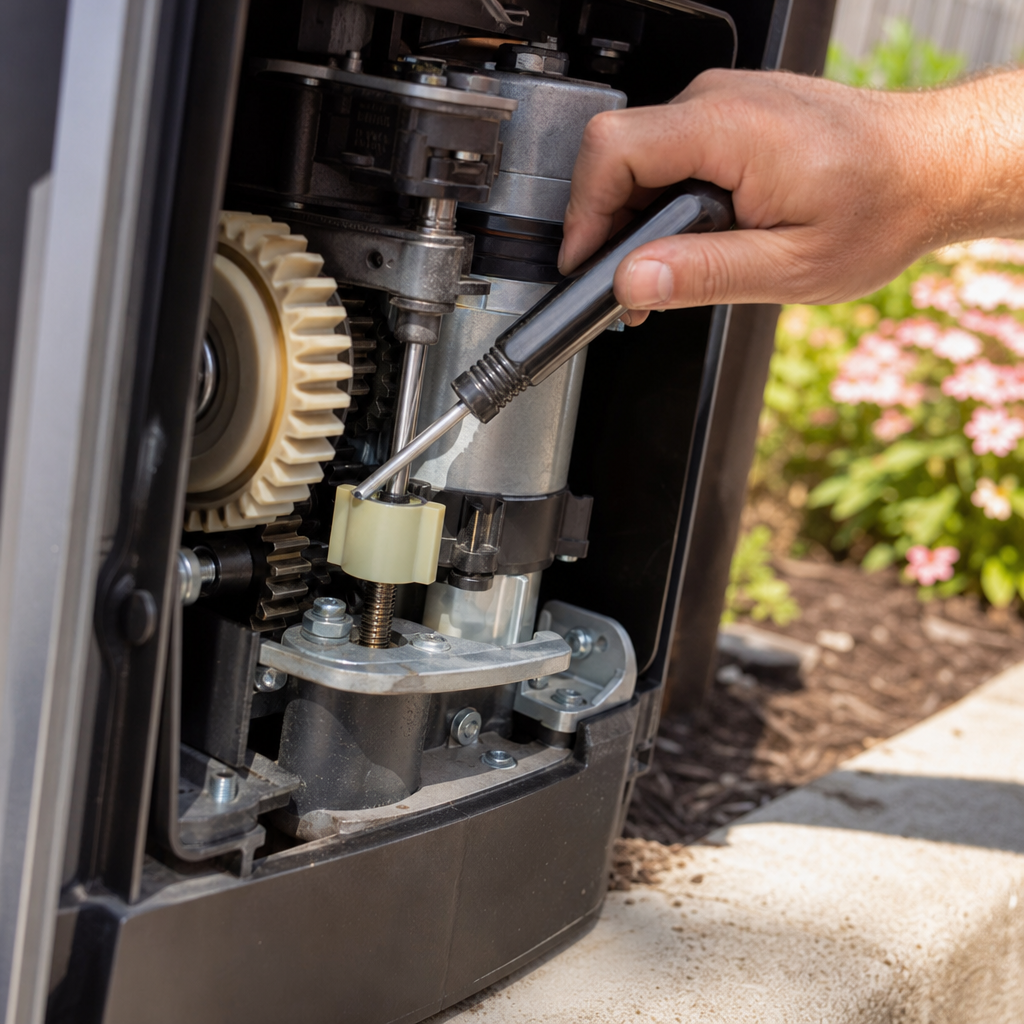
According to the technicians at Ironworks Gate Co., on heavy swing and slide gates, physical drag is another possible cause of travel failure. Over years of seasonal ground expansion, strong winds, and daily wear, support posts can lean out of plumb. Even slight post sag at the hinge transfers downward torque to the gate frame, causing swing gates to drag against driveway concrete or bind inside the latch receiver.[3]
- Look for ground scrape marks: Check the asphalt or concrete beneath the swing path for scrape lines or friction grooves.
- Inspect hinges and pivot points: Worn bronze bushings, ungreased ball-bearing hinges, or rusted pivot pins create heavy friction that can stop a gate halfway through its stroke.
- Test manual movement safely: Only attempt this if permitted by your operator manual and the gate is secured against unexpected movement. Disengage the operator release clutch according to the manual and gently move the gate by hand. The gate should move smoothly across its travel path without sticking, catching, or dropping.
Never increase the motor torque or force limits to overpower a sagging gate frame. Forcing a dragging gate burns out drive gears and creates a severe safety hazard. Structural, electrical, and safety-device faults require a qualified technician.
Step 4: Check Limit Switch Calibration
As general guidance, limit switches tell your gate operator when the gate has reached full open and full close positions. Depending on your operator brand, these limits are managed mechanically through rotating cams and microswitches, or digitally through an electronic control board. Always consult your specific manufacturer manual for limit adjustment and component replacement.
Over time, vibration, loose drive chains, or worn limit components can cause travel boundaries to drift out of calibration. If the operator registers its programmed endpoint before the gate physically reaches the catch post, it shuts off power early.
- Consult your operator manual: Travel limit reset procedures differ across screw-drive, articulating-arm, and slide-gate operators. Always follow the specific sequence provided by the manufacturer.
- Inspect mechanical limit nuts or cams: For chain-driven slide operators, verify whether limit switch activators on the drive shaft have slipped out of position, referring to your manual.
- Reset digital travel limits: On digital operators, resetting limits involves following the specific manufacturer manual sequence for learning travel limits.
If limit adjustments do not hold, refer limit switch diagnostics and component replacement to a qualified technician or the specific manufacturer manual.
Step 5: Power Supply and Control Board Resets
Need electric gate not closing fully?
We’re available now - call for a fast, free estimate.
As general guidance, power surges, nearby lightning strikes, or temporary utility brownouts can cause gate control logic to hang. Always consult your specific manufacturer manual before resetting electronics or disconnecting batteries.
- Disconnect power: Switch off the dedicated breaker or master power switch feeding the gate system according to manufacturer instructions.
- Check battery backup: If your system features battery backup, consult your specific manufacturer manual for battery disconnection procedures to ensure the control board completely discharges.
- Restore power and run a test cycle: Reconnect power and run the gate through a test cycle via your remote or keypad, watching for smooth travel.
Do not probe live electrical terminals or open high-voltage transformer boxes without proper electrical training. Refer structural, electrical, and safety-device faults to a qualified technician.
What Does Electric Gate Repair Cost?
Repair prices vary widely by fault, equipment, location, and labor. The available research does not support a reliable neutral price range.
Frequently Asked Questions
Why does my electric gate stop before closing completely?
As noted by Ironworks Gate Co., possible causes include obstructed or misaligned safety photo-eyes, physical debris wedged in the track, worn hinge bearings causing mechanical drag, or misadjusted limit switches that cut power before the gate reaches the stop post.
How do I reset the limit switches on an electric driveway gate?
Resetting limits depends on your operator. Mechanical units use adjustable threaded limit nuts or rotating cams next to internal microswitches. Digital units use set buttons on the main circuit board to record open and close positions during a setup cycle. Always refer to the specific manufacturer manual for your model’s exact reset procedure.
Are optical safety sensors causing my automatic gate to stay open?
On many systems, if optical safety eyes detect dirt, moisture, spiderwebs, or bright sun glare, or if the brackets have been knocked out of line, the operator assumes an object is blocking the opening and keeps the gate open as a built-in safety safeguard. Indicator meanings and behaviors vary by manufacturer, so consult your manual.
Can cold weather or track debris prevent an electric gate from shutting fully?
Possible causes include cold temperatures thickening gearbox grease and increasing drag on motor parts, ground frost or heavy rain shifting soil and lifting tracks, and compacted gravel, mud, or ice along the ground rail stopping a sliding gate mid-travel.
When should I call a professional gate technician instead of fixing it myself?
You can perform basic visual checks and cleaning if permitted by your manual. However, refer structural, electrical, and safety-device faults to a qualified technician, including sagging posts, seized hinges, grinding drive gears, internal circuit board faults, welding repairs, and high-voltage electrical diagnostics.
Need electric gate not closing fully?
We’re available now - call for a fast, free estimate.
Sources
- New Safety Standard for Automatic Security Gates Helps … – cpsc.gov (2001)
- [PDF] Investigation Guideline Product: Automatic Gate Operators Appendix – reginfo.gov (2000)
- Independent review of train operators' revenue protection … – orr.gov.uk (2023)
Related reading: How to Fix Automatic Gate – Call Now-10% Off – Same-Day Service – Free Estimate
Related reading: Ironworks Gate Co Warranty | Call Now-10% Off | Same-Day Service | Free Estimate
Related reading: How to Open Electric Gate Without Power | Call Now-10% Off | Same-Day Service | Free Estimate
Frequently Asked Questions
What should I do if my electric gate closes almost all the way and then immediately reverses?
This typically occurs when the operator detects sudden resistance near the end of its travel from a misaligned catch post, worn rollers, or drifting travel limits, which triggers an automatic safety reversal. Avoid forcing the mechanism or adjusting internal force dials, as this can damage the drive motor. If clearing the track does not solve the rebound, contact Ironworks Gate Co. to schedule a professional assessment of your limit switches and physical alignment.
Can I increase the motor force setting to push a dragging electric gate closed?
You should never turn up the operator force dials to overcome a sagging post or dragging gate frame. Overpowering physical resistance can burn out internal gears and create severe entrapment hazards that violate safety standards. Structural drag requires physical correction, such as hinge replacement or post realignment, by a qualified technician from Ironworks Gate Co.
How can I safely test whether my gate closing issue is mechanical or electrical?
Consult your operator manual to safely disengage the manual release clutch, then guide the gate along its path by hand. If the gate moves smoothly without friction or scraping, the failure is likely electrical, involving limit switches, safety photo-eyes, or control boards. If you feel grinding, sticking, or heavy resistance during manual movement, contact Ironworks Gate Co. for same-day mechanical gate repair.
About the author
 |
Sarah Miller Sarah Miller is a specialized content creator with a focus on property security and access control systems. Drawing from her five years of experience writing for the home services sector, she provides homeowners and property managers with clear, actionable insights on gate maintenance, repair processes, and transparent pricing. Sarah holds a Bachelor of Arts in Communications from California State University, Fullerton. |
Gate not opening, off track, or opener dead?
We’re available now - call for a fast, free estimate.
Call Now - Free Estimate