
Last updated August 25, 2026
Free on-site gate assessment - hinges, posts, and your LiftMaster or Nice gate operator checked before anything is quoted
The assessment is free and the quote is the invoice.
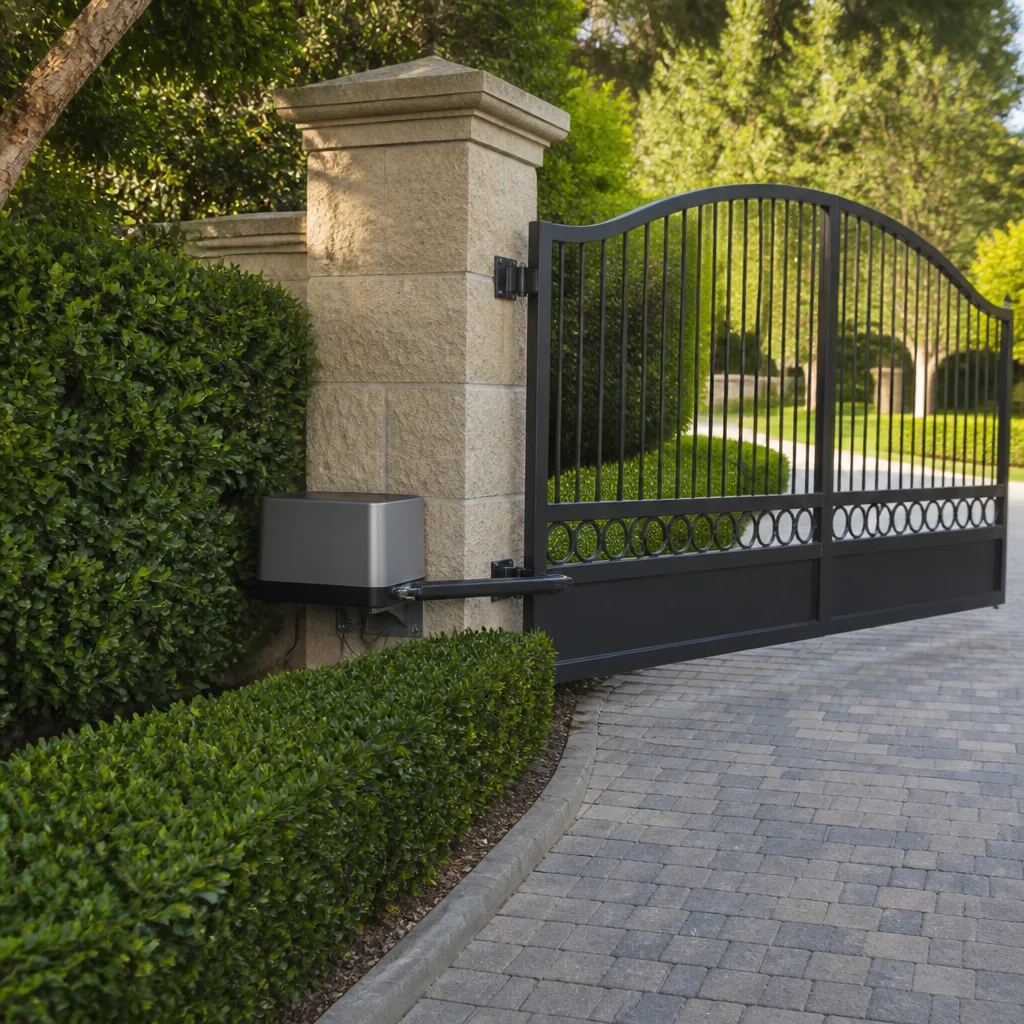
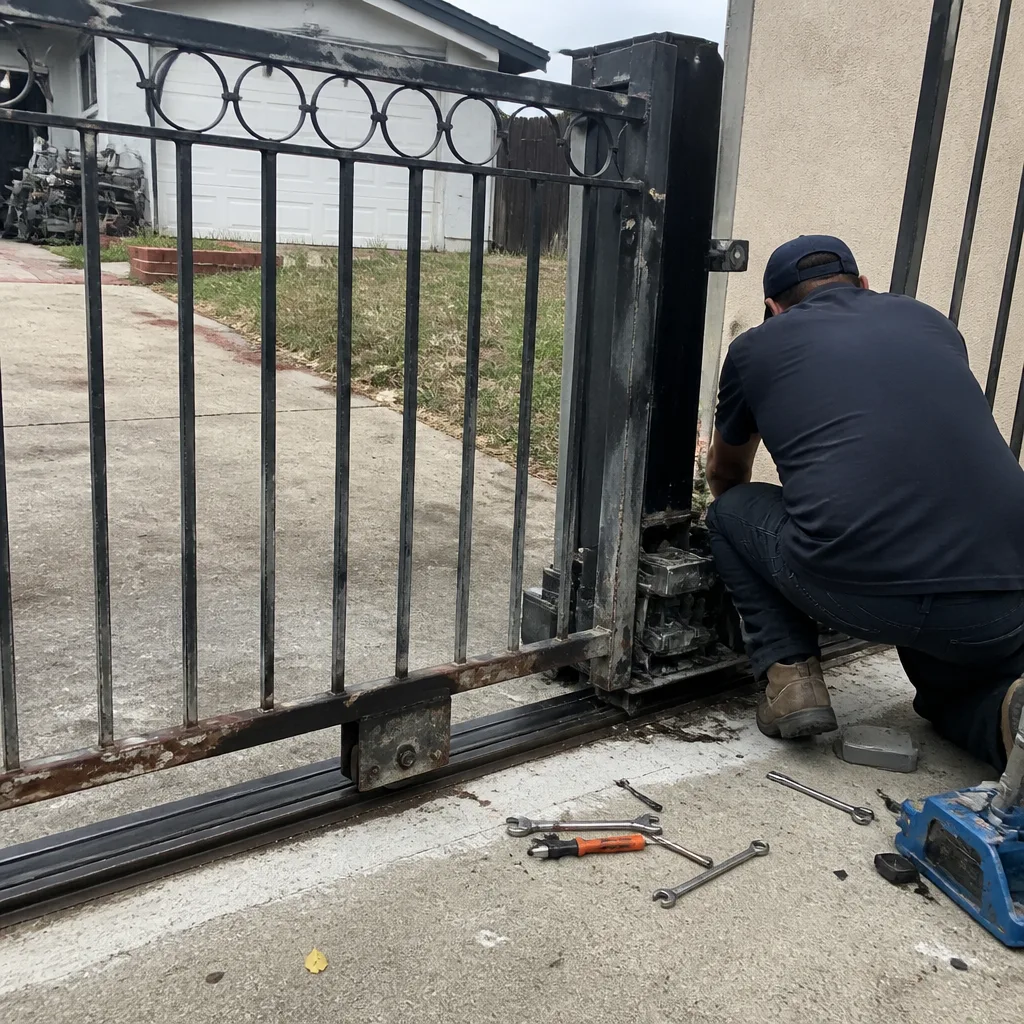 Before
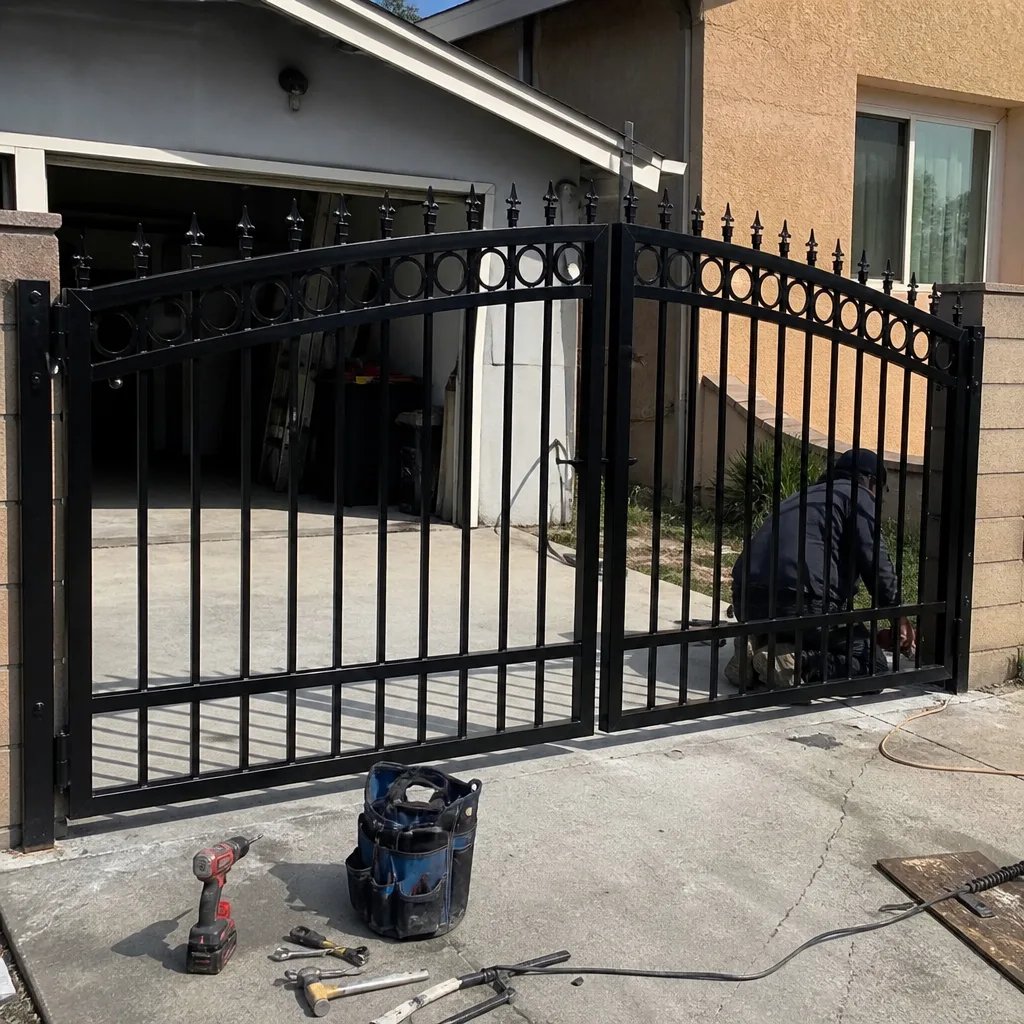 After
After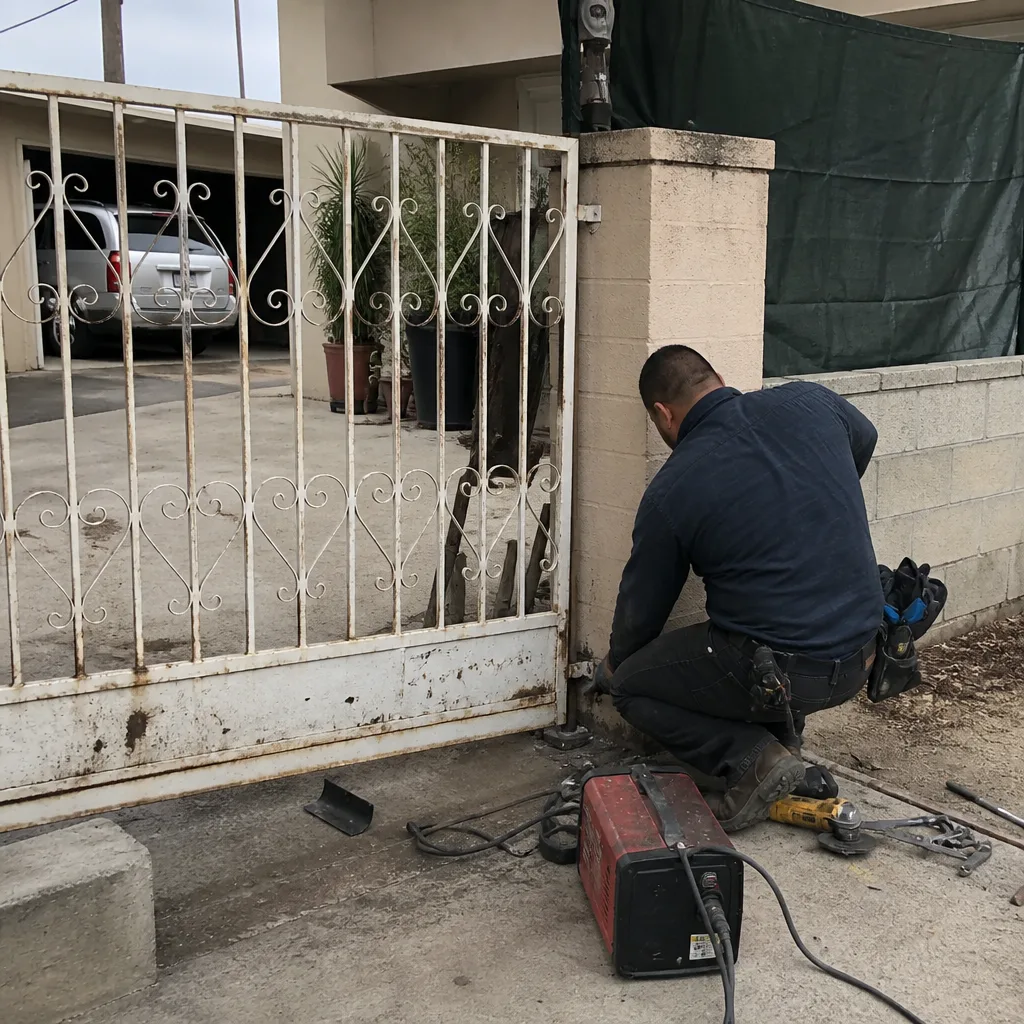 Before
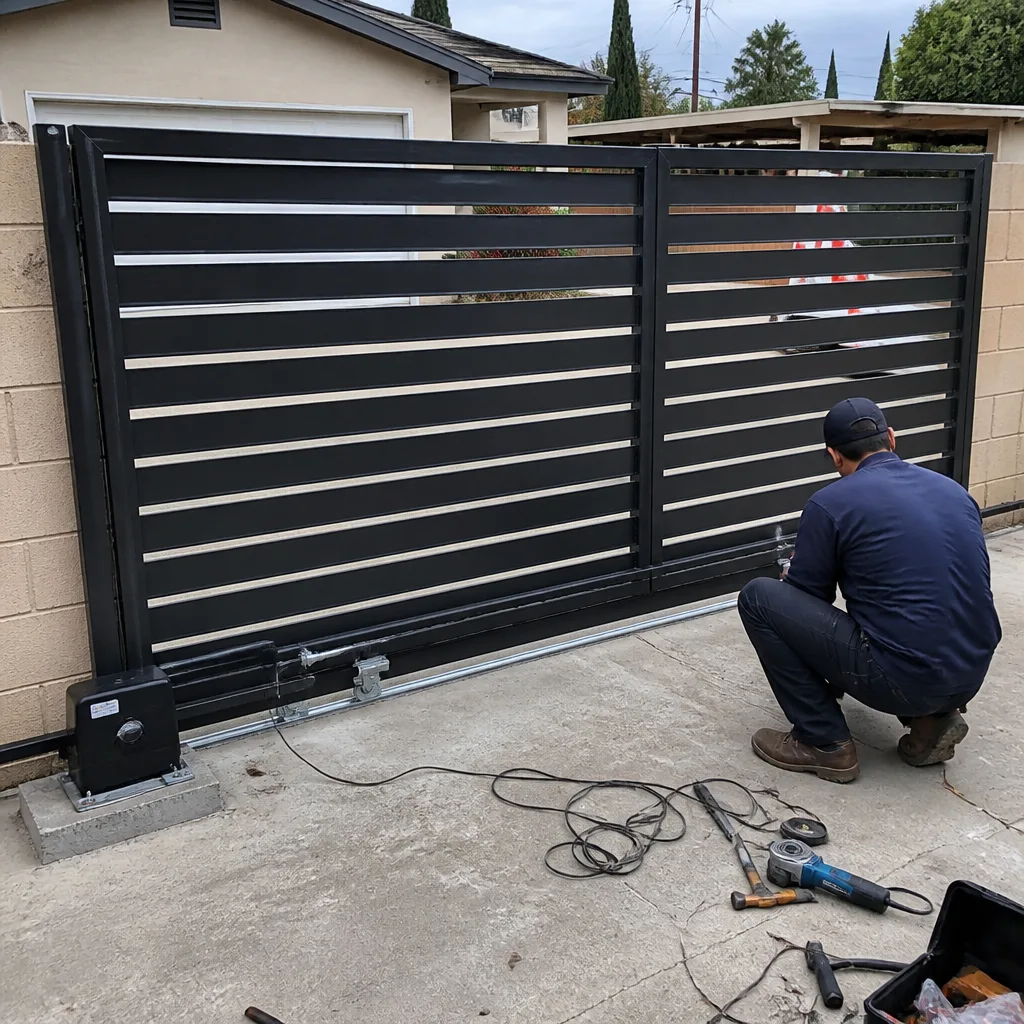 After
After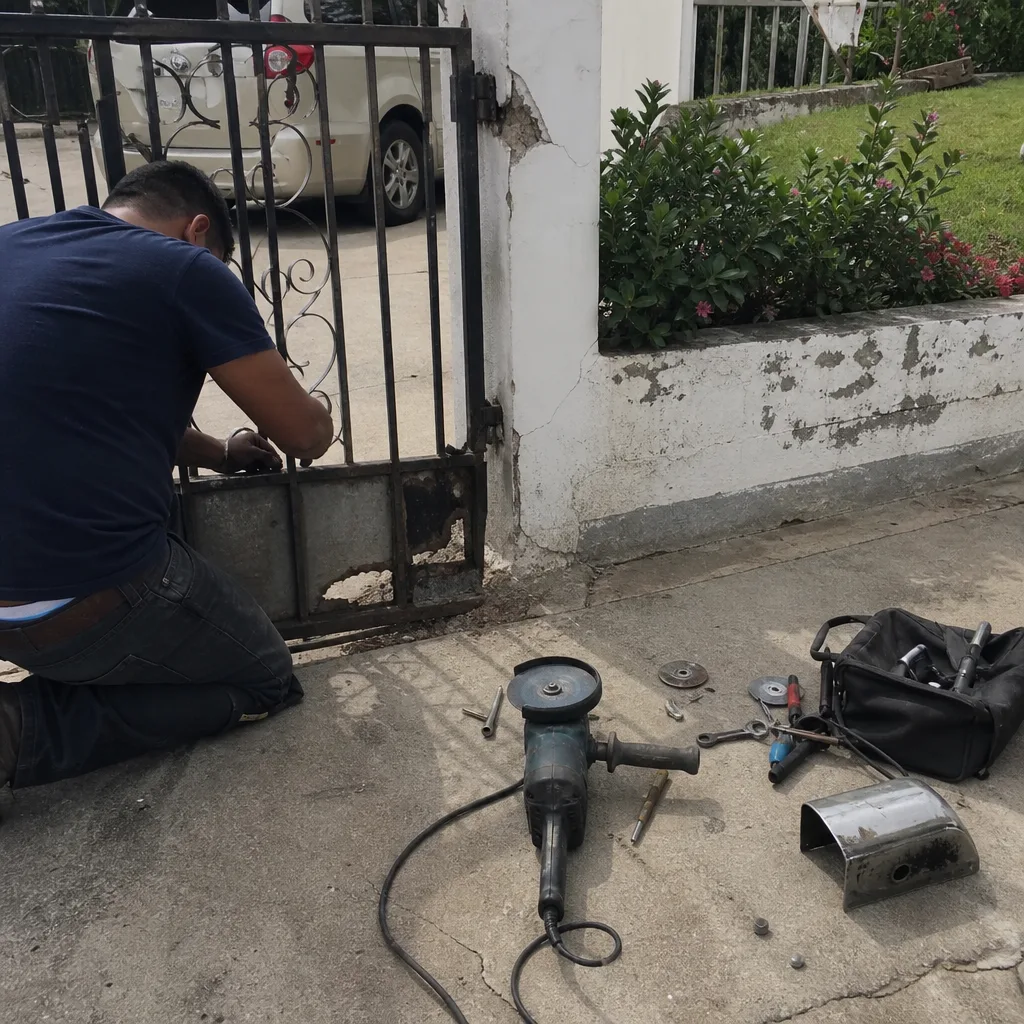 Before
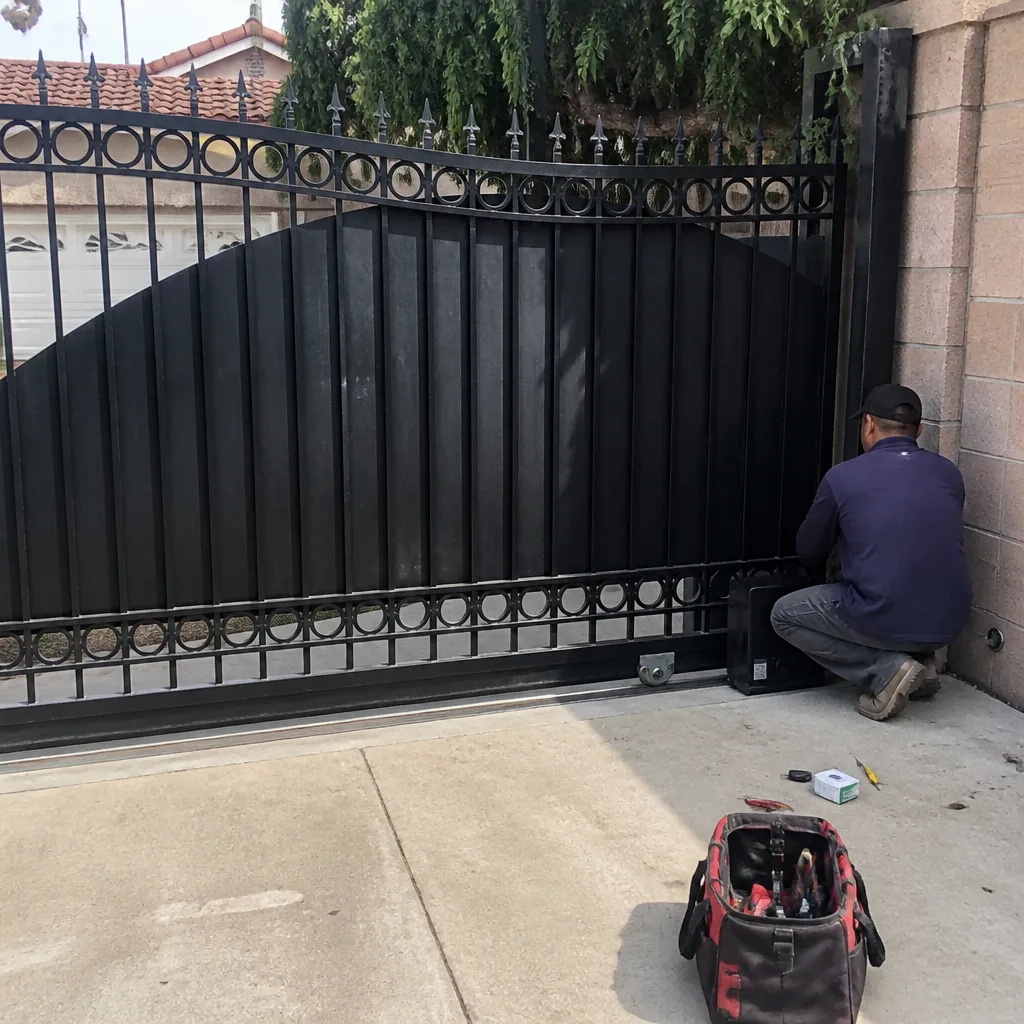 After
AfterDIY vs Professional Gate Repair: The Bell Gardens Homeowner’s Decision Guide
Most gate failures in Bell Gardens don’t happen the way homeowners expect. The gate doesn’t collapse, the motor doesn’t explode, and there’s rarely a single dramatic moment you can point to. Instead, a hinge wears thin over five years of opening and closing on a slightly settled post. A capacitor weakens through hundreds of hot summer cycles. A wheel bearing grinds itself down until the gate rolls like it’s pushing through gravel. By the time you notice, the damage is done. This guide walks you through which gate repairs make sense to handle yourself, which ones will cost you more if you try, and how to tell the difference before you make the call. We’ve spent 42 years watching Bell Gardens gates fail, and we know where homeowners save money and where they bleed it.
Quick Answer
Most Bell Gardens homeowners should handle only cosmetic and surface maintenance themselves: cleaning tracks, tightening visible bolts, lubricating hinges, and testing sensors. Anything involving gate springs, motors, circuit boards, welding, or a gate that has come off its track calls for a professional. The reason is simple: a gate that weighs 400 to 1,200 pounds carries enough stored energy to break bones or worse when a tensioned part lets go. For the average single-family driveway gate in Bell Gardens, expect a professional repair to run $180 to $450 for mechanical work and $250 to $700 when a motor or control board is involved.
Table of Contents
- What You’re Actually Dealing With: Gate Anatomy for Bell Gardens Homeowners
- What’s Safe to DIY: The Short, Honest List
- What You Should Never DIY: The List That Keeps You Out of the ER
- DIY vs Professional: What It Actually Costs in Bell Gardens
- Why Bell Gardens Gates Fail the Way They Do
- Common Mistakes to Avoid
- When to Call a Professional
- Frequently Asked Questions
What You’re Actually Dealing With: Gate Anatomy for Bell Gardens Homeowners
Before deciding whether to pick up a wrench or pick up the phone, it helps to know what’s behind that panel of iron or steel. A driveway gate is not a door. It’s a mechanical system with five distinct components, and each one fails differently.
The frame and pickets carry the weight and take the weather. In Bell Gardens, that means dry heat, occasional heavy rain, and a steady dose of airborne grit from the 710 and 5 freeways. Powder-coated steel and wrought iron hold up well here, but any scratch that reaches bare metal will rust within a season or two.
The hinges and posts do more work than anything else on the assembly. A sliding gate puts lateral load on its rollers and track; a swing gate hangs its entire weight on two or three hinge points. When a post shifts even half an inch, the gate starts to sag, bind, or scrape.
The motor and operator arm do the heavy lifting on an automated gate. These are 1/2-horsepower to 1-horsepower units in most Bell Gardens homes, and they are not designed to force a gate that’s already binding. When the gate starts to drag, the motor works harder, draws more current, and burns out capacitors or gears. That’s the failure sequence we see most often on service calls.
The control board and sensors are the brains. Photo-eye sensors, loop detectors, keypads, and remotes all feed into a circuit board the size of a hardcover book. A single shorted wire or a failed relay can mimic a dozen other problems, which is why guessing at electrical fixes usually wastes time and money.
Finally, the wheels, rollers, and track on a slide gate take the same abuse as a car’s suspension. Bell Gardens soil shifts with moisture changes, so track sections settle unevenly. That’s why a slide gate that ran fine in March can bind in July.
What’s Safe to DIY: The Short, Honest List
There are a handful of gate maintenance and repair tasks a careful Bell Gardens homeowner can handle without special tools or risk. None of them involve springs, tension, electricity, or lifting the gate off its mounts. Here’s the complete list, and it’s shorter than most people expect.
1. Cleaning and lubricating the track
A slide gate’s track collects dust, leaves, and grit. Every few months, clear the track with a stiff brush or leaf blower, then apply a silicone spray or white lithium grease to the wheels and roller brackets. Do not use WD-40 as a long-term lubricant; it cleans but doesn’t stay. This takes 20 minutes and costs under $10 in materials.
2. Tightening visible hardware
Walk the gate with a socket set and check every bolt you can see: hinge bolts, bracket bolts, operator arm connections, wheel axle nuts. Vibration loosens hardware over time. If a bolt spins without tightening, the hole or insert is stripped, and that’s a call to us, not a bigger wrench.
3. Cleaning photo-eye sensors
The small round sensors near the bottom of the gate opening get dusty and spider-webbed. Wipe them with a dry cloth and make sure nothing blocks their line of sight. If the gate still reverses or refuses to close after cleaning and checking alignment, the issue is likely the wiring or the board.
4. Testing the auto-reverse and obstacle detection functions
Every month, place a roll of paper towels in the gate’s path and try to close it. The gate should stop and reverse without crushing the roll. This is a safety check, not a repair, but it tells you whether the force settings and sensors are still calibrated. If the gate hits the roll and keeps pushing, disable the opener and call a professional immediately.
5. Painting and rust touch-up
Surface rust on a steel gate is a DIY job with the right prep: wire-brush the rust to bare metal, wipe with mineral spirits, apply a rust-inhibiting primer, then a topcoat made for exterior metal. In Bell Gardens, do this before the rainy season; once moisture gets into the rust pocket, it spreads under the paint.
That’s the list. Everything else on a gate involves weight, tension, electricity, or structural alignment, and that’s where home tools stop being useful and start being dangerous.
What You Should Never DIY: The List That Keeps You Out of the ER
Some gate components fail in ways that punish a homeowner who tries to fix them. We do not say this to protect our business; we say it because we have repaired the gates and the mistakes.
1. Torsion springs and tension springs
If your gate uses a torsion spring to offset its weight, that spring is under enough tension to break a hand, arm, or face if it releases while you’re working on it. There is no safe way to release that tension without the right winding bars, a solid anchor, and the physical position of someone who has done it hundreds of times. A broken torsion spring on a Bell Gardens driveway gate is a same-day professional repair, not a weekend project.
2. Any work on a gate that has come off its track or fallen from its hinges
A gate that has jumped its track weighs hundreds of pounds and is resting on its own damaged hardware. Jacking it up, prying it, or winching it without understanding where the load is can turn a $300 repair into a gate replacement and a hospital visit.
3. Control board diagnosis and replacement
When the gate won’t respond to a remote, or opens but doesn’t close, or beeps without moving, the board is one of at least six possible causes. We service nine opener brands, including Ghost Controls, DoorKing, and Elite, and even across that narrow product range, each board has its own failure modes. Swapping boards without diagnosing the underlying short or load problem means you’ll burn out the new board the same way.
4. Welding and structural repair
Cracked welds on an iron gate look like a simple bead run. They are not. The crack usually indicates a stress point, and welding over it without addressing the frame alignment or adding a gusset means it cracks again next season. Arc welding on a gate that’s still mounted also risks frying the opener’s board through the ground path.
5. Any fix that requires bypassing a safety feature
Disconnecting the auto-reverse, zip-tying a sensor out of the way, or holding down the close button to force the gate shut are all ways people make a gate work today and create a hazard for tomorrow. These are not repairs. They’re deferred injuries.
DIY vs Professional: What It Actually Costs in Bell Gardens
The math is not what most homeowners assume. DIY gate repair looks cheaper on the first trip to the hardware store, but the full picture usually tells a different story. Here’s a line-by-line comparison based on what we see across Bell Gardens repair calls.
Typical repair costs: DIY materials vs professional service
| Repair | DIY Materials Cost | Professional Cost in Bell Gardens | Notes |
|---|---|---|---|
| Track cleaning and lubrication | $8 to $20 | Usually included with service call | Safe DIY. Do this yourself. |
| Hinge replacement on swing gate | $30 to $90 per hinge | $220 to $550 installed | Requires supporting the gate weight. Professional job. |
| Wheel or roller replacement on slide gate | $25 to $70 per wheel | $200 to $480 including alignment | Alignment is the skill. Wrong install wears new wheels fast. |
| Capacitor replacement in operator | $15 to $40 | $180 to $340 | Capacitors store charge even with power off. Not a beginner fix. |
| Control board replacement | $150 to $400 for the board | $400 to $850 installed and programmed | Board must match opener brand and revision. Wrong board = dead board. |
| Full operator replacement | $600 to $1,100 for the unit | $1,500 to $3,200 installed and programmed | Includes removal, mount fabrication, sensor alignment, and programming. |
The hidden costs of DIY are where the comparison breaks down. A homeowner who misdiagnoses a limit-switch problem and replaces a $250 board has now spent $250 plus the $150 to $300 it costs us to install the correct part and fix the original switch. A homeowner who strips a hinge insert while forcing a sagging gate back into position now needs a post repair or a new gate frame.
Professional pricing in Bell Gardens reflects a few things: the cost of carrying insurance and licensing, the cost of training technicians across nine automation brands including Mighty Mule and Ghost Controls, and the cost of standing behind the work with a written guarantee. Our price is quoted and agreed before any work starts, so the invoice matches the estimate. That’s not a marketing line; it’s how we run every job, and it’s why our customers don’t get surprises.
Why Bell Gardens Gates Fail the Way They Do
Gate problems are not the same in every city. Bell Gardens has specific conditions that shape what fails and when, and knowing them helps you make better repair decisions.
Heat and UV exposure. Bell Gardens regularly sees summer temperatures in the high 80s and 90s. Control boards and capacitor banks inside operator housings, especially dark metal ones in direct sun, run hot. Heat accelerates capacitor aging and shortens board life. It also bakes the plastic gears in older operators, which become brittle and strip under load. We replace more capacitors in Bell Gardens between July and October than any other time of year.
Soil movement. Bell Gardens sits on alluvial soil with a high clay content. It swells in wet weather and contracts in dry months. That seasonal movement shifts gate posts enough to change track alignment on slide gates and put bind on swing gate hinges. A gate that scraped the ground in April and then ran fine in June didn’t fix itself; the soil dried out. The post is still moving, and the gate needs a proper alignment adjustment.
Freeway-adjacent dust and grime. Homes in the western part of Bell Gardens, near the 710 and I-5 corridors, get a steady film of brake dust, tire particulates, and exhaust residue. That grime works into wheel bearings, chain drives, and keyboard contacts. Track cleaning matters more here than it does in, say, Downey or Lakewood.
Older housing stock, older gates. Many Bell Gardens homes were built in the 1950s and 1960s, and a lot of the driveway gates and estate gates went in during the 1980s and 1990s. These are well-built iron gates, but their openers are on their second or third decade. Parts for some of those older operators are no longer made, so repair decisions often come down to rebuilt components versus a full operator upgrade.
Property-line tightness. Bell Gardens lots run small, and that means gate posts are often close to the house, a stucco wall, or a neighbor’s fence line. A swing gate that needs to swing outward into a narrow parkway has clearance issues that a simple hinge swap won’t fix. When we assess a gate repair in Bell Gardens, we look at the whole property, not just the damaged part.
Common Mistakes to Avoid
- Ignoring a small noise for months. A gate that squeaks, grinds, or rattles is telling you something. The longer the noise persists, the more expensive the root cause becomes. A squeak fixed with a $10 tube of grease beats a seized bearing replaced for $350.
- Forcing a binding gate with a stronger opener. When a gate drags, some homeowners respond by adding a larger motor or raising the force settings. That overloads the gate frame and the hinges and turns a $200 alignment job into a $1,500 frame repair.
- Replacing the remote battery before checking anything else. A gate that won’t respond is usually not a battery problem. We see homeowners buy new remotes for $60 to $90 only to find out the photo-eye sensor was dirty or the board had a tripped fuse.
- Lubricating a gate without cleaning it first. Grease on top of dirt forms a grinding paste. Clean the track, chain, and hinges before applying anything.
- Using the wrong lubricant on a chain drive. Heavy axle grease attracts grit and loads the chain with debris. Use a chain-specific spray lubricant that penetrates and stays light. Belts and screws need no lubrication at all.
- Making a “temporary” fix permanent. A c-clamp holding a bracket, a wire nut exposed to rain, a 2×4 propping a sagging gate: these are not repairs. They fail at the worst moment, usually when you’re late for work or when the gate is blocking a car in the driveway.
- Assuming a gate problem is the motor’s fault. More than half the operator failures we diagnose in Bell Gardens are actually mechanical problems upstream: a binding hinge, a shifted post, a warped track. Replacing the motor without fixing the mechanical issue kills the new motor.
When to Call a Professional
Call a gate professional when the gate has come off its track, when a spring is broken or visibly loose, when the opener runs but the gate doesn’t move, when the control board shows no power or lights, when a welded joint cracks, or when the gate moves in a way it didn’t a month ago. Those are the signals that the problem is structural, electrical, or tension-related, and none of them get better with patience.
If the gate still opens and closes but you’ve noticed a change in how it sounds or how smoothly it moves, that’s the best time to get an inspection, because the repair is cheapest before the part fails completely. Ironworks Gate Co. offers free estimates in Bell Gardens, with pricing agreed before work begins and a written 90-Day Done Right Promise on every job. Call (213) 497-0081 and a live person answers, day or night.
Frequently Asked Questions
Typical gate repairs in Bell Gardens run $180 to $450 for mechanical issues like hinges, wheels, and track alignment, and $250 to $700 when the operator motor, capacitor, or control board is involved. Full operator replacement ranges from $1,500 to $3,200 installed. Every Ironworks Gate Co. job is quoted and agreed before work starts, with no surprises on the bill. Call (213) 497-0081 for a free estimate.
You can check the simple things first: confirm the opener has power, clean the photo-eye sensors, and test the remote with fresh batteries. If none of those work, do not open the operator housing and start swapping parts. Capacitors inside the unit hold a charge even when the power is off, and misdiagnosing the board can ruin a new part. The safer move is a professional diagnosis, which costs less than a wrong guess.
A Bell Gardens homeowner can safely clean and lubricate the track, tighten visible bolts, clean the photo-eye sensors, test the auto-reverse function, and touch up surface rust. Those tasks require no special tools and do not involve stored energy or electrical exposure. Everything else is a professional job.
Bell Gardens clay soil expands when wet and contracts when dry. In winter, the ground under the gate posts can lift enough to change track alignment or shift a swing gate’s hinge geometry. The scrape stops when the soil dries, but the post has still shifted. A proper alignment adjustment fixes the seasonal bind.
We carry parts, training, and service experience on nine major automation brands, including LiftMaster, FAAC, BFT, Linear, Viking, Ghost Controls, DoorKing, Elite, and Mighty Mule. Whatever is on your driveway, our technicians have worked on it before.
Yes. Every Ironworks Gate Co. job carries our written 90-Day Done Right Promise: if it is not right, we come back and make it right, no paperwork and no arguing. We also offer a free second opinion on any written estimate from another company, and a $89 seasonal tune-up if you want the whole system checked before summer. Call (213) 497-0081 to schedule.
The Bottom Line
Most gate repairs in Bell Gardens are not DIY jobs, and the line isn’t about skill; it’s about weight and voltage. Clean the track, tighten the bolts, and touch up the paint yourself. Leave springs, motors, boards, welding, and anything off-track to someone who does it every day. The money saved on the simple tasks is real; the money lost on a botched tension spring or a misdiagnosed board is much bigger than any professional invoice you’ll see. We’ve spent 42 years on Bell Gardens driveways, and the gates that last are the ones maintained early and repaired correctly the first time. That’s what we do, and we back it in writing.
Written by Victor Salinas, Owner at Ironworks Gate Co., serving Bell Gardens since 2013.