
Last updated August 25, 2026
Free on-site gate assessment - hinges, posts, and your LiftMaster or Nice gate operator checked before anything is quoted
The assessment is free and the quote is the invoice.
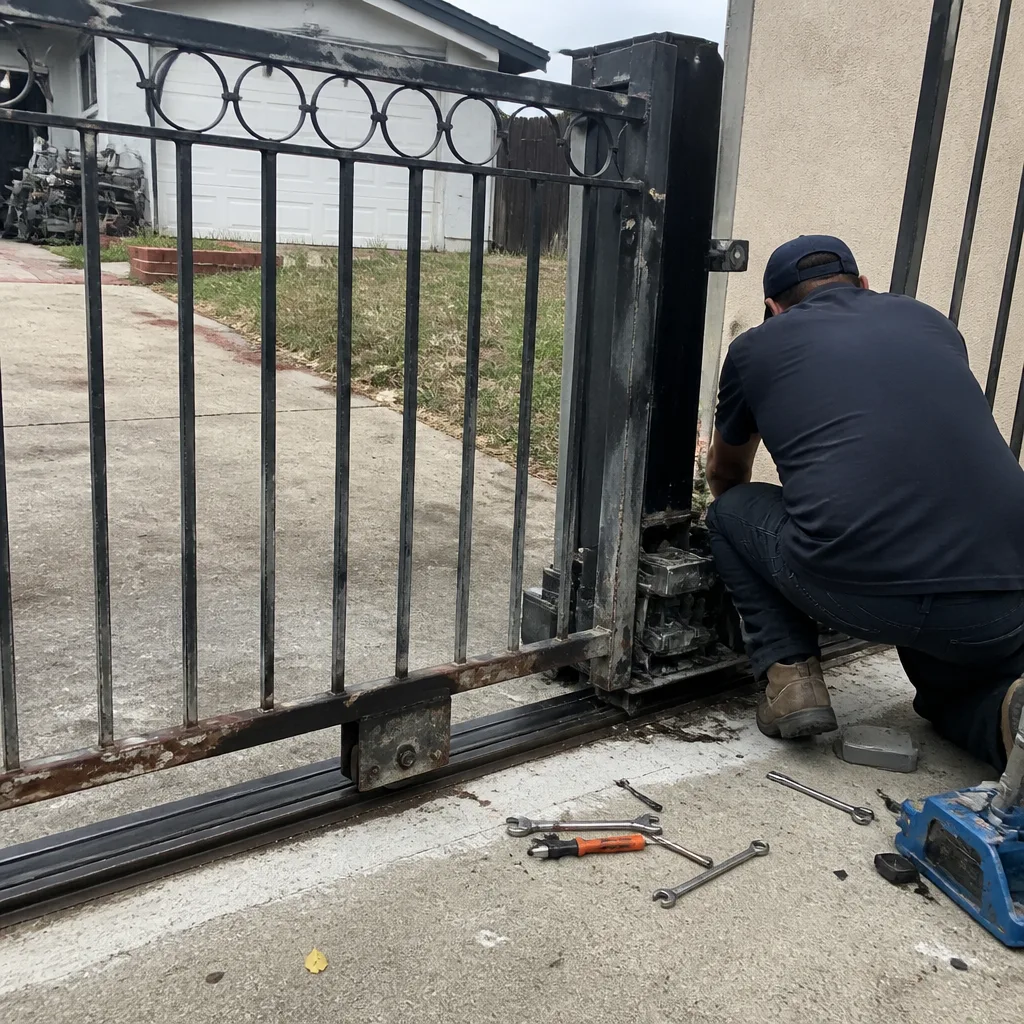 Before
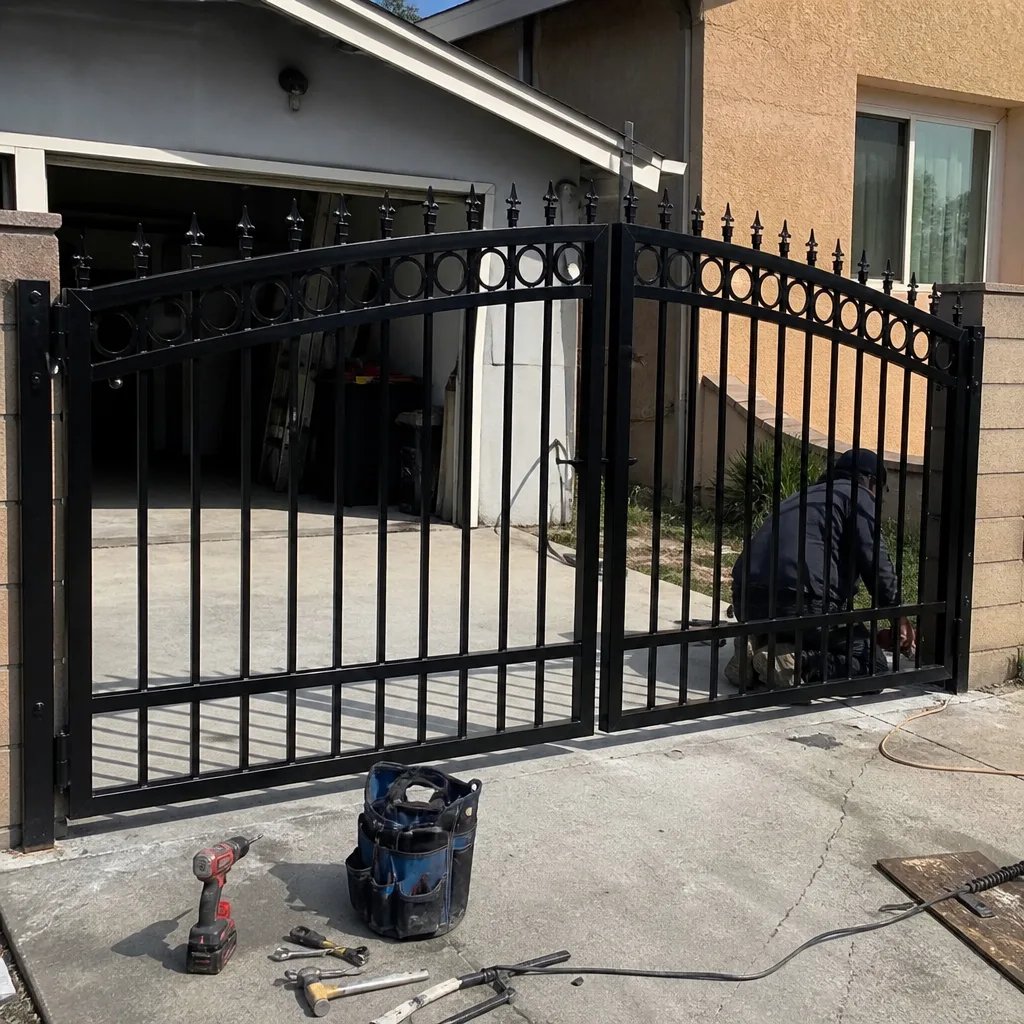 After
After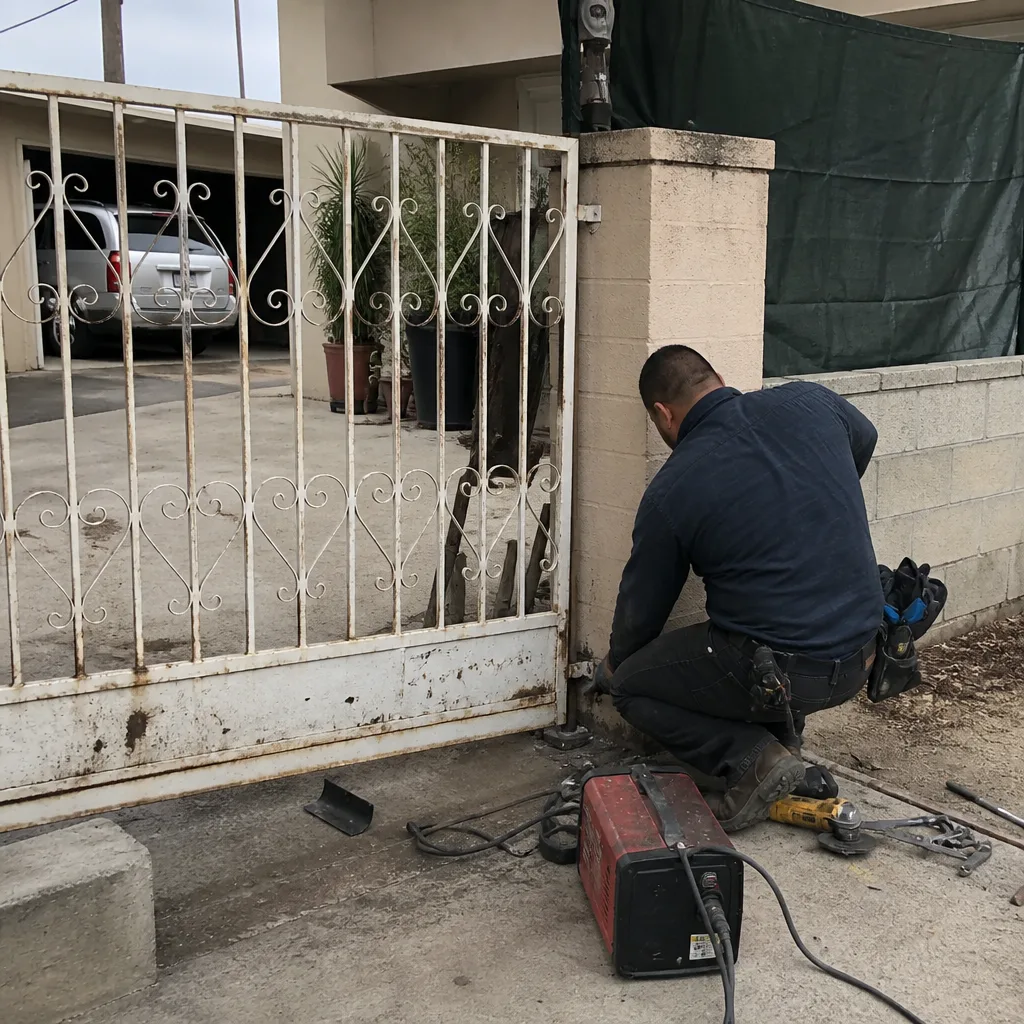 Before
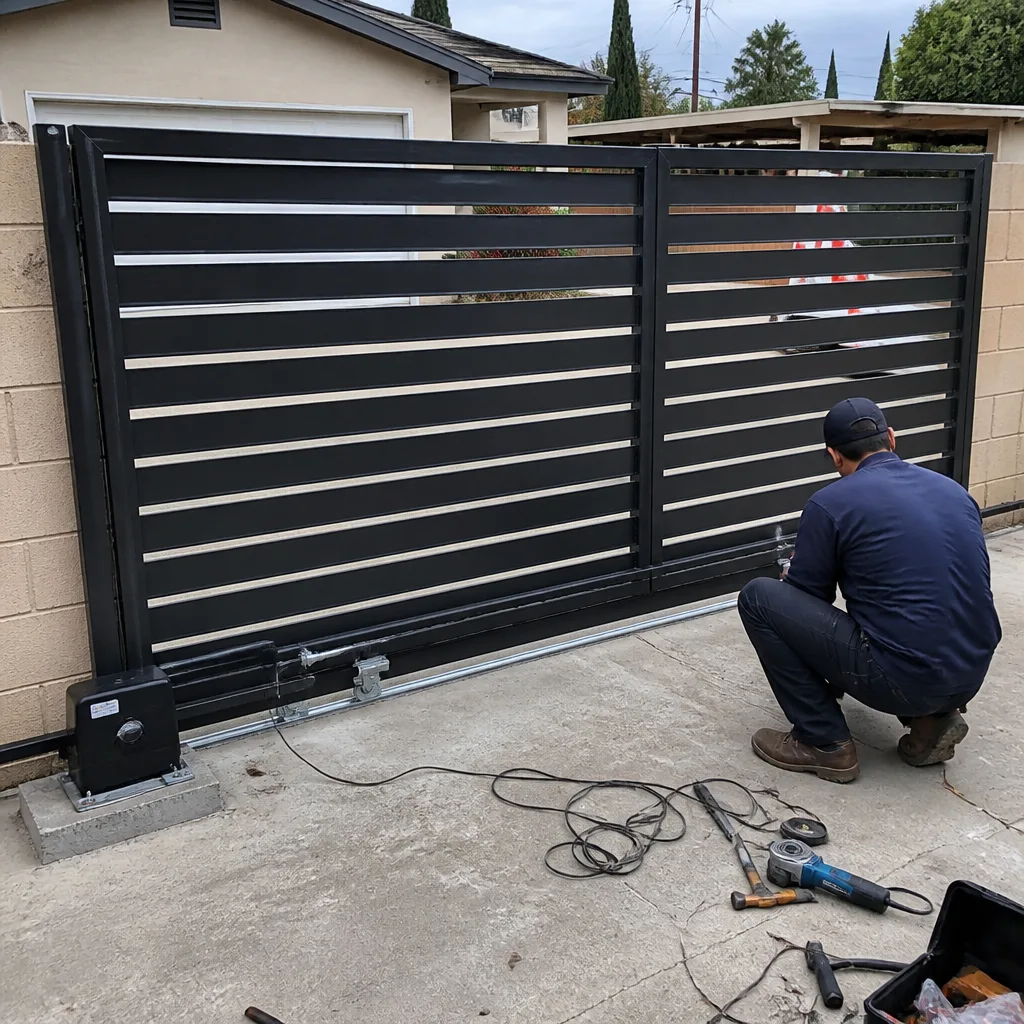 After
After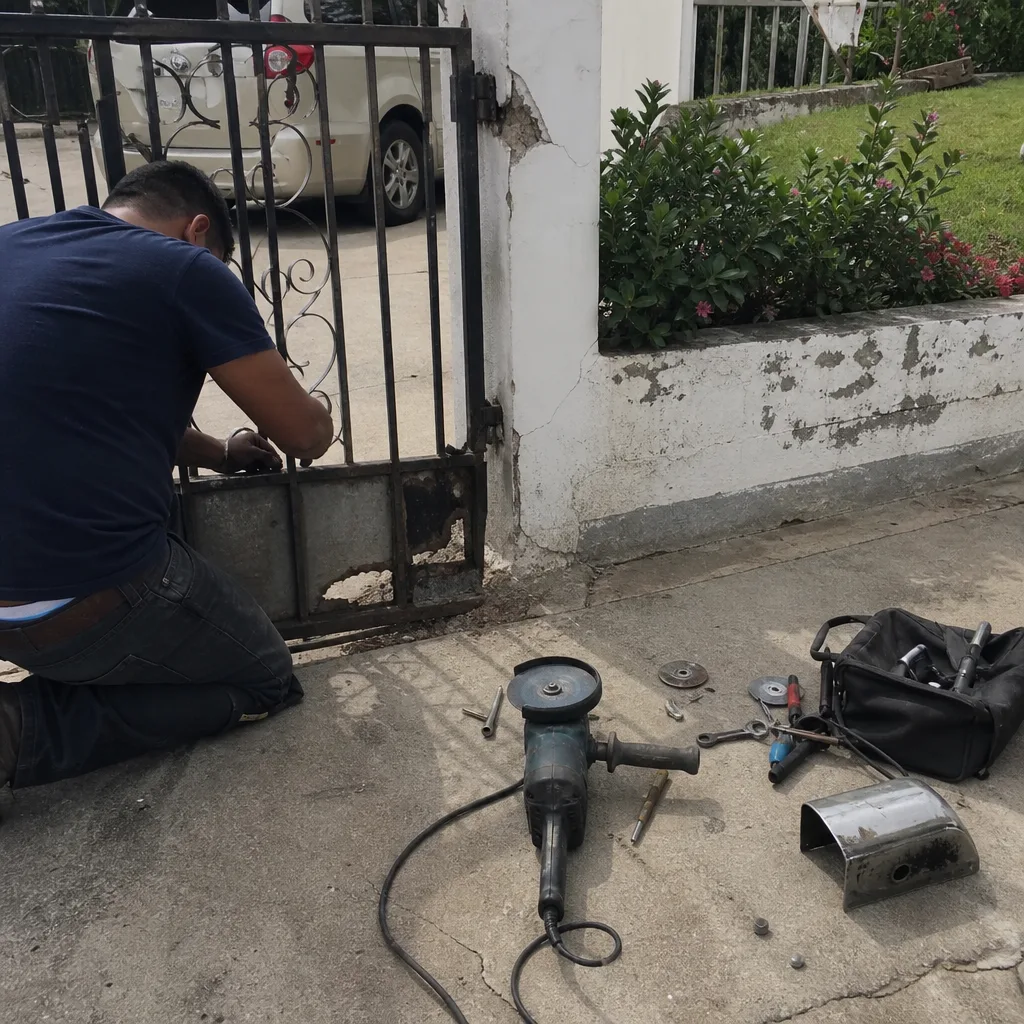 Before
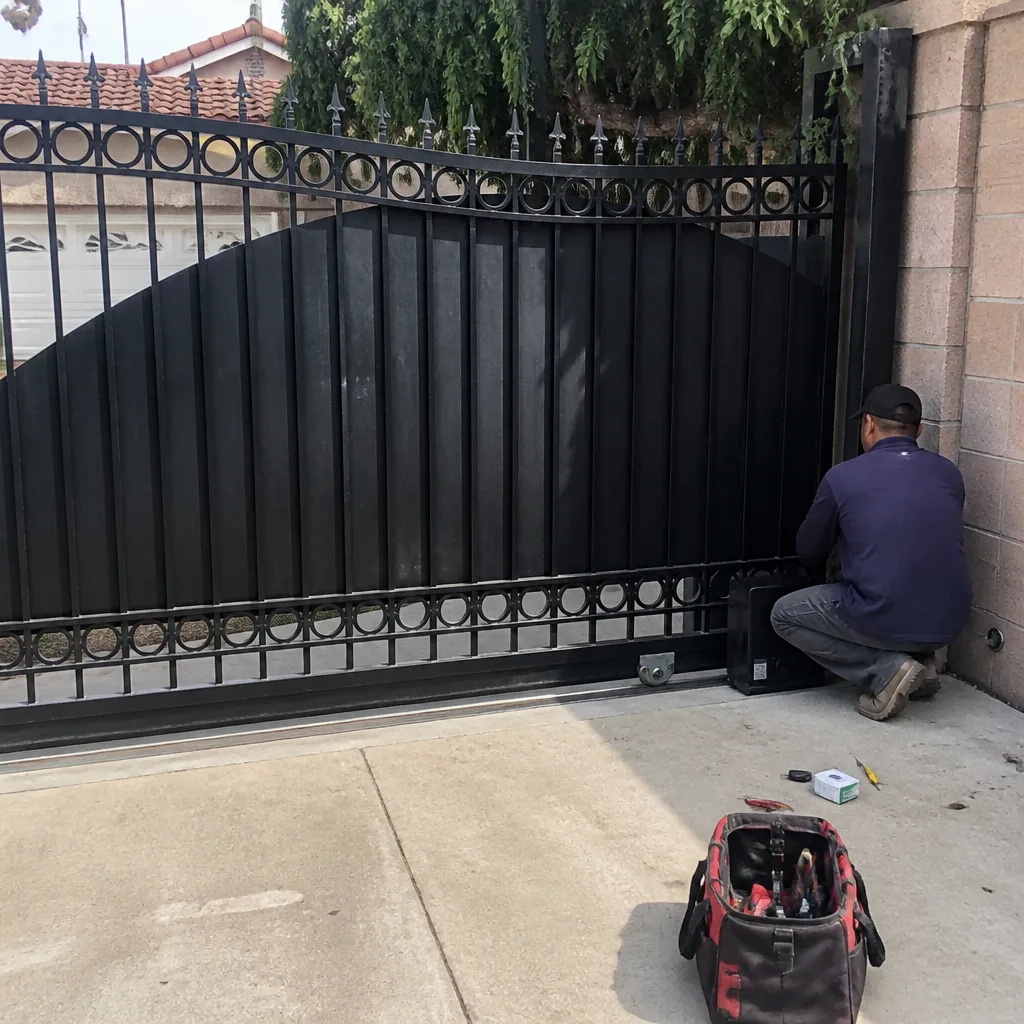 After
AfterGate Repair Warning Signs: A Bell Gardens Homeowner’s Reference Guide
A gate that has worked faithfully for fifteen years does not usually fail without warning. It drops hints. It sags a fraction of an inch. It hesitates half a second longer before the motor kicks in. It makes a sound you haven’t heard before. Most Bell Gardens homeowners do not notice these signals until the morning the gate will not open at all, and the car is stuck in the driveway. This guide is written so you catch the warning signs early, understand what they mean, and know when a repair is simple enough to schedule at your convenience and when it needs attention the same day.
Quick Answer
The four warning signs that tell a Bell Gardens homeowner a gate needs professional attention are: visible sagging or dragging, grinding or squealing sounds from the motor or hinges, slow or jerky movement, and a gate that stops mid-cycle or reverses for no reason. Any of these four, left alone, will turn a small repair into a full gate replacement. Most of these repairs cost between $150 and $450 when caught early, and a qualified gate company can complete the work in a single visit.
Table of Contents
- A Sagging Gate or a Gate That Drags
- Sounds That Should Not Be There
- Slow, Jerky, or Hesitating Movement
- A Gate That Stops Mid-Cycle or Reverses for No Reason
- The Remote Only Works From Six Feet Away
- Rust, Corrosion, and the Bell Gardens Climate
- Safety Sensors and Photo Eyes: What a Blinking Light Means
- Common Mistakes to Avoid
- When to Call a Professional
- Frequently Asked Questions
- The Bottom Line
A Sagging Gate or a Gate That Drags
This is the warning sign we see most often in Bell Gardens, and it is also the one most homeowners ignore for the longest time. A swing gate that scrapes the driveway by a quarter inch seems like a minor annoyance. It is not. The gate’s weight, which was designed to be carried by its hinges and the post, is now being carried partly by the driveway itself. Every cycle grinds the bottom edge down, and every cycle pushes the hinge bolts further out of alignment.
Sagging happens for a handful of predictable reasons. The hinge bolts loosen over years of daily cycles. The post itself shifts, often because the original installers set it in concrete that was too shallow for Bell Gardens soil. The gate frame was welded from thinner steel than the job required, and years of heat expansion and contraction have worked the welds loose. In neighborhoods like Bell Gardens’ older residential streets, where many homes were built in the 1950s and 1960s, we routinely see original wood or chain gates that were never designed for automated openers at all.
How to check for sagging without any tools:
- Open the gate halfway and let go. It should stay put. If it swings open or closed on its own, the hinges or post are out of level.
- Look at the gap between the bottom of the gate and the ground along its full length. A taper of more than half an inch from the hinge side to the latch side means the gate is dropping.
- Close the gate and look at the latch. If the latch bolt no longer lines up with the receiver without lifting the gate, the frame has moved.
- Watch the gate move through one full cycle. A gate that is dragging will visibly scrape or catch, usually at the same spot every time.
What does it cost to fix a sagging gate in Bell Gardens? A hinge replacement or adjustment on a standard residential gate typically runs $150 to $300. If the post itself has shifted, the post may need to be dug out, re-seated, and re-cemented, which is a $400 to $800 job depending on access and whether the concrete has undermined the post footing. The gate itself rarely needs replacing at this stage. Catching the sag early is the single best way to avoid a full replacement.
One more thing worth knowing: a gate that drags is working against its own motor. The opener is pushing harder than it was designed to push. That extra strain shortens the motor’s life, and the motor is the most expensive part on the gate. Fixing the sag for a few hundred dollars now protects an $800 to $2,000 opener later.
Sounds That Should Not Be There
A healthy gate makes a sound you can describe in one word: smooth. A low, steady hum from the motor. A soft creak from hinges that need grease once a year. That is the entire list. Anything else is the gate telling you something is wrong, and each sound points to a different problem.
A grinding or metallic scraping sound from the motor almost always means the drive gear or chain sprocket is wearing. On chain-drive openers from brands like Ghost Controls or Mighty Mule, the chain stretches over time, and a loose chain drags across the sprocket teeth. On screw-drive openers, the screw and nut assembly wears and the two surfaces gall against each other. Both problems are repairable, but both get dramatically worse the longer they run. A worn gear that costs $80 to replace today will destroy the entire transmission if it strips, and that is a $400 to $600 repair.
A high-pitched squeal that happens only when the gate first starts moving usually points to the bearings in the idler pulleys or the wheels on a sliding gate. The bearings go dry, then they go flat-spotted, then they seize, and then the gate is dragging steel on steel. In Bell Gardens, where the air carries more dust than homeowners in coastal cities realize, bearings cake up with grit faster than the manufacturer’s maintenance schedule assumes. A $10 bearing replacement takes twenty minutes. A seized bearing that snaps the gate’s alignment does not.
A banging or clanking sound when the gate stops suggests the end stops or limit switches have drifted out of adjustment, and the gate is slamming into its physical stops rather than being decelerated by the motor. This is hard on the welds, hard on the hinges, and hard on the gate’s frame. It is also one of the fastest problems to fix, usually a limit-switch adjustment that takes under an hour.
If you hear any of these sounds, call a gate company before the next full cycle. The sound is the diagnosis. A technician who hears the sound in person can identify the problem in minutes, and the repair is almost always significantly cheaper while the gate still opens and closes.
Slow, Jerky, or Hesitating Movement
When a motorized gate begins to move a beat after you press the remote. When it starts, stops for a quarter second, then lurches forward. When it moves like it is tired. Homeowners describe this to us in different ways, but the underlying truth is the same: the opener is no longer moving the gate with confidence.
There are four usual causes, in order of frequency in Bell Gardens.
Low or failing battery on the opener. Solar-powered openers, which are common in the parts of Bell Gardens where running conduit from the house to the gate is impractical, depend on a battery that has a working life of roughly two to four years. When the battery weakens, the motor still turns, but it turns slowly. The gate hesitates. This is a $120 to $250 battery replacement, and it is the first thing any experienced technician checks.
Worn capacitor or motor windings. On AC-powered openers from DoorKing or Elite, a failing capacitor delivers less starting torque, which shows up as a sluggish first second of movement. Left alone, the motor eventually will not start at all, and the capacitor failure can damage the windings that follow it.
Debris or damage on the track. Sliding gates ride on a steel track that catches dirt, leaves, gravel, and in some parts of Bell Gardens, sand that blows in from the Los Angeles River channel. A track that has never been cleaned forces the motor to work harder every cycle, and the motor responds by slowing down.
Gate out of balance. This connects back to the sagging section above. A gate that is physically out of level requires more force to move, and the motor’s response is slower, jerkier motion.
The sequence for diagnosing a slow gate is simple: battery and power first, track condition second, gate balance third. Any one of these can be the culprit, and frequently two of them are contributing at once. A tune-up that addresses all three takes a technician about an hour and typically prevents the downstream motor failure that would otherwise follow within a year.
A Gate That Stops Mid-Cycle or Reverses for No Reason
This is the warning sign that gets the phone call the same day, because the gate has become actively inconvenient. It opens six inches and stops. It opens, then reverses and closes while the car is halfway through. It behaves erratically, and the homeowner no longer trusts it.
The most common cause in modern automated gates is a false trigger from the safety photo eyes or edge sensors. Photo eyes sit on either side of the gate opening and project an invisible beam. If anything interrupts that beam while the gate is moving, the gate stops and reverses. That is exactly what the system is designed to do. The problem is that in Bell Gardens, the eyes get dirty, they get bumped out of alignment by sprinkler overspray or by a kid on a bike, and they never get cleaned. A dirty photo eye produces the same signal as a car in the path of the gate. The fix is often a clean lens and a two-minute re-aim, and the gate works perfectly again.
The second common cause is limit switch drift. Limit switches tell the motor where to stop. When they drift out of calibration, the gate travels too far before stopping, hits its physical stop, and the motor’s overload protection kicks in and reverses the gate. This is the gate saying “I hit something I shouldn’t have” when what it actually hit is its own end stop. A limit adjustment fixes it.
The third cause, less common but more serious, is a failing control board. On openers from LiftMaster, FAAC, and BFT, the control board interprets signals from the remote, the photo eyes, and the limit switches. A board with a failing relay or a corroded connector will behave intermittently, and those intermittents get worse over time. A control board replacement typically runs $300 to $600 installed, which is why it is worth checking the photo eyes and limit switches first. The cheap fixes get ruled out before the expensive one is blamed.
Safety note: a gate that reverses unpredictably is a serious safety hazard, particularly for anyone who is not familiar with how the gate normally behaves. If the gate has ever reversed into a car or person, stop using it and call for repair the same day. This is not a “wait and see” problem.
The Remote Only Works From Six Feet Away
The remote used to open the gate from the end of the block. Now the car has to be nearly touching the gate before it responds. That is normal wear, and it is also a warning sign.
Remote range deteriorates for three reasons. The remote’s internal battery is the simplest: most clicker-style remotes use a small coin or A23 battery that lasts two to three years. A remote with a weak battery still transmits, but the signal is weak and the receiver only picks it up when the remote is close. This is a $5 fix and five minutes of work.
The second reason is antenna damage on the receiver. The receiver is mounted inside the opener housing or on a nearby post, and its antenna is a small wire. If that wire has been bent, corroded, or, as we have seen in some Bell Gardens homes, accidentally cut by gardeners with string trimmers, the receiver’s range drops dramatically. An antenna repair is quick and inexpensive.
The third reason is signal interference, which has become more common in recent years as homes add LED landscape lights, smart-home hubs, and wifi extenders. Some LED drivers emit radio frequency noise on the same bands the gate remotes use, and the result is a remote that only works at short range. If a homeowner recently added LED lighting near the gate, that is where we look.
None of these are expensive problems. All of them are easy to ignore. But a gate that only responds to the remote at very close range is a sign that the remote or receiver is failing, and it will eventually fail entirely. The difference between a $5 battery and a $200 receiver replacement is often just a matter of how long the problem is left.
Rust, Corrosion, and the Bell Gardens Climate
Bell Gardens sits inland enough to get real summer heat, close enough to the coast to get morning marine influence, and downwind of enough urban dust that metal surfaces accumulate a fine grit that holds moisture. That combination is harder on steel gates than most homeowners expect. The result is that rust is not a cosmetic issue in Bell Gardens. It is structural.
Surface rust is normal and manageable. It starts at scratches, at weld points, and at the bottom edge where the gate meets the driveway. If a homeowner sands and repaints those spots every few years, the gate will last decades. But if surface rust is left alone, it becomes pitting, and pitting becomes holes, and holes become a gate that can be punched through with a screwdriver. We have seen this progression take less than five years on unmaintained gates in Bell Gardens.
The critical rust points on any gate are the hinges, the welds where the frame meets the pickets, the bottom rail, and the tracks on a sliding gate. Those are the points under the most mechanical stress, and they are the points where rust failure turns a cosmetic problem into a safety problem. A rusted bottom rail on a sliding gate will eventually let the gate drop off its rollers. A rusted hinge will snap under load, and a gate leaf that snaps off its hinge becomes a heavy, dangerous object.
How to inspect for rust in ten minutes:
- Take a bright flashlight and walk the entire perimeter of the gate, top to bottom.
- Look for bubbling paint. The bubble means rust underneath, even if the surface still looks intact.
- Press on any visible rust with a screwdriver or key. If the metal gives, the rust is structural, not surface.
- Check the hinge welds with the gate both open and closed. Hairline cracks at weld joints are a failure in progress.
- Examine the bottom rail and any plates at ground level, because those are the most exposed to moisture.
Rust repair is usually a welding job. Small rusted sections can be cut out and re-welded with new steel, ground smooth, and repainted. That is a $200 to $500 repair depending on the size of the section. Extensive rust means the gate’s structural integrity is compromised, and at that point replacement is the honest recommendation. Our company includes welding and gate-parts fabrication in its Ironworks Gate Co. home service scope for exactly this reason: a gate with rusted sections does not always need to be replaced, but it does need a welder who understands gate frames, not a painter with a can of rust converter.
Safety Sensors and Photo Eyes: What a Blinking Light Means
Every automated gate installed in the last two decades carries safety devices, and the most visible of those devices is the photo eye. Homeowners know the photo eyes as the small plastic boxes mounted on the gate posts on either side of the opening. What they usually do not know is that the photo eyes are connected to a diagnostic light on the opener, and that light is telling you something.
A steady green light on the photo eyes means the beam is aligned and the system is happy. A blinking light, or a light that will not come on at all, means the beam is broken or the eye is misaligned. The gate responds to that by refusing to close, because the system cannot confirm that the path is clear. That is the photo eyes doing their job. It is also the most common reason a gate will open but not close, which is the single most frequent complaint we hear from Bell Gardens homeowners.
The fix is usually simple: clean the lenses with a soft, dry cloth, then check that both eyes are aimed at each other. Some systems have a small alignment LED that turns solid when the aim is correct. If the lens is clean and the aim is correct and the light is still blinking, then the problem is wiring, or the eye itself has failed, and either one is a repair for a technician.
One note for owners of gates made by Elite and Mighty Mule: those openers use a slightly different diagnostic pattern than other brands, and a blinking light that looks like a misalignment can sometimes indicate a low-battery condition on the solar models. A technician trained on that specific brand will read the pattern correctly on the first visit, which is why we train our people across all nine major brands rather than specializing in one or two.
Safety caveat: the photo eyes exist to prevent the gate from closing on a person, a car, or a pet. Bypassing them, jumping the terminals, or taping the eyes together so the gate will close is not a repair. It disables the safety system, and it puts everyone who uses the gate at risk. If the photo eyes are misbehaving, the repair is simple enough, and it should be done properly.
Common Mistakes to Avoid
- Greasing a chain with engine oil or WD-40. Engine oil attracts dust, and in Bell Gardens the dust load is high. The chain becomes a grinding paste within weeks. Chains on openers like Ghost Controls and Mighty Mule should use a dry chain lubricant designed for the purpose, and mostly they should be left alone.
- Power-washing the gate and opener housing. A power washer forces water into the motor housing, the control board, and the photo eye connectors. Water intrusion kills openers. Wash the gate by hand with mild soap, and stay away from the motor entirely.
- Adjusting the hinges or gate alignment with the opener connected. Any work that changes the gate’s geometry while the opener is still attached puts uneven force through the motor and the arm. Disconnect the opener first, or have a professional do the work.
- Ignoring a sag for a year because the gate still opens. The gate will keep opening until the day it does not, and that day is usually the busiest morning of the month. The repair cost climbs the entire time you wait.
- Replacing the remote before checking the receiver. When the remote stops working, many homeowners buy a new remote first. If the receiver is the problem, the new remote will not work either. A technician can test both in minutes and tell you which one is at fault before any money is spent.
- Welding the gate without disconnecting the control board. Welding current travels through the gate frame and can fry the opener’s control board instantly. A welder who does not work on gates every day will sometimes skip this step, and the homeowner pays for a new board on top of the weld. We disconnect the board as a matter of course on every weld, because we learned that lesson on someone else’s gate forty years ago.
- Running a gate with a known safety sensor fault because it is inconvenient to fix. A gate that closes on a car once is more expensive than even the most thorough sensor repair would have been. If the gate ever behaves unpredictably, stop using it and call.
When to Call a Professional
Call the same day if the gate has reversed into a car or person, if the gate is stuck open and cannot be secured, if the motor is making a grinding sound that is getting louder, or if the gate has dropped visibly on its hinges and the latch no longer engages. These are safety issues, not convenience issues.
Call within the week if the gate is slow, if the remote range is degenerating, if the photo eye light is blinking, or if there is rust that has progressed beyond surface level. These are the repairs that cost $150 to $450 now and four times that amount if they are left until failure.
Ironworks Gate Co. offers free estimates in Bell Gardens. Call (213) 497-0081 and a live person answers, day or night. We will tell you honestly if the gate needs attention now or if it can wait, and we will give you a written price before any work begins.
Frequently Asked Questions
A hinge adjustment or hinge replacement on a sagging residential gate in Bell Gardens typically costs $150 to $300, and a shifted post that needs to be re-set in concrete runs $400 to $800. The gate leaf itself rarely needs replacing if the sag is caught before the frame is damaged. Call (213) 497-0081 for a free estimate on your gate, and we will quote the exact price before any work starts.
A gate that opens but refuses to close is almost always a photo eye problem, either dirty lenses, misaligned eyes, or a broken beam wire. The system closes only when it confirms the path is clear, and a dirty eye reads as an obstruction. Clean the lenses and check the alignment first; if the problem continues, call (213) 497-0081 and a technician will diagnose it the same day.
Yes, most gate repairs in Bell Gardens are completed in a single visit, and we carry parts for the nine major opener brands on our trucks. The exceptions are unusual control boards or special-order frame sections that must be fabricated. Call (213) 497-0081 and we will tell you which situation you are in before you hang up.
Our seasonal tune-up includes checking and lubricating the hinges and rollers, testing the photo eyes and safety edges, inspecting the chain or screw drive, checking the battery on solar openers, adjusting the limit switches, and testing the remote range and keypad. It is designed to catch the warning signs in this guide before they become failures. Call (213) 497-0081 to schedule.
We repair and service openers from LiftMaster, FAAC, BFT, Linear, Viking, Ghost Controls, DoorKing, Elite, and Mighty Mule, whether we installed them originally or not. Most homeowners call us for the first time with a problem opener on a gate that was installed years ago, and we get it running correctly on the first visit. Call (213) 497-0081 and describe the issue, and we will give you a straight answer.
With regular maintenance, a quality gate motor in the Bell Gardens climate should last eight to twelve years. Without maintenance, the same motor often fails in five to seven. The difference is usually the condition of the battery, the cleanliness of the track and hinges, and whether a sagging gate was allowed to drag for years. The most direct way to extend a motor’s life is the $89 seasonal tune-up, which catches the problems that shorten it. Call (213) 497-0081 to schedule one.
The Bottom Line
A gate does not fail without warning. It sags, it groans, it hesitates, it reverses, and it blinks. Every one of those signals is the gate asking for a repair that is measured in hundreds of dollars rather than thousands. The discipline is to act on the first signal, not the last one. In Bell Gardens, where the dust, the heat, and the years all work against metal, that discipline is the difference between a gate that lasts another twenty years and a gate that fails on the first busy morning of the next heat wave. We have been repairing gates in this area for over forty years, and the one thing we have never seen is a gate that fixed itself. Call (213) 497-0081, and we will be there when we say.
Written by Victor Salinas, Owner at Ironworks Gate Co., serving Bell Gardens since 2013.